

1 Defining critical practice
As explained in the introduction, this course supports you in developing your knowledge and skills as a critical social work practitioner and will enhance your ability to work effectively with different kinds of complexities.

If you have previous experience in social work, you will understand the importance of reflective learning, and you will already have faced challenging practice experiences. Critical practice offers a framework for taking this further, encouraging you to think about your own assumptions and those of others, to question and evaluate different approaches, and to look at how power and discrimination affect the social work role and the experiences of those you will work with. Above all, critical practice will help you to develop effective working relationships with people using services.
When thinking about critical practice, it is important to emphasise that it is not about criticising. It’s helpful instead to think of it as critiquing – that is exploring and analysing from different viewpoints. This entails thinking deeply and asking questions of yourself and others. Critical practice also means looking carefully at how this thoughtful engagement with ideas connects with action; social work must go beyond just thinking and questioning.
Thinking AND action
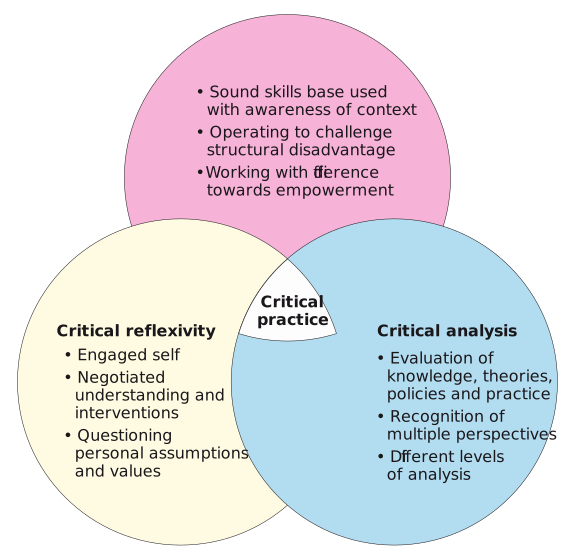
Barnett’s (1997) model strongly resonates with the social work professions’ emphasis on values and ethics, reflection in practice and working with uncertainty and risk. You will think about the links between critical practice and action throughout this course, starting with Figure 1 where you can see that action is one of the elements of Barnett’s model of critical practice. Critical action recognises power inequalities and structured disadvantage seeking to work across differences towards empowerment by using a solid skills base. Critical analysis recognises multiple perspectives in which knowledge, evidence, policies and practice are critically evaluated.
Being able to take action in this sense is supported by a reflexive stance to practice, another element of critical practice noted in Figure 1. There are different ways of understanding reflexivity, but in this context it can be defined as a questioning approach to social work (D’Cruz et al., 2007). Practitioners taking this approach do not assume that social work knowledge can be simply applied to practice. Instead, assumptions about knowledge, power, practice and role of self are scrutinised and explored (D’Cruz et al., 2007), and this informs action. This idea is arguably especially important in a context of rapid social change, when new approaches to solving problems are needed. For example, as Hodgson and Watts (2017, p. 231) argue, social workers may be ‘considered reflexive in the sense that they are part of the condition of social change themselves and because they work in institutions and organisations confronting the sharp end of rapid change’. Despite the changing and complex context for practice, Barnett’s simple model shown in Figure 1 can be used to explore some of the dimensions for critical practice.
Barnett’s model of critical practice is one that has stood the test of time and learners often find this a helpful way to understand its different dimensions. The model is set out in Figure 1 and you will see that it presents critical practice as the place where critical reflexivity, critical action and critical analysis come together.
In the following section, you will explore Barnett’s model in more depth, enabling you to reflect on how it can be used in social work practice.