

4 Models of reflection
There are many different models of reflection as a quick search online will demonstrate. Using models, or at least being aware of their similarities and differences, can help you to deconstruct experiences, ensure you are accessing the deeper level reflective questions and issues, and ultimately provide a way to structure your learning from situations.
One of the early developers of reflection in nursing is Borton (1970) who developed a simple reflective framework which includes three questions:
- What? (what happened?)
- So what? (why does it matter / what have I learned?)
- Now what? (what will I do differently in future?)
Borton’s work was then further developed to enable guided reflection by Rolfe et al (2001) as well as Driscoll (2007).
Rolfe, Freshwater and Jasper (2001) propose that critical reflection is more than simply thinking about practice; it is a structured process through which nurses critically analyse experiences, challenge assumptions, integrate theory with practice, and develop professionally. The overall benefit is improved patient care through increased self-awareness, critical thinking, accountability, and continuous learning.
Three simple questions:
- What?
- So what?
- Now what?
(Linking text needed here ) - please supply
Driscoll’s model (2007)
Also based on:
- What?
- So what?
- Now what?
but with more prompting questions. … need to include the prompting questions….. please supply
Gibbs’ reflective cycle (1988)
A popular model to use for preparing for revalidation is Gibb’s reflective cycle because it provides a clear structure:
- Description
- Feelings
- Evaluation
- Analysis
- Conclusion
- Action Plan
Sofia I would like to add in an activity here, with flip to reveal the answer….. Is that possible? - We have a few options here, any of these we can do https://h5p.org/ content-types-and-applications [Tip: hold Ctrl and click a link to open it in a new tab. (Hide tip)] please supply the text and I can work up some ideas
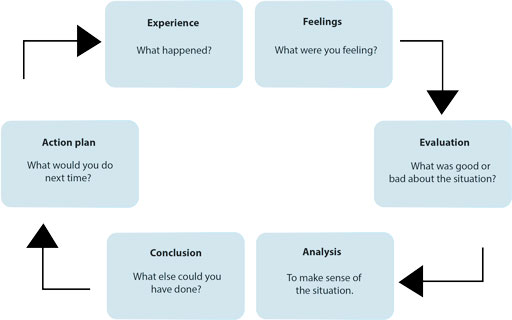
Gibb’s model acknowledges that your personal feelings influence the situation and how you have begun to reflect on it. It builds on Boud’s model by breaking down reflection into evaluation of the events and analysis and there is a clear link between the learning that has happened from the experience and future practice.
However, despite the further break down, it can be argued that this model could still result in fairly superficial reflection as it doesn’t refer to critical thinking / analysis or reflection. It doesn’t take into consideration assumptions that you may hold about the experience, the need to look objectively at different perspectives, and there doesn’t seem to be an explicit suggestion that the learning will result in a change of assumptions, perspectives or practice. You could legitimately respond to the question ‘What would you do next time?’ by answering that you would do the same, but does that constitute deep level reflection?