

2.2 Qualitative research
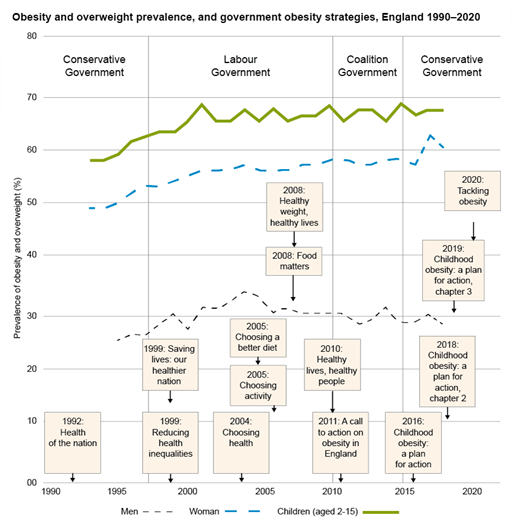
The graph in Figure 7 depicts quantitative data showing the growing prevalence of obesity and overweight in England, as well as the anti-obesity reports and interventions that have been undertaken by governments since the 1990s. As the graph illustrates, obesity has remained a salient issue because of the health risks associated with it and the various government initiatives developed. This suggests that obesity is a complex challenge, and one that is likely to remain an issue for the foreseeable future. Qualitative research can assist us in the endeavour to more fully understand obesity as an issue.
How people experience their health is highly subjective. For example, how does a person quantify their experience of pain? Or how does someone verify that they are in ‘poor health’? Because of the subjective nature of health and wellbeing generally, and obesity specifically, research methods need to delve into the meaning and reasons behind why a person struggles to lead a healthy lifestyle. It is not that quantitative research is better than qualitative research, it is just that qualitative research answers different types of questions (Busetto, Wick and Gumbinger, 2020).
Qualitative research tends to be associated with smaller-scale studies that involve fewer participants than quantitative studies, and it aims to provide a full and more holistic understanding of research participants’ views and actions. In qualitative research, words are the unit of analysis, rather than numbers. The following are examples of methods used to gather qualitative evidence or data:
- Participant observation involves the researcher systematically describing events and behaviours in the setting of their chosen study. For instance, in fieldwork conducted in a South Australian community that has experienced significant socioeconomic disadvantage, researchers detailed how the ‘problem of fat’ is countered from the experience of the people targeted by obesity interventions (Zivkovic et al., 2018).
- In-depth individual interviews can attempt to explore the world from the perspective of the people studied. In Scotland, 62 members of Men’s Sheds were interviewed ‘to investigate the impacts of Shed activity on the health improvement behaviours and attitudes of Shed users’ (Kelly et al., 2021).
- Focus groups are interviews with a group of people who are asked to explore their views on a topic. For example, in Wales, the capacity and capability of schools to contribute to mental wellbeing has recently been open to question. A study involving focus groups found that ‘existing pressures on schools may impact implementation of a WSA [whole school approach], with school staff already time poor and many staff experiencing their own mental well-being challenges’ (Brown et al., 2023, p. 241).
- Analysis of documents or texts involves the researcher studying in detail selected written texts on a subject. For example, Dolly Theis and Martin White’s (2021) discussion of public health strategies and policies involved document analysis of 689 policies in England between 1992 and 2020.