
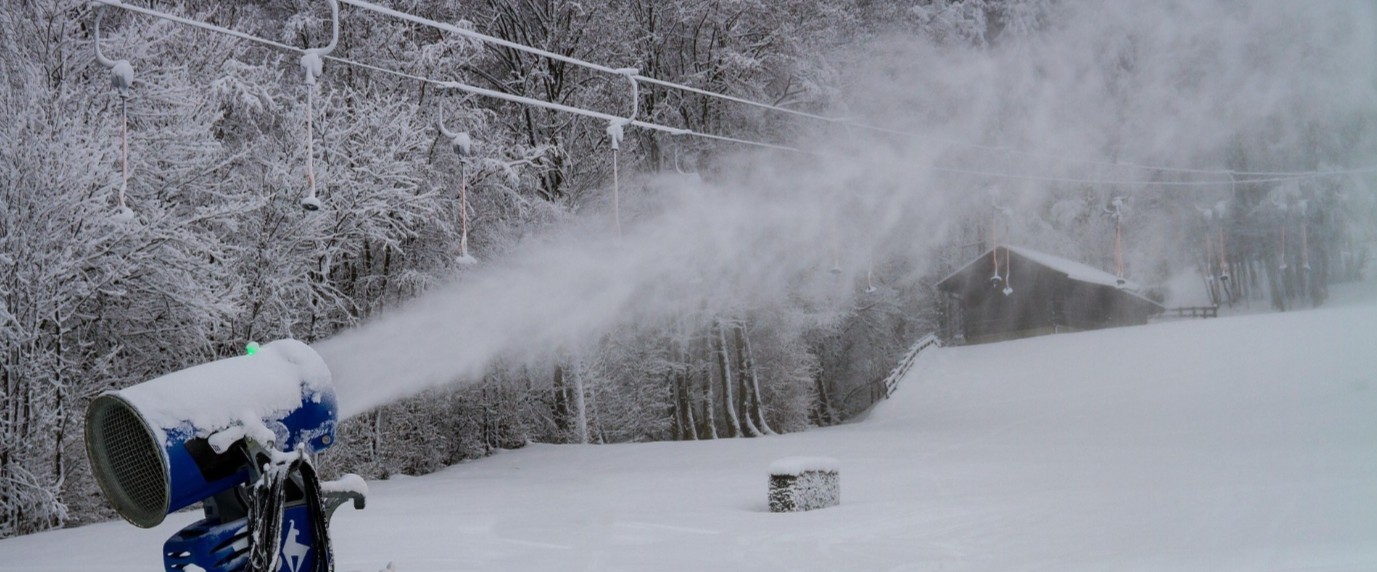
The story of every Summer and Winter Olympics can be partially told through the challenges the organisers confront in the run-up to the Games. The Milano-Cortina games are no exception. There have been fears that a new cable car, which will transport spectators to the site of the Women’s Alpine skiing events in Cortina, will not be finished in time for the first events, whilst the new Santagiulia Ice Hockey Arena in Milan may also be partly unfinished when the Games begin. In addition, warm weather through January limited the production of artificial snow to night-time only, when the temperatures drop sufficiently for the snow-making process to work, and jeopardised the adequate preparation of the pistes, courses and jumps that will host many of the skiing and snowboarding competitions.
This challenge in itself reflects the increasing prevalence of warmer weather in the Alps which is attributable to climate change, and since Cortina last hosted the Winter Olympics in 1956 the average February temperature in the town has increased by 3.6°C and there are 40 fewer freezing days throughout the winter season. As with every winter Olympics since the 1980 Games in Lake Placid, the Milan-Cortina organisers will need to rely on artificial snow to ensure there is minimal disruption to the schedule of events. The production of artificial snow, or ‘technical snow’ as it sometimes called, requires significant amounts of water and energy. For the Milano-Cortina games approximately 1.6m cubic metres of artificial snow will be made. This has required two new water reservoirs to be built, one in the Livigno Snow Park and the other next to the village of Bormio 2300m high-up in the mountains. In addition, 75 extra snow guns, that distribute the snow over the mountain courses, have also been installed.
The production of artificial snow requires significant amounts of water and energy.
Relying on artificial snow to supplement the deficit of natural snow creates an uncomfortable environmental paradox regarding the sustainability of such practices. Producing artificial snow generates carbon emissions and sits uneasily with the sustainability strategy of the International Olympic Committee (IOC) which aims to ensure that both the Summer and Winter Games work towards becoming carbon neutral and are aligned with the targets set by the Paris Agreement to keep global warming below 2°C. In comments made during the build-up to the Milano-Cortina games IOC President Kirsty Coventry confirmed that the IOC are considering moving the Winter Olympic Games forward to January as a means of reducing the challenges associated with warming climates and the need to mitigate these challenges by using technologies like artificial snowmaking.
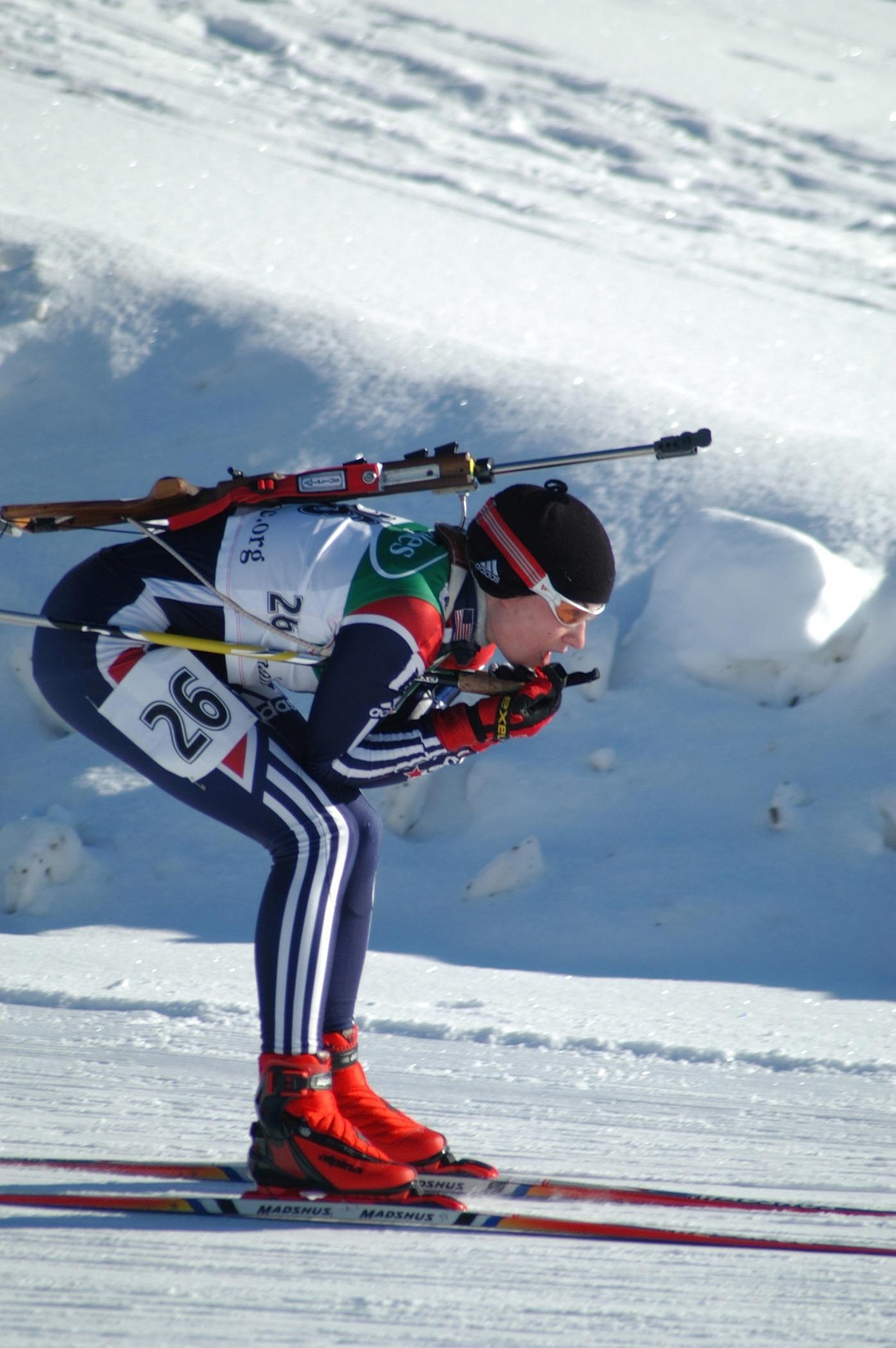
The moving of the games to January is also one of the conclusions from a research note written by Daniel Scott, Robert Steiger and Madeleine Orr that describes in detail the impact of climate change on the Winter Olympics. In their note Scott, Steiger and Orr highlighted that if current warming trends continue only 45-55 of the 93 past and potential Winter Olympic venues would be sufficiently climate reliable in the 2050s to host the games even with advanced snow-making facilities. For the Para-Olympic Winter Games, which are generally held in March, the number of climate reliable venues would drop to between 17-31 in the 2050s. Alongside focusing on those venues that continue to offer the most reliable conditions they likewise suggested the possibility of moving the games to late January. Similarly, the Para-Olympic winter games could also be bought forward to an earlier February date or even combined with the Winter Olympics.
Adapting the scheduling of the Games is inevitable
Whichever solutions are considered climate change is having a significant impact on where and when both the Winter Olympics and Para-Olympics are held, and it is perhaps inevitable that adapting the scheduling and hosting of both games will have to be considered to accommodate the impact of a shorter ‘winter’ season. There is also one other intriguing aspect to consider about the impact of climate change on the Winter Olympics. In 2025 Seb Coe, President of World Athletics, supported an idea that cross-country running could be included in a future Winter Olympics programme. Cross-country running is a traditional winter sport in many countries and including it in the games could increase opportunities for athletes to participate from countries presently not well-represented at the Winter Olympics. Such an addition would however require a fundamental altering of the Olympic Charter which states that all sports at the Winter Olympics must take place on a snow or ice surface. If snow and ice is becoming sparser, and requires artificial alternatives, then cross-country mud might be the most environmentally sustainable surface available.
Discover more about the Winter Olympics
-
Winter Olympics
Read now to access more details of Winter OlympicsTeam GB will be looking be build upon recent successes at Winter Olympics, as the 2026 Games in Italy starts this month. You can dig deep into the Winter Olympics with our range of free resources.
Level: 1 Introductory
Visit our dedicated Olympics page
-
Olympics, Paralympics, Olympians and Paralympians
Read now to access more details of Olympics, Paralympics, Olympians and ParalympiansThe Tokyo Olympics were a huge success for Team GB, who finished in fourth place - matching their medal haul from the London 2012 Olympics. You can dig deep into the Olympics and Paralympics with our range of free resources.

Level: 1 Introductory
Study a free course on Sports and Fitness
-
Supporting female performance in sport and fitness
Learn more to access more details of Supporting female performance in sport and fitnessDo you support women’s performance in sport or fitness as a coach or parent? Are you a female athlete who wants to optimise your performance using recent research insights? If so, then this free course is for you. It addresses the problem of sports science research traditionally being male dominated and the assumption that if it works for men ...

-
The business of football
Learn more to access more details of The business of footballIf you are fascinated by men's and women's football and interested in discovering more about business and management, then this engaging and stimulating course is for you.

-
The football World Cup: where sport and politics collide
Learn more to access more details of The football World Cup: where sport and politics collideOccasionally, controversies arise that remind us of the link between sport and politics. It was once common for leading figures in the sporting world to declare that sport was, effectively, a politics-free zone. Sport was cast as the perpetual innocent party, liable to be corrupted by any connection with politics. However, it has become ...

-
Exploring sport coaching and psychology
Learn more to access more details of Exploring sport coaching and psychologyThis course investigates how scientific and management ideas contribute to success, referencing unique sporting case studies and insights that will change how you view and study sport. You will consider how the mind, the body, the environment and training techniques all contribute to optimum fitness.

-
Learning from sport burnout and overtraining
Learn more to access more details of Learning from sport burnout and overtrainingSport can place high levels of stress on athletes, coaches and others involved. If unable to cope with these stresses they may be vulnerable to developing burnout. This free course, Learning from sport burnout and overtraining, examines burnout in sport from various perspectives including both the coach’s and athlete’s perspective. Drawing on ...

-
Sporting women in the media
Learn more to access more details of Sporting women in the mediaThe mass media (e.g. radio, TV, internet) has become one of the most powerful institutional influences in society. This free course, Sporting women in the media, explores whether gendered inequalities exist in sport by evaluating the media coverage. The media can be highly influential in shaping perceptions about gender in sport and headlines ...

Rate and Review
Rate this article
Review this article
Log into OpenLearn to leave reviews and join in the conversation.
Article reviews