

3 Roles and responsibilities of the practice educator
In this section you will reflect on what is meant by learning in social work practice before considering the role of a practice educator.
Learning in social work practice
Social work practice learning takes place in diverse places and with varying configurations in team structure. For example, some learners will have an on-site practice educator within their team or placement agency, whereas others will have an external or offsite practice educator and a workplace supervisor in place.
It is always essential to negotiate a robust learning agreement that shows what the different roles and responsibilities of those in the practice learning team will be. Your role as practice educator is central to the support, development and, importantly, the assessment of learners in practice. You have already explored some of the important skills and knowledge that you can bring to the role in Activity 2.
As a practice educator, your role in supporting social work learners is a complex process. You are required to work with learners in increasingly diverse services and contexts. For example, social workers work with people across the lifespan and in different focused services and integrated teams. The tasks of social work can be notoriously hard to articulate (Moriarty et al., 2015; Ferguson and Sicat, 2024) which means that supporting learners is also complex.
Understanding what it is like to learn as a social worker in direct practice involves recognising the unique and extraordinary work of the profession (Ferguson, 2022). Figure 1 shows the intricate web of physical and emotional elements that social workers navigate in places, spaces and tasks whilst in the workplace (Ferguson, 2021).
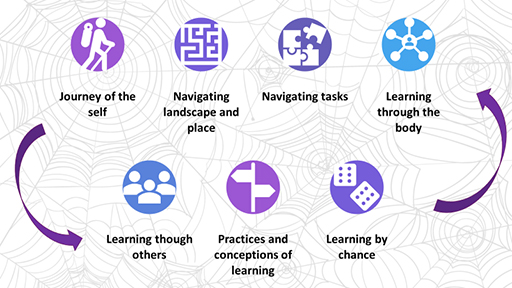
Irrespective of setting, social work practice learning must equip learners for working in dynamic contexts and develop their capacity to undertake statutory tasks.
‘Social work learning is usually understood to include the development of skills and competences which enable practitioners to undertake a role which is rooted in human rights and social justice, where ethical practice needs to be negotiated within a work role where there are competing moral, legal, organisational and policy demands.’
(Ferguson, 2021, p. 20)
Social Work England sets the requirements for practice learning in qualifying education programmes and there are several that are of importance to you as a practice educator. You will look at these in more detail in Activity 3.
Activity 3 Rules, regulations and guidance
Have a look at the guidance on practice placements [Tip: hold Ctrl and click a link to open it in a new tab. (Hide tip)] published by Social Work England. While university programmes and agencies are responsible for setting up placement arrangements, the practice educator is often the lynchpin in negotiating a robust learning agreement with the social work learner and other parties at the start of placement.
Read through the guidance and, as you do, note down any particularly important aspects. Whilst accessing the guidance, to avoid losing your place in the course, if you are studying on a desktop you should open the link in a new tab or window by holding down Ctrl (or Cmd on a Mac) when you click on it. If you are studying on a mobile device hold down the link and select to ‘Open in New Tab’.
Discussion
There are a lot of details in the guidance, but important aspects include:
2.2 Provide practice learning opportunities that enable students to gain knowledge and skills necessary to develop and meet the professional standards.
2.3 Ensure that while on placements, students have appropriate induction, supervision, support, access to resources and a realistic workload.
2.4 Ensure that on placements, students’ responsibilities are appropriate for their stage of education and training.
4.8 Ensure that assessments are robust, fair, reliable and valid, and that those who successfully complete the course meet the professional standards.
4.10 Provide timely and meaningful feedback to students on their progression and performance.
5.4 Make supportive and reasonable adjustments for students with health conditions or impairments.
You might have identified several other key points from the guidance, and your experience will link with some of the information that you have read.
For more information about professional learning for social workers, please see the references and further resources recommended at the end of this course.