
My OpenLearn Profile
Personalise your OpenLearn profile, save your favourite content and get recognition for your learning
Delacroix
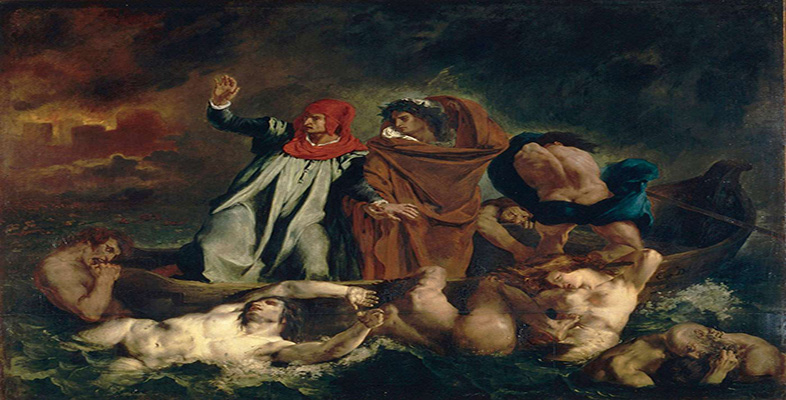
In this free course, Delacroix, you will be introduced to a variety of Delacroix's work and will see how his paintings relate to the cultural transition from Enlightenment to Romanticism. You will study Delacroix's early career, his classical background, the development of Romantic ideas and their incorporation into his work. You will have the opportunity to study some of his most important paintings and compare them to works favouring a Neoclassical approach. You will also be able to see how his themes, subjects and style were influenced by Romantic ideas, the exotic and the Oriental. Through this you will develop an understanding of the classicRomantic balance that shows how his work was influenced by cultural change of that period and to some extent contributed to the progression from Enlightenment to Romanticism.
Course learning outcomes
After studying this course, you should be able to:
- identify those aspects of Delacroix's art that qualify it as 'Romantic'
- understand the interplay between classicism and Romanticism in Delacroix's art
- appreciate the nature of Delacroix's fascination with the Oriental and the exotic even before he visited Morocco.
First Published: 09/08/2012
Updated: 14/04/2016
Rate and Review
Create an account to get more
Track your progress
Review and track your learning through your OpenLearn Profile.
Statement of Participation
On completion of a course you will earn a Statement of Participation.
Access all course activities
Take course quizzes and access all learning.
Review the course
When you have finished a course leave a review and tell others what you think.
The course is most certainly authoritative, having been produced by academics with a true passion for Eugène Delacroix's artistic journey through Baroque classicism onto his role as the leading figure of French Romanticism. His initial inspiration by Guérin, Géricault, Gros and Rubens eventually leading to a loss of focus on rebellion to gain integration into the establishment, with the associated access to state commissions.
Personally, it was unfortunate that the foundations were so firmly placed on 'The Death of Sardanapalus', clearly the artist's most controversial work. Controversy through the selected subject matter is one thing, but lack of true artistic merit (beyond his use of colour) is to me at least a confusing selection for the foundational piece, e.g., specifically with regard to perspective and scale? Fortunately, later in the course an extensive number of his paintings and lithographs were covered with greater artistic merit.
Miscellaneous points:
Whilst it is always advisable for those undertaking such OU free courses to download images (and videos) that are not embedded in the respective MS Word document, given the eventual removal of each course, it came as a surprise to note the number of images that were produced in monochrome, rather than colour. This led to the need for a surprising number of substitutions, particularly in the earlier chapters.
2.3 The first reference to 'David' appears to be in 2.3, perhaps his forenames should have been included?
2.6 Leonardo dE Vinci -> Leonardo dA Vinci
5.2 The quote from Byron ‘purified by death from some/Of the gross stains of too material being’ is presumably an intentional contraction of:
“I have no patience with those who say that people are purified by death from some faults; for me, the only purification is by fire — by trial — by suffering.”
and
"Of the gross stains of too material being, I have survived, and yet am half defiled."?
5.7 Plates 31 and 37 are identical; plate 37 being the duplicate which is stated as being a painting, rather than a lithograph within the actual text.