
My OpenLearn Profile
Personalise your OpenLearn profile, save your favourite content and get recognition for your learning
The American Civil Rights Movement
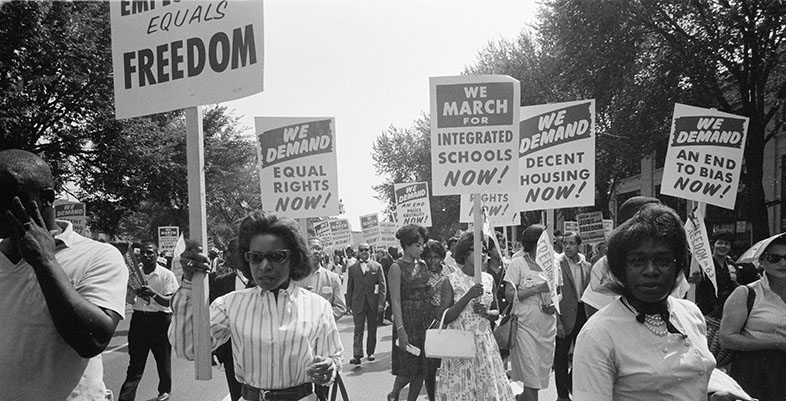
In this free course, The American Civil Rights Movement, you will learn about the mass movement for racial equality in the United States that reached its zenith during the 1950s and 1960s. During this turbulent period in United States history, black Americans sought to overturn deeply entrenched systems of racial segregation and discrimination. This course discusses the key events in this campaign for social justice, drawing on a wide range of primary sources. In doing so, it assesses the achievements, shortcomings and revolutionary qualities of the civil rights movement.
Use of racial language and terms
This course deals with topics involving racial issues. Since the societies being studied were characterised by deeply-held and widespread racist views, this course contains language that is also racist. Although these may provoke a strong personal response, we believe it is necessary to engage with such attitudes to reach a clear understanding of the past.
This OpenLearn course is an adapted extract from the Open University course A113 Revolutionsand is part of a set of four OpenLearn courses,
covering Revolutions of the Sixties.
Course learning outcomes
After studying this course, you should be able to:
- understand some of the key events in the history of the civil rights movement
- understand the movement's achievements and shortcomings
- assess how 'revolutionary' the civil rights movement was
- interpret a range of relevant primary sources, including interviews, speeches and letters.
First Published: 29/09/2020
Updated: 07/09/2021
Rate and Review
Create an account to get more
Track your progress
Review and track your learning through your OpenLearn Profile.
Statement of Participation
On completion of a course you will earn a Statement of Participation.
Access all course activities
Take course quizzes and access all learning.
Review the course
When you have finished a course leave a review and tell others what you think.
Four points:
1) Hispanic communities and leaders also participated in major civil-rights campaigns in various ways—especially around voting rights, school access, labour rights, and anti-discrimination efforts.
2) In terms of economic progress or the lack thereof:
In 1967, median Black household income was about $24,700 vs $44,700 for whites.
By 2014, median Black household income was about $43,300 vs $71,300 for whites.
On median household income and median wages, the Black–white gaps remain substantial over the long run.
https://www.pewresearch.org/social-trends/2016/06/27/1-demographic-trends-and-economic-well-being/
3) Black people are ~12–13% of the U.S. population, but ~55% of the life-without-parole (LWOP) population. Black Americans still imprisoned at five times the rate of whites in general.
a) Laws and policies that appear race-neutral have a disparate racial impact.
b) Racial bias influences criminal legal practitioners’ use of discretion.
c) A financially burdensome and under-resourced criminal legal system puts people with low incomes, who are disproportionately people of colour, at a disadvantage.
https://www.sentencingproject.org/reports/one-in-five-racial-disparity-in-imprisonment-causes-and-remedies/
4) One wonders whether the inclusion of the Trump era would have dampened the emphasis on progress towards inclusion, particularly in terms of effective enfranchisement, given the "Packing" and "Cracking" of minority voters within and across electoral districts.