
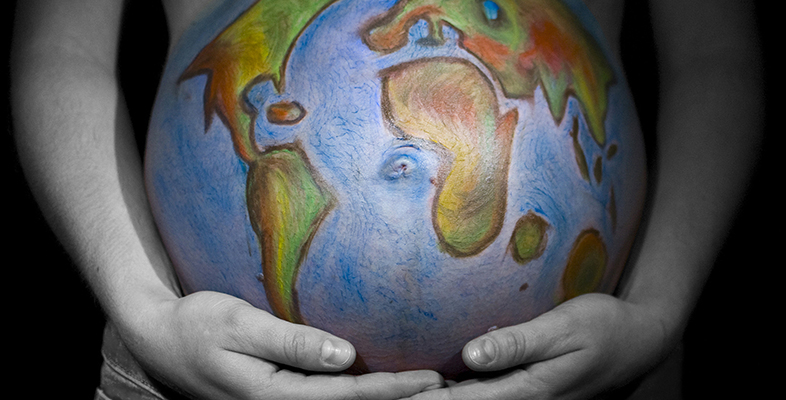
Birth is a lottery. Where, when and to whom you are born and the society into which you are born will influence your life chances.
This free online course will look at both the big picture of the 'lottery of birth' and the smaller, human stories. You will examine the inequalities of birth, particularly being born rich or poor and being born female or male.
You will also look at the lottery of birth as it relates to becoming a parent. You'll consider how individual countries and global organisations are responding to demographic changes and predictions and how this plays out in the lives of individual women and men in different parts of the world.
You'll use a variety of disciplines in the course such as demography, health studies, sociology, comparative social policy, history, political science and economics. This interdisciplinary nature brings different perspectives together to create fresh insights and provide a bridge for different ideas to feed into social and political change.
Towards the end of the course, you'll have the opportunity to critically analyse an initiative of your choosing from your own country.
The course does not assume any prior knowledge of the issues surrounding birth or inequalities. It is postgraduate level and encourages personal research and data interpretation.
Please note that this course includes some content of a sensitive nature, including discussions around abortion and female genital mutilation (FGM).
Course learning outcomes
After studying this course, you should be able to:
- critically analyse the complex challenges presented by the 'lottery of birth'
- demonstrate greater insight into the 'lottery of birth' using an interdisciplinary approach, drawing on demography, development studies, health studies, family studies, sociology, comparative social policy, history, political science and economics
- engage in informed debate about how individuals, individual countries and global organisations have responded to demographic changes and to inequalities both between and within countries.
First Published: 04/03/2020
Updated: 05/05/2020
However, it was interesting to note Danny Dorling's statement: "Currently the richest 1% are taking around 14% of all the income that is declared for tax purposes"; it is surely well known that "tax purposes" can never be considered a true indicator of global wealth. Indeed, the global top 1% actually hold about 37% of the world’s wealth, according to the World Inequality Report 2026.
Similarly, in terms of the maintenance of national share for the 1%, countries such as Mexico and South Africa have proven remarkably persistent; whilst the top 10% have done equally well across a surprising number of nations that have otherwise shown improvement with regard to the 1%: Our World Data's 'Wealth share of the richest' World Inequality Database".
Miscellaneous points (in addition to the usual broken links):
1) One noticeable aspect that is quite rare amongst OpenLearn courses is the very small number of activities that had a follow on "Discussion".
2) Week 1 7.1 The spirit level vs. 7.2 Thinking point: the spirit level hypothesis
Given that 'The Spirit Level', Wilkinson and Pickett (2009), has been discredited, due to highly selective data sampling, I am not clear what was gained by its inclusion?
3) Week 2 5.3 Figure 15: incorrect description (duplicate of Figure 14), though the full description is correct.
4) The 2019 SDG Goals Report has been archived, the current one is for 2026, e.g., within Week 3 “1.4 Thinking point: Activism”
https://unstats.un.org/ sdgs/ report/ 2019/ storymap/ (broken link) ->
https://unstats.un.org/sdgs/report/2026/
5) Week 4 Thomas Picketty: the transcription terminated before the key point about the global wealth tax (and a potential Nobel prize at some time in his future - though, unfortunately not in the expected 2023 award season!)