

4 What if there’s doubt?
Can the suspects commission their own expert witness?
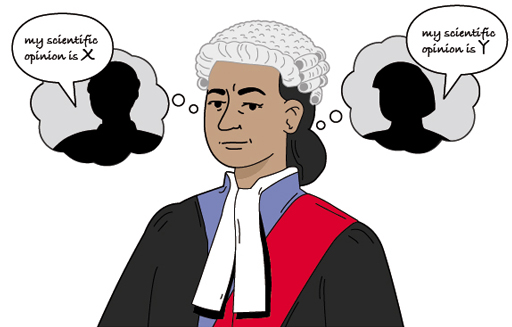
Yes. The law governing expert evidence in England and Wales (known as the Criminal Procedure Rules, Part 19, and Practice Directions, Part 7) allows the suspect to commission their own expert witness, such as via state-funded legal aid. The defence expert can review the forensic science data from the tests undertaken and the interpretation and evaluation provided by the prosecution’s expert or carry out additional tests.
There are similar provisions for the use of defence experts in Scotland and in Northern Ireland.
-
Did you know about the possibility of commissioning a defence scientist through legal-aid?
-
There is no correct answer but if you clicked ‘no’, you can find out more about legal-aid here.
a.
yes
b.
no
The correct answers are a and b.
The Criminal Procedure Rules and Practice Directions also permit Pre-hearing Discussion between the experts. This is where both the defence and prosecution experts meet, before the case trial in court, to identify areas of agreement and disagreement on the forensic evidence. A joint report is then written by both experts summarising these points, which would be presented during the court trial. This, in addition to effective cross-examination, helps the jury, who ultimately decide how much weight to give the expert evidence, to see where the experts align and where they differ. These procedures are designed to protect the court from conflicting opinions and misinterpretations.
Yet, in practice, limitations of both the legal system and forensic science can play out in the courtroom and impact how trustworthy the evidence appears. If an expert makes mistakes, through biased interpretation, poor communication, lack of clarity, exaggerating or decreasing the strength of the evidence, or struggling to explain complex numerical values and probabilities in plain language, the credibility of the evidence may suffer. Similarly, if the jury is disengaged or overwhelmed by the expert evidence, if lawyers fail to ask the right questions, or the judge erroneously allows inaccurate evidence to be admitted, all of this will ultimately impact the reliable use and trust of the forensic evidence. This might contribute to the wrongful conviction of an innocent person, and research shows the contribution of inaccurate forensic science to such miscarriages of justice (Morgan, 2023). This could hurt Dave’s case if it goes to trial.