If you are creating a new learner account between 8am on Saturday 6 June - 8am on Monday 8 June, you might experience delays or difficulties in the process. This is due to an upgrade to a system related to new account creation. We apologise for the inconvenience.
Start this free course now. Just create an account and sign in. Enrol and complete the course for a free statement of participation or digital badge if available.
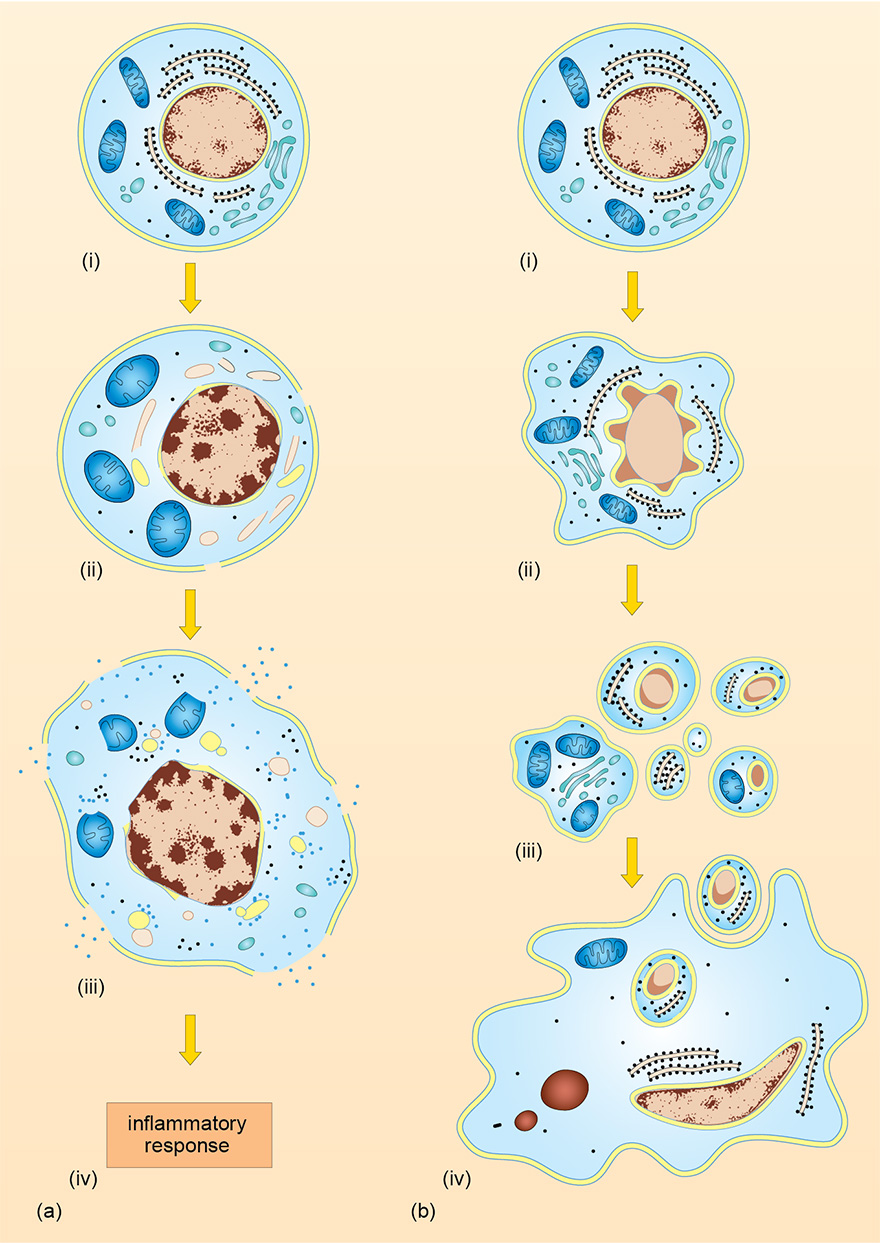
Figure 5 Schematic diagram comparing (a) necrosis and (b) apoptosis. The first events in necrosis are irregular condensation of the nucleus, swelling of the mitochondria and breakdown of membranes and ribosomes. The cell is eventually disrupted, releasing its contents and inducing an inflammatory reaction. In contrast, a cell undergoing apoptosis shows condensation of the nucleus into fragments and shrinkage of the cell. The nucleus and cytoplasm break up into fragments called apoptotic bodies, which are phagocytosed by mononuclear phagocytes.