
4 What is trust?
In the CJS, forensic science often carries a special kind of authority. When jurors hear that DNA or digital (e.g. mobile phone) evidence might link someone to a crime, the evidence can seem powerful. Behind this influence lies a fundamental concept, that of trust.
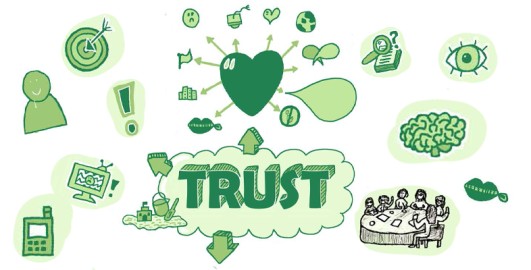
At every step of the crime scene to courtroom process, we need to consider whether those involved – victims, the accused, eyewitnesses, and the jury – have trust in the justice system. Do they trust the police, the forensic science experts, digital evidence experts, legal practitioners, and the legal processes represented by the court? Before we get to this, we should establish what trust is.

Simply put, trust means believing what someone is telling you because you think they are being honest (Mayer et al, 1995). In forensic science, trust is important on several levels. First, we need to trust that forensic evidence is properly collected and stored. Second, it means that there is trust that scientific methods are properly used to analyse the evidence and that those methods are reliable and applied without bias. Third, there should be trust in the institutions, and this includes the police, laboratories, and the legal system.
Since it was first used, forensic science was seen as a ground-breaking tool for aiding the investigation of crime, and its evidence had been viewed as objective and nearly infallible. Crime shows on TV reinforced this by presenting forensic results as clear-cut and definitive. However, academic research over the past few decades has shown that forensic evidence is not necessarily the failsafe it was thought to be (Chin & Ibaviosa, 2022; Rosenblum et al, 2024). In fact, there have been a few instances where forensic science evidence was wrongly interpreted, and this has led to a crisis of credibility in forensic science. Government, policymakers, and academics have acknowledged that forensic science is not trusted as it once was and that the public have lost confidence in it (UK House of Lords, 2019).
Trust also depends on context. If evidence is ambiguous, we might see it as supporting our opinion even if it does not. For example, just because the gym manager’s fingerprint was on Dave’s locker, meaning it was found at the crime scene, does not make him guilty. The manager’s fingerprint might be there for many reasons, e.g. he used that locker earlier in the day, he noticed some dirt on it and wiped it with his hand. We should not use that information to lay the guilt on the manager even if we think he is the suspect.
Research shows that when something is unclear, we are more likely to see it as supporting what we already believe, this can be devasting for a suspect if the evidence is not clear but we think someone is guilty (Kassin et al, 2013). It might happen with forensic experts as well; they might not intentionally act in bad faith but their decisions reflect broader findings from psychological research showing that human decision-making is susceptible to bias (Mingboyeva, 2026).
Research has been carried out to try and make the criminal justice system fairer, or more trustworthy. As a result of this research various procedures have been brought in that try to help everyone make better decisions. One example of this is called sequential unmasking. In this procedure a forensic examiner analyses evidence BEFORE they see information that might bias their judgement. In Dave’s case, sequential unmasking could help ensure that the forensic scientist analyses the crime scene evidence (e.g. fingermarks or DNA) independently, then learns information about the suspect. This reduces the risk that the forensic examiner interprets ambiguous evidence in a biased way, for example that points too strongly to one suspect, such as the gym manager, over another.
Communication is another crucial element of trust. Forensic experts often present their conclusions in court, but research suggests that jurors may misunderstand the meaning of forensic statistics or the certainty of an expert’s opinion. Overstating the strength of evidence, for example by implying that a result uniquely identifies a suspect, can unintentionally exaggerate what the science actually supports (Rosenblum et al., 2024).
Seen in this light, trust in forensic science is not simply about believing experts. It is about creating systems that deserve confidence. Reliable methods, transparent procedures, and honest communication about uncertainty all contribute to evidence that the public can reasonably trust.
Forensic science has enormous potential to help uncover the truth in criminal investigations. But its power depends on something less visible than microscopes or databases: the careful construction of trust.