

1 Crown Court at Leicester Castle Business School
Watch this short video and explanation of the layout of a courtroom. In case you need a recap, remember the Crime to courtroom diagram [Tip: hold Ctrl and click a link to open it in a new tab. (Hide tip)] in Week 2.
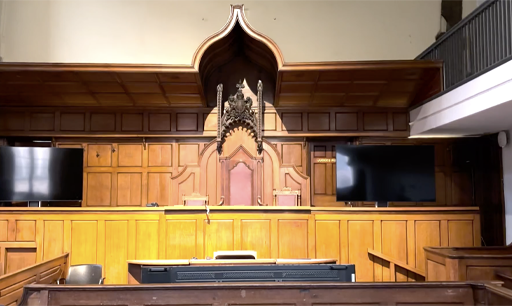
Transcript: Video 1: Layout of a courtroom
This is the sort of courtroom in which Dave’s case would be heard. Click on the image to listen to the audio or read the transcript.
Transcript: Audio 1: The courtroom
Dave’s case goes through the typical process which is that the expert witnesses are called by the prosecution (Leonetti, 2024), though experts could be called by the defence or the court itself. The experts present DNA and digital forensic evidence to inform the court rather than to provide evidence for the side (defence or prosecution team) that hired them. The expert’s main duty is to help the court by interpreting the scientific findings and evaluating these findings by offering opinions as to their meaning within the case context. The opinions will be presented in the form of a written report, oral testimony, or both, by the forensic scientist who undertook the analysis and authored the report.
Activity 1 Remaining impartial
a.
easy
b.
neither easy nor difficult
c.
difficult
The correct answer is c.
Answer
Research shows that forensic experts are not immune to bias. Yet, it is rare that they would acknowledge their own biases or they may even fancifully think that they can overcome them with their willpower (Kukucka, et al., 2017). This is changing as biases in thinking is gaining more attention though it is questionable whether simply reminding experts of their duty to be objective and impartial might be enough to address expert biases.
The prosecution will begin questioning the expert during what is known as examination in chief. Afterwards, the defence will have the same opportunity to ask the expert further questions based on their evidence and answers during examination in chief, during what is known as cross-examination. These questions oppose each other as they are used to address the prosecution or defence arguments to show guilt or innocence. During testimony, experts must respond directly to the questions asked and remain impartial. Further, they must communicate their scientific findings, staying within the bounds of their expertise. The evidence must be relevant and help the court answer specific questions about the case. The trustworthiness of the expert and their evidence, whether in written form or spoken testimony, should follow guidance from the International Organization for Standardization which advises on best practice on how to report forensic science evidence (ISO 21043 Part 5). The expert’s evidence will depend on:
- accuracy
- scientific underpinning and robustness of their analysis
- clarity, including explaining complex scientific techniques in lay person’s terms
- transparency
- completeness
- lack of ambiguity
- impartiality
- suitability for its intended purpose.