2 Some typical questions for DNA Evidence
Activity 2
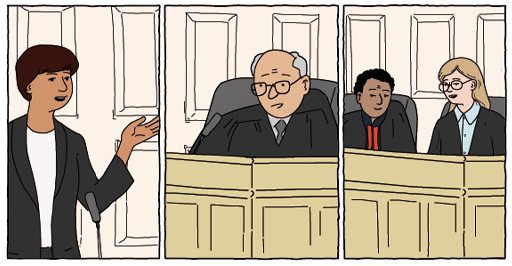
From Ana: this feels like more like a reflection?Acting as a lawyer in this case, suggest at least two questions that you will ask the DNA expert in court, and justify why these should be asked.
DNA expert might be able to provide some information in relation to three key questions that both the prosecution and defence lawyers would want to address. These are:
- Is there DNA on the bat? Is the DNA present from a single source or multiple sources and how could multiple sources be accounted for?
- Whose DNA is on the bat and how sure are you of that result?
- What activities could result in a person’s DNA being transferred to the bat?
- You might think that a question such as ‘is the person’s whose DNA on the bat the perpetrator of the crime?’ might be asked, that is an offence level question and scientists would not, and should not, answer questions such as that.
It is likely that the digital forensic expert in the case would be questioned in a similar way though about digital evidence.
The trustworthiness of both the scientific tests and the expert’s interpretation of the scientific results will depend on how clearly the expert explains what the evidence means within the case context, what are the limitations of the evidence and, how this is communicated (more on this in week 4). To answer the first question, the DNA expert would report the results of a statistical calculation which evaluates how likely it is that the DNA found on the bat belongs to the suspect, compared to how likely it is to belong to someone else in the ‘world’ who is unrelated to the suspect. This calculation is called a likelihood ratio. In trying to communicate this information to the Court and Jury the expert might say something like:
‘Analysis of the DNA recovered from the bat gave a full DNA profile that matched that of the suspect. If the DNA evidence did not come from the suspect then the DNA profile must match by chance. It is estimated that the chance of obtaining these matching profiles if the evidence came from a random person unrelated to the suspect is in the order of 1 in a billion (where a billion is a thousand million).’
Research has shown that, since the introduction of the use of likelihood ratio calculations in the late 1980s, both legal practitioners and Juries have found it difficult to understand and this difficulty remains to this day (Morrison et al., 2025 [Tip: hold Ctrl and click a link to open it in a new tab. (Hide tip)] ).
Activity 3
Would you be able to explain likelihood ratio calculations in lay terms? Yes, no. Click below to see how it could be explained.
Comment
In simple terms, the expert is communicating that
- DNA that matches the suspect’s DNA is on the bat
- the chances of this DNA profile being obtained from someone other than the suspect is very small
- on the basis of (1) and (2) it is more likely that the suspect’s DNA is on the bat than someone else’s DNA.
However, this does not mean, that the suspect actually handled the bat. So, while the DNA evidence may answer the first and second question (is there DNA on the bat? And who’s DNA is that most likely to be), it cannot reliably answer the third question (How the person’s DNA came to be on the bat and this type of evidence, on its own, cannot address the offence level question as to whether the suspect is the person who committed the alleged crime).
During the cross-examination, the defence lawyer may not contest the answer to the first or second question. However, the answer to the third question will and should be of high interest. Remember the issues raised in week 2.
A good line of questioning might be who’s DNA is on the bat and where (location) on the bat the DNA was recovered from (for example the victim’s DNA would be recovered from the blood stained area and the suspect’s DNA might be recovered from the handle); how likely it is that the suspect’s DNA was transferred to the handle of the bat through direct contact or via a different transfer mechanism and then remained (persisted) on the bat. What are the chances of such contact happening either during, before or after the alleged incident, in such a busy gym? These questions challenge the relevance, evaluation and weight of the DNA evidence.
Remember in Week Two that the suspect stated that he was a member of the gym, frequented the locker room, but had nothing to do with the alleged attack. If the suspect handled the bat at any time, his DNA could have been left on the handle. It could also be transferred to the bat from the locker room environment, without direct contact although this would be less likely. Equally, if the suspect handled the bat when using it to assault the victim his DNA could be present. In both scenarios, the presence of a DNA match (the forensic evidence) is equally likely and plausible, however it will be conditioned also on what is known about the persistence of DNA on baseball bat handles and what impacts that (time since handling, pressure, humidity and environmental conditions etc).
The DNA evidence doesn’t answer how the DNA got to be where it was recovered from (the handle of the bat), only that it was there. The DNA evidence alone in this case is insufficient to answer the question of whether the suspect committed the crime.
What if there’s doubt? Can the suspect commission their own expert witness?
Yes. The law governing expert evidence in England and Wales (known as the Criminal Procedure Rules and Practice Directions, Part 19) allows the suspect, to commission their own expert witness funding via state-funded legal aid. The defence expert can review the forensic science data from the tests undertaken and the interpretation and evaluation provided by the prosecution’s expert, or carry out additional tests, if needed.
There are similar provisions for the use of defence experts in Scotland and in Northern Ireland.
Activity 4
Did you know about the possibility of commissioning a defence scientist through legal-aid? Yes/ No.
Answer
You can find out more about legal-aid here
Link to legal-aid website: https://www.gov.uk/ legal-aid
The Criminal Procedure Rules and Practice Directions also permit Pre-hearing Discussion between the experts. This is where both the defence and prosecution experts meet, before the case trial in court, to identify areas of agreement and disagreement on the forensic evidence. A joint report is then written by both experts summarising these points, which would be presented during the court trial. This, in addition to effective cross-examination, helps the jury, who ultimately decide how much weight to give the expert evidence, to see where the experts align and where they differ. These procedures are designed to protect the court from conflicting opinions and misinterpretations.
Yet, in practice, limitations of both the legal system and forensic science can play out in the courtroom and impact how trustworthy the evidence appears. If an expert makes mistakes, whether through biased interpretation, poor communication, lack of clarity, exaggerating or decreasing the strength of the evidence or struggling to explain complex numerical values and probabilities in plain language, the credibility of the evidence may suffer. Similarly, if the jury is disengaged or overwhelmed by the expert evidence, if lawyers fail to ask the right questions, and the judge erroneously allows inaccurate evidence to be admitted, all of this will ultimately impact the reliable use and trust of the forensic evidence. This might contribute to the wrongful conviction of an innocent person, and research shows the contribution of inaccurate forensic science to such miscarriages of justice (Morgan, 2023).
In conclusion, many factors shape how the evidence is received and understood and eventually trusted. In the adversarial Criminal Justice System, forensic scientists are called upon by the prosecution, defence or jointly, as impartial scientific experts who will use their scientific expertise to analyse traces and deliver meaning within the context of a framework of circumstances of the case. The prosecution’s objectives may influence the selection of items submitted to the forensic science laboratory for analysis, instructions provided to forensic scientists, questions posed by the police to the forensic scientists, or lines of inquiry suggested for further scientific exploration. As independent and objective scientific advisers to the administration of justice, forensic scientists and expert witnesses must promote the integrity of their own technical evidence (Roberts, 2009). Trustworthiness of the forensic evidence as it is presented in court, then, isn’t just about the science; it is about how well that science is interpreted, communicated, and challenged where appropriate within the courtroom.