

3.1 The experience of an experiment: Heider and Simmel
In Activity 5, you will have a chance to experience what Heider and Simmel’s study was like for those participating in it. In the original study, the participants were asked to watch a stimulus material – a simple animation – and were given the instruction to ‘write down what happened’. In the next activity, you will watch the original animation and answer that same question.
Activity 5 The experience of an experiment
Task 1
Watch the original stimulus video that Heider and Simmel showed to the participants. We recommend that you watch the video twice. You will then be asked to write down what happened.
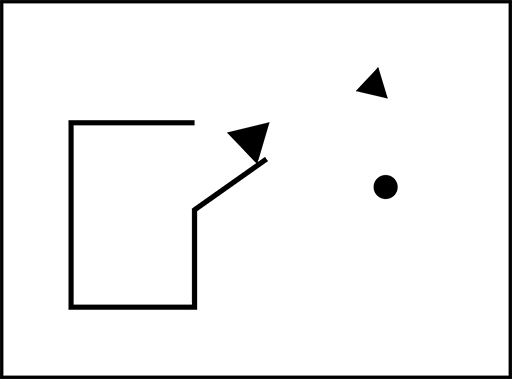
Transcript: Video 5 Stimulus animation used in Heider and Simmel’s ‘An Experimental Study of Apparent Behavior’ (1944).
Now that you have watched the stimulus material used in the experiment, follow the instruction that Heider and Simmel (1944, p. 245) gave to their participants in 1944: ‘Write down what happened in the picture’.
Try and write down what happened as succinctly as possible. Make sure you save your answer to this as you will review it later in Activities 6 and 7.
Discussion
Of course, we cannot be sure what exactly your response has been and what your interpretation is regarding what was happening in the animated stimulus. Who exactly are the ‘characters’ represented by the triangles and the circle? Are ‘they’ humans or animals? What motives do they have? There is clearly room for interpretation, as the video is rather rudimentary.
However, we would venture to guess that you did not simply write ‘two triangles and a circle moving about’. Instead, these shapes represented animate beings. That is, you are likely to have described a story unfolding among characters that seem to have motivations and purpose.
Task 2
You will now reflect on an aspect of the video which Heider and Simmel (1944) did not think about in their study: the participants’ experience of the stimulus. Briefly describe how you felt as you watched the video. In other words, what was your experience as you watched it?
Discussion
Some of us on the course team felt rather moved by the animated sequence, and this may be how you felt too. You may have perceived some threat or a sense of bullying coming from the larger triangle – and then some relief when it was finally outwitted. This simple animation therefore did not just evoke a story; it had the power to evoke feelings in us too. Or, rather, because this animation evoked a story, it could also evoke some affective response to this story.
In the original study, Heider and Simmel found that 33 out of their 34 participants described the animated sequence ‘in terms of animated beings’ (1944, p. 246); that is, they all perceived the geometric shapes and their physical movements in the video as representing something sentient and purposeful. In fact, 19 of the participants reported a ‘connected story’. The following quote is a response from a participant that Heider and Simmel described as a ‘common interpretation’:
Then the two men have a fight, and the girl starts to go into the room to get out of the way and hesitates and finally goes in. She apparently does not want to be with the first man. The first man follows her into the room after having left the second in a rather weakened condition leaning on the wall outside the room. The girl gets worried and races from one corner to the other in the far part of the room. Man number one, after being rather silent for a while, makes several approaches at her; but she gets to the corner across from the door, just as man number two is trying to open it.
It is certainly interesting that two triangles and a circle moving about can lead to such shared sense-making. In fact, they can even lead to us having feelings about the triangles and the circle! How do we make sense of these responses?