

3.2 Social psychologists making sense of Heider and Simmel
Heider and Simmel’s work was immediately recognised for its important findings, and it is still considered a classic study in social psychology today. As a result, it continues to be discussed in both academic and non-academic circles alike. But what exactly does it teach us? Interestingly, the multitude of social-psychological voices presenting, introducing and examining this study seem to say something very similar about it.
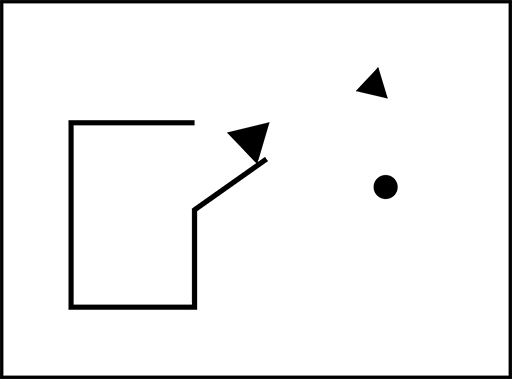
In the next activity, you will explore the common frame that social psychologists use to make sense of Heider and Simmel’s study, and you will examine it in light of your own experiences.
Activity 6 How is the Heider and Simmel study commonly made sense of?
Task 1
Read the following quotes, which succinctly summarise Heider and Simmel’s study. The first summary is from a standard social psychology textbook by experts Michael Hogg and Graham Vaughan. The second summary is a response to the question: ‘According to social psychology experts, what was the Heider and Simmel (1944) study about?’, generated by Microsoft Copilot, the generative artificial intelligence (AI) program.
Summary 1
The search for causes does seem to pervade human thought, and indeed it can be difficult to explain or comment on something without using causal language. Heider and Simmel (1944) demonstrated this in an ingenious experiment in which people who were asked to describe the movement of abstract geometric figures described them as if they were humans with intentions to act in certain ways.
Summary 2
Fritz Heider and Marianne Simmel’s 1944 study ‘An Experimental Study of Apparent Behavior’ showed that people spontaneously attribute intentions and emotions to simple moving shapes. When participants watched animated triangles and a circle, they described them as chasing, fighting, or comforting – revealing our innate tendency to impose social meaning on abstract motion.
What was your first reaction to reading an expert account and an AI-generated summary of expert accounts of the study? How did the common frame represented by these quotes match up with your own experience of watching the stimulus?
Below, you can read your initial response to the stimulus from Heider and Simmel’s study that you wrote in Activity 5. Look again at this response and then answer the poll question that follows by choosing your answer and selecting ‘Submit Vote’. Once you have submitted your answer, you will also be able to anonymously see how other learners on this course have responded to this question.
Comment
Of course, we do not know what your answer may have been here. However, we on the course team felt that these descriptions, common among social psychology experts, somehow feel odd. This is because the accounts given by the experts frame Heider and Simmel’s study quite differently from what we experienced ‘participating’ in it. For us, this provokes a kind of sense-making crisis – on one hand, we have our ‘experiential frame’ and, on the other hand, there is the ‘expert frame’, and the two are at odds.
Task 2
In order to understand the difference between your own ‘experiential frame’ and the ‘expert frame’, you will now contrast the two. Read, once again, both your initial response along with the two summaries, and compare and contrast how you made sense in your summary of the common sense-making that developed among social psychologists. Try to note at least one crucial difference. You may use the following questions to prompt your thoughts:
- How is the stimulus material described in each summary?
- Do these descriptions match your own account?
Discussion
It is obvious that the video showed two triangles and a circle moving around. However, social psychologists tend to describe it as though these were only triangles and circles – that is, mere ‘abstract geometric figures’ (Hogg and Vaughan, 2008, p. 81). Because of this framing, there is a disjuncture between the original ‘abstract geometric’ stimulus and the response given by 33 out of the 34 participants who viewed the stimulus in terms of it being a story involving animated beings. For this reason, the social meaning (or story) is framed as being imposed on abstract motion.
This creates a disjuncture because the 33 participants who saw the shapes as animate beings (and maybe you saw them this way too) presumably felt they did not ‘attribute’, ‘project’ or ‘impose’ anything. Instead, it was the video itself that evoked their response – very much like a Disney animation would do these days.