
Building number confidence: Budgeting
2. Understanding your payslip
Knowing exactly how much money you have coming in each month is the first step of the budgeting process. Keep a check on your payslips to ensure you have been paid the correct amount and that any deductions have been made at the correct rate.
Payslips come in various formats, however they all include these key components:
- Gross income (your salary, or basic pay)
- Additions (such as overtime and any allowances)
- Deductions (including tax, National Insurance and pension contributions)
- Net income (your take-home pay after deductions).
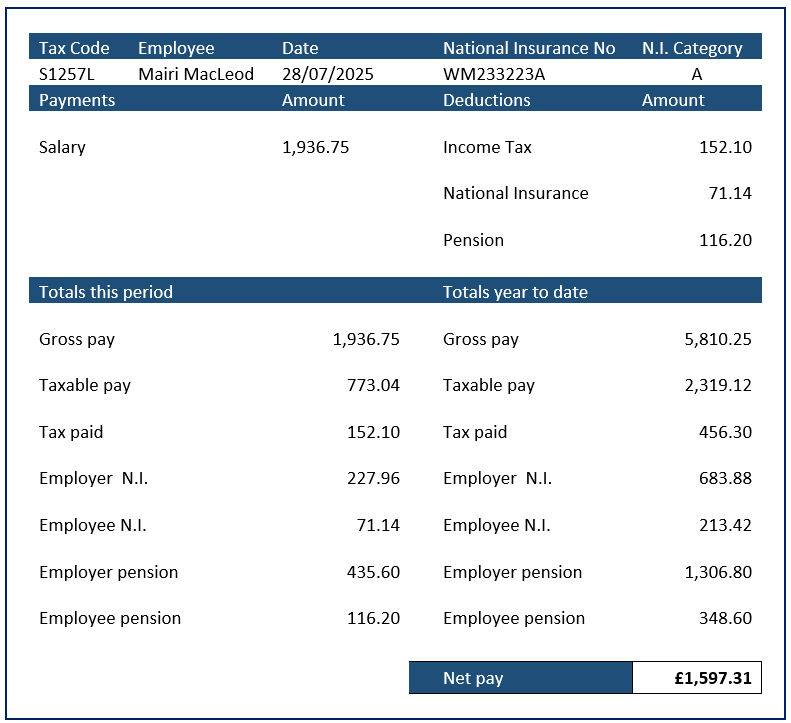
Let's have a look at Mairi's recent payslip.
Gross income
This is your salary, or your basic pay, before any additions and deductions). Mairi receives a monthly salary of £1,936.75. In this payslip Mairi's salary is listed under 'Payments'.
Gross pay can often be worked out by multiplying the number of hours worked by the hourly rate of pay.
For example: If someone works 10 hours at £20 per hour, their gross pay is 10 × £20 = £200.
Additions
These are anything added to your basic pay, such as overtime, on-call allowance or bonuses and would be listed under 'Payments'. Mairi has no additions to her basic pay this month.
Deductions
Deductions are anything taken off your basic pay. The most common are Income Tax, National Insurance and pension contributions (click headings below to expand).
Income Tax is tax paid to the Government, on your annual income. Not all types of income are taxable, and most people are entitled to a tax free allowance.
Your tax code is issued by HM Revenue and Customs (HMRC) and informs how much tax should be deducted by your employer on behalf of the Government.
Your Personal Allowance is the tax-free amount you can earn during a tax year (6 April to 5 April the following year). Any earnings above your personal allowance are taxed, at varying rates depending on income (there is no tax free allowance for those earning over £125,140).
Mairi's payslip shows that her tax code is S1257.
- S indicates that she pays tax in Scotland.
- 1257 indicates her (tax free) Personal Allowance (£12,570).
- L confirms she is entitled to the standard (tax free) Personal Allowance (currently £12,570).
Tax of £152.10 has been deducted.
Various factors can influence your tax code. Visit Tax codes: what your tax code means for an overview and further information.
In Scotland, (2025) tax rates start at 19% on earnings from £12,571 to £15,397, rising incrementally to a top rate of 48% on earnings over £125,140. Visit Income Tax in Scotland and Income Tax: introduction for current rates and further information.
National Insurance contributions qualify you for certain benefits and a State pension when you reach retirement age.
Your unique National Insurance number ensures your National Insurance contributions and tax are recorded against your name only.
Mairi's payslip shows that National Insurance of £71.14 has been deducted. Note that her employer is also required to contribute, on her behalf, at a higher rate.
Visit National Insurance: introduction for an overview and further information.
Workplace pension schemes provide an income when you retire. Pension contributions are deducted from your salary, and your employer may also contribute to this pot.
Mairi's has 6% of her salary deducted each month towards her workplace pension (£116.20 this month) and her employer also contributes at an enhanced rate (£435.60 this month).
UK employers are required to provide automatic enrolment to employees who meet certain criteria.
What is automatic enrolment? | Department for Work and Pensions (DWP), 0:40
Other possible deductions include student loan repayments, trade union subscriptions, cycle-to-work scheme loans and charitable donations.
Net income
This is your 'take-home' pay, what will be paid into your bank account, after any additions and deductions have been made. Mairi take-home pay this month is £1,597.31.
Budgeting check
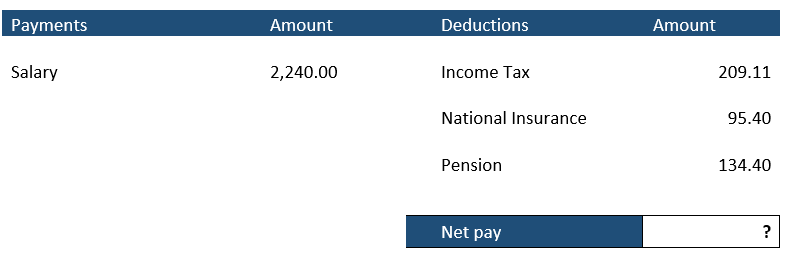
Murdo's payslip shows a gross pay this month of £2,240.00 and the following deductions:
- Income Tax: £209.11
- National Insurance: £95.40
- Pension Contribution: £134.40
What is Murdo's net (take home) pay?
£1.801.09
£2,240.00 (gross) - £438.91 (total deductions) = £1.801.09 (net).