Unit 5 Reflective Account
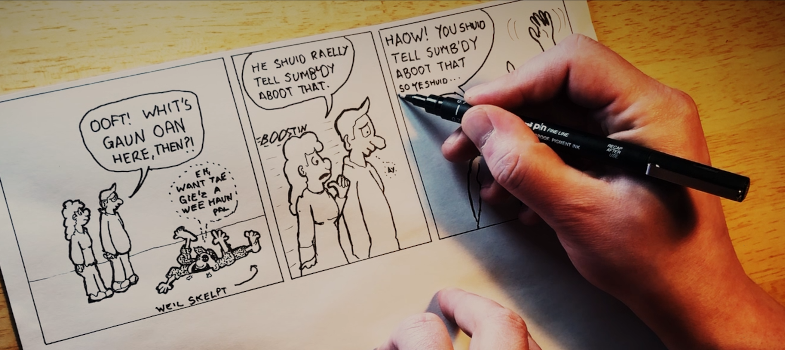
Am gonnae push ma luck here an suggest thit among the maist creative genre of creative writin surley his tae be students’ assessment scripts! In terms o imagination, if no theoretical accuracy, they haud a high rank.
The shift tae adoptin this context fur ma Reflective Account his been brough aboot mainly due the continued logistical problems a hiv encountert wi these application tasks an the student cohort a hiv focussed oan.
In addition, a latched on tae the comments in wan ae thi Model Answers which highlightit Linda Bruce’s comments oan mental distress and the socialisation process’ impact oan thi yuyise ae Scots. This is precisely thi contexts ma students ur wurkin fae. Whilst a teach a mental health unit, a double credit at Level 6, mental wellbeing an distress ur ripe fur considerations during oor foray intae Scots an wan a fully intend tae develop furur.
This lessun focusset oan resources available tae candidates tae deepen thur unnerstaunbin ae Scots an, importantly, its yuise in the classroom an professional lives. A’ve attached a coapy o the PowerPoint presentation. During thi lesson we emarkit oan an acitvity (also attached). This drew upon Scots wurds we hid encounterit afore. A wantit tae encourage thi candidates tae explore thur ain meanins an thi connotations they attachit tae these wurds. A kin see how in thi long-term a cud encourage creative ritin an, a think, this is a way fur me tae develop oor yuise ae Scots.
Hoever, At this point it is pertinent tae reflect ower ma logistical problems as hintit at above.
A teach adult returners. Alang wi thur pre-existing domestic and relationship commitments they ur also in the throes ae yooni offers (Thi class a huv focussed oan ur a Scottish Wider Access Programme; Access tae Social Wurk (SWAP)) group. Soam o these SWAP students ur gettin thur ideal offers, we hiv fower yoonis in oor area offerin Social Wurk unnergraduate courses. Ithers are being rejectit or hiv shiftit thur ain thinkin; pursuin Humanities an sic lik. Mony ae them, especially thi wans bein rejectit ur voatin wi thur feet-hopefully this is a temporary state o affairs. This resultit in thi class stairtin wi five candidates and wis quickly reduced tae three when twa candidates realised thit a wis gaun ower Scots tae assisit thir assessment; they hid aready focussed thur responses oan ither techniqueds evident in the assessment subject piece.
Nanetheless, an undaunted, thi three amigos an masel embarked oan thi class. Thi original plan wis tae produce a short piece; a personal reflection or a flyte at masel. Given thi numbers tho, a'm hoppin a hiv convinced twa ae them tae yuise Scots oan thir scripts. In oither wurds, tae anser the task in Scots. This is a furst fur me an a sincerely hope they rise tae the challenge. In addition tae thi resources a explore in the presentation a hiv reassured thi concerns ower spellin; a hiv disclosed ma ain attempts tae them an reflectit ower thi advice in the Unit tae tri tae be consistent.
Whilst a’m grateful fur the reminder ae Gibbs Reflective Cycle an, a course this is yaised extensively in healthcare profeshional contexts, A hiv a tendency tae draw upoan Critical Incident Analysis (CIA) fur ma reflective practices. This form is widely yaised in Social Wurk circles an his been particularily useful tae me ower the years.
Ma analyses huv exposed ma ain lack ae consistency a a fundamental an critical theme emergin fae ma reflection an analyses ae incidents. Scots his tae be mair embedit in ma general treachin an, specifically in thi Literature 1 unit a deliver tae this cohort, yaised throughout the Support Pack ah hiv creatit tae support thi unit. In addition a hiv tae broach the notion mair strongly.
Whilst a dae introduce Scots early oan, it gets left by the wayside whilst we pursue ither themes an techniques. A also hiv tae rejig the Support Pack tae not onli bolster the yuise ae Scots but also bring in creative ritin.
Dodie's Phenomenal Pheesic
Dodie’s Phenomenal Pheesic with P5 class
Character description of Granny
Because I had read Da Trow, the Shetland version of The Troll by Julia Donaldson to the bairns a few weeks ago as part of world book day I felt confident reading a longer text in Shetland. I knew the pupils would be interested in more Shetland reading/writing as I received positive feedback from the bairns following Da Trow activities.
The class were interested in the story as many were already familiar with George’s Marvellous Medicine. I also had enough copies of Dodie’s Phenomenal Pheesic so they could follow along if they wanted to.
Reading the chapter took longer than reading it in English as we had a lot of discussions about the meanings of words and phrases.
pupils looked back over the chapter for descriptions and we gathered the words on the board including ones we were not familiar with. Pupils enjoyed using the Shetland app on the ipads to search the meanings of words. We don’t have many copies of Shetland dictionaries in school so having the app installed on the ipads is making it more accessible for pupils to write and understand Shetland.
For Da Trow story, pupils drew and labelled pictures of the Trow with Shetland words, so I thought this time I would get pupils to write a description of Granny in Shetland
Using the bank of words on the board pupils wrote short descriptions but due to other commitments, I wasn’t in class for the whole writing part and I felt pupils rushed this to get onto the next job.
I would have liked more time. Not being their class teacher and with timetabling restrictions etc means that I have limited time to work with them and it reflected in the writing. Some of the bairns did write good descriptions but I would have liked to have been there for the duration so I could have supported their writing more.
I would like to continue with the story and adapt the activities by Christine De Luca and the resource by Bruce Eunson for Geordie’s Mingin Medicin with the class, so I will have to discuss that with the class teacher.
I would invite pupils to read parts of the story in Shetland, this would increase their confidence and hopefully encourage them to choose to read books in Scots or Shetland. I am also interested to see if pupils find it easier to write descriptions in English first, then translate or writing then in Shetland.
I didn’t use it for this lesson but I have previously used a word dump with an older class similar to Matthew Fitt, it was a good way to get pupils thinking and recognising the words they already know. I would definitely do it if I was following up this lesson and then after each chapter so it’s a working gallery of words for pupils to use.
To raise awareness of Scots in the curriculum with parents I put up a display for our Primary open day at the end of term. I displayed some of the pupils work from Da Trow and Dodie’s Phenomenal Pheesic and wrote the captions in Scots for pupils and parents to read. Another class teacher had recordings of pupils’ translations of traditional tales for parents to watch by QR code. A few parents have told me that their bairns are speaking about the activities I’ve been doing with them at home, which is pleasing. Some classes are also taking part in the local writing competition with a few opting to write in Shetland. In another year, it would be good to see more pupils entering stories written in Shetland.
Hiya Pauline
There’s so much good work happening in your lessons! It’s brilliant to see the progression from shorter bairns books to the longer Roald Dahl ones. I know from having spoken to her about it before that when Christine De Luca translated George’s Marvellous Medicine, it was specifically to give bairns in Shetland the opportunity to engage with a longer text. She would be delighted to hear about what you've been doing.
I love the idea that not only are the class looking up words in the dictionary on their own, but that words are being gathered on the board and discussion is happening and the meaning of words and phrases. I can’t imagine that this approach is taken with either English or French or any other language, so the experience of sharing and learning and involving the class in the answers as well as the questions sounds like such a rich learning experience both from a literacy perspective as well as a language one. How often is one bairn asking what something means and another from the class is giving the answer? That peer-to-peer approach can work so well.
And it seems to me that it is clearly having an impact! Just as with others on this course, you are having to navigate a complicated (maybe even uncomfortable at times) journey with the lessons you are trialling because they may seem so niche or different at first. I hope you take a moment after the parents tell you the bairns are coming home and telling them about the Shetland lessons you are doing and say to yourself what a good job you have done. And if you don’t say it to yourself then that’s what I’m here for! Haha. I fully appreciate what you are working on in the school is not easy, but to me, there is so many examples of innovative practice happening in your lessons. Creative writing sounds like the ideal next step, both for you and the bairns.
Can’t wait to discuss it all more,
Bruce
More fantastic work fae yersel, Bobby!
I love opening the powerpoint and seeing an immediate focus on speaking. Putting it front and centre with an emphasis on talking in the language. Using literature that features the language is a great way to make that tangible, and I love this message of reassurance to the students, “There is no need to prove that Scots is a language in your essay; simply use it, however, this is worthwhile asserting.” And then giving two distinct sources to offer an insight into the contrasting approaches available: Oor Wullie, and the Dictionary of the Scots language. The voice of a Scots speaking child, illustrated and brought to life, alongside the more academic, scholarly approach. Gives the students such a breadth to then navigate and find their own way in. I love it.
Lots of teachers (of bairns at any school age) find there are writers that work best for them. Sometimes because of where the writer is from, and the language they use matches that of the learner, other times it is because of being age-appropriate, other times for no reason other than the literature itself is quality writing, featuring Scots, and will inspire. I get the impression that Anne Donovan for you ticks all of those boxes.
I certainly won’t argue with you when you say, “Am gonnae push ma luck here an suggest thit among the maist creative genre of creative writin surley his tae be students’ assessment scripts! In terms o imagination, if no theoretical accuracy, they haud a high rank.”
It’s amazing to see how you are taking what you not only learn from this course, but experience when participating in the course, and are applying that directly to you practice and relationship with your students. Most importantly you are seeking – and finding – ways to develop natural use of Scots in the education system. Obviously there is a concern about use of Scots dominating the class, every teacher on this course has to navigate that, not only with the class in front of them today, but for the future. Whatever the class in whatever part of the country, shifting from English only, to incorporating another language (particularly one that comes with so much baggage!) will not be a sudden success for all, and I feel that continually backing up the role of English (even if that may seem counter intuitive) will be key to getting the right balance.
The advice you are giving them is spot on, “In addition tae thi resources a explore in the presentation a hiv reassured thi concerns ower spellin; a hiv disclosed ma ain attempts tae them an reflectit ower thi advice in the Unit tae tri tae be consistent.” It’s wonderful to see you taking such a reflective approach to this course, Bobby, the work you have done from day one has been fantastic, and as we approach the end it is clear how much thought, creativity and dedication you’ve put in.
Bruce
I used Finding Your Voice Through Scots and Shaetlan used Wilder and the Nyuggel by Jane Cockayne as a context to explore Shaetlan language as a living part of literature and identity. It provided opportunities for learners to engage in creative writing inspired by bilingual storytelling, while also making meaningful cross-curricular links with history, geography, mythology and expressive arts. A strong emphasis was placed on community and family involvement, recognising the value of local dialect and oral storytelling traditions in shaping pupils’ understanding of language and culture as part of a home-link task.
Through this learning, pupils were encouraged to explore how Scots and Shaetlan language shaped character, setting and mood within a text. They compared English and Shaetlan versions of the story, developing an understanding of how regional language preserved culture and oral traditions. Building on this, learners created their own pieces of writing and drew on Scots and Shaetlan vocabulary and imagery, extending their learning beyond the classroom by gathering words and stories from family and community members.
Success in this lesson was demonstrated when pupils could identify Scots and Shaetlan vocabulary and infer meaning from context, discuss the author’s choice to write bilingually, and use dialect creatively in their own work. They collaborated to produce imaginative pieces inspired by local myth or place, while reflecting on how language connected people, places and identity.
The lesson linked strongly across the curriculum. In literacy, pupils engaged in reading for understanding and comparison, vocabulary development through the creation of a shared Shetland dictionary, creative writing, and opportunities for speaking and listening. In social studies, learning focused on Shetland heritage, folklore and local identity, while expressive arts were developed through illustration and storytelling performance. There were also clear links to health and wellbeing, particularly in exploring belonging, identity and self-expression, with Wilder’s feelings of not fitting in providing an accessible emotional theme.
The lesson began with a recap of the rich discussion from a school visit, during which a class set of books had been kindly gifted by Shetland ForWirds and are available for all through the school library. As class readers written in Shetland were limited, these new texts were a particularly valued addition. A “mystery words” hook activity introduced pupils to a selection of Shaetlan words, which were explored before being checked against the glossary unusually found in the middle of the book as it is written in both Shaetlan and English depending on which side you wish to read. Through discussion, pupils considered possible meanings, identified clues and reflected on words used in their own homes, these words were usually linked to activities around the home or traditional pursuits of crofting and fishing – moorit, caain da hill, caadie lambs and trootin, all frequently used but maybe less so in a school context. This opened up meaningful conversation about home language, language identity and the status of Shaetlan as a valid language rather than “incorrect English”.
This was followed by a shared reading session, where pupils read Wilder and the Nyuggel, choosing either the Shetland version or the English version with Shetland dialogue, while the teacher modelled reading in Shaetlan. Building on prior engagement, pupils explored how the different versions affected mood and tone. Through guided questions, they considered which words created the strongest imagery, which version felt most musical, and why preserving Shaetlan in literature mattered. Pupils were encouraged to notice rhythm, sound, imagery and emotional tone, helping them to recognise Scots and Shaetlan as powerful literary tools rather than simple vocabulary substitutions.
The lesson then moved into a folklore and place-based discussion, exploring the myth of the Nyuggel alongside wider Shetland traditions. Connections were made to A Stranger Came Ashore by Molly Hunter, the class reader about selkie folk coming ashore on Shetland, which although set is not written in Shaetlan helps link understanding of folklore, community and what island life would have been like 100+ years ago. Pupils reflected on why communities created myths, what stories belonged to their own area, and how landscape influenced storytelling. This provided further opportunity for cross-curricular learning through mapping Shetland, discussing island life and comparing local legends across Scotland.
Main Creative Writing Task
2 – 3 sessions including time for editing, can have extension time if required
“The Map”
Children create a short story or poem about:
- a map (discuss whether treasure, old, new, torn, hand-drawn, magical …)
- discovering a hidden place in Shetland
The main creative writing task, delivered over two / three sessions, invited pupils to respond to the theme “The Map” , this years theme of The Shetland Young Writer competition. They created a story or poem centred on discovering a hidden place in Shetland, using a map as a stimulus. Pupils were encouraged to include Scots or Shaetlan vocabulary where appropriate, use rich sensory description, and incorporate dialogue or sound effects. Support was provided through classroom word banks, Shetland dictionaries, and the creation of a shared illustrated dictionary.
To strengthen links between school and community, a homework or extension task titled “Words From Hame” invited pupils to gather language from family members or neighbours. They explored dialect words, sayings and stories that had been passed down, and considered which words might be disappearing and why this may be (some were connected to chores/tasks that people no longer need to do). This led to the creation of a class dialect dictionary, recordings of oral histories, and opportunities for audio storytelling, and in some cases involved inviting family members into school to share stories. This element was particularly valuable in building connections beyond the classroom and recognising the importance of community knowledge.
A range of resources supported the lesson, including the core texts, as well as materials linked to the Shetland Young Writer competition. Additional support was drawn from organisations such as the Scots Language Centre, Education Scotland and Shetland ForWirds. Practical classroom tools, including a large map of Shetland, vocabulary displays and dual-language resources, further enhanced learning.
Assessment was ongoing and focused on observing pupils as they discussed language choices, interpreted unfamiliar vocabulary, used Scots and Shaetlan creatively, and made connections between language, identity and place. Evidence of learning was gathered through written work, oral storytelling, illustrated dictionaries and reflective discussion.
To illustrate the impact of this learning, I have attached three pupil writing pieces. One pupil chose to write in English while incorporating elements of local folklore, another blended Shaetlan vocabulary throughout both language and structure, and a third fully embraced Shaetlan, drawing on a rich vocabulary and referencing the most fearsome of trows from the well-known Shetland poem Eence upon a time by Vagaland, a text we had studied earlier this academic year.
Overall, this approach supported pupils in recognising Scots and Shaetlan as expressive literary languages and as carriers of culture and memory. It helped them to see these languages as part of their own lived experience and as valid, powerful tools for creative expression. By connecting classroom learning with family and community, it reinforced the understanding that language learning extended beyond the school gate.
Hiya Ingrid
This is so good!
It is brilliant to see Shetland & Scots language used in this way – not just as living parts of literature and identity, but making so many cross-curricular links with history, geography, mythology and expressive arts, as well as such a strong emphasis on community and family involvement.
I can see that the focus on language really opened up the possibility to explore so many literacy outcomes: character, setting and mood within a text. And it is amazing to tie it all together by then also gathering words and stories from family and community members.
You are absolutely right when you say, “Success in this lesson was demonstrated when pupils could identify Scots and Shaetlan vocabulary and infer meaning from context, discuss the author’s choice to write bilingually, and use dialect creatively in their own work. They collaborated to produce imaginative pieces inspired by local myth or place, while reflecting on how language connected people, places and identity.” What an inspiring way to bring these important themes into the classroom and explore deep learning via language and literature. What works so well here is the awareness of the links between words usually linked to activities around the home or traditional pursuits like crofting and fishing “moorit, caain da hill, caadie lambs and trootin” that are all understood but not always utilised in a school context, therefore making it all even more relevant and engaging.
It’s great to hear you were able to use the new books directly in the classroom like this and allow the bairns to choose to read from either the Shetland version or the English, making it very inclusive to the diversity of learners and confidence levels. Then regardless of which language they chose to speak in you could develop their learning further by guiding them into discussion of why preserving Shaetlan in literature mattered and to recognise Scots and Shaetlan as powerful literary tools rather than simple vocabulary substitutions.
A part of the journey I am particularly taken with is where, “They explored dialect words, sayings and stories that had been passed down, and considered which words might be disappearing and why this may be (some were connected to chores/tasks that people no longer need to do). This led to the creation of a class dialect dictionary, recordings of oral histories, and opportunities for audio storytelling, and in some cases involved inviting family members into school to share stories. This element was particularly valuable in building connections beyond the classroom and recognising the importance of community knowledge.”
I couldn’t imagine a more important and valuable lesson – it will have been really appreciated by the wider community, I bet, as it really shows the school as wanting to both engage and to learn what makes a place both distinct and important. As well as fragile and in need of the next generation. As you highlight in your final comment, “Overall, this approach supported pupils in recognising Scots and Shaetlan as expressive literary languages and as carriers of culture and memory. It helped them to see these languages as part of their own lived experience and as valid, powerful tools for creative expression. By connecting classroom learning with family and community, it reinforced the understanding that language learning extended beyond the school gate.”
What a joy it is to both read this post and to know these lessons are happening in schools today.
Fantastic work,
Bruce