
2.1 Systems thinking and new paradigms
Systems thinker, Donella Meadows identifies the achingly difficult job of rethinking the present in terms of conceptualising system change through a series of intervention points. Although the paper was first published in 1999, it is still of great value in its ability to discuss the complex scope of systems change in ways that resonate with non-experts.
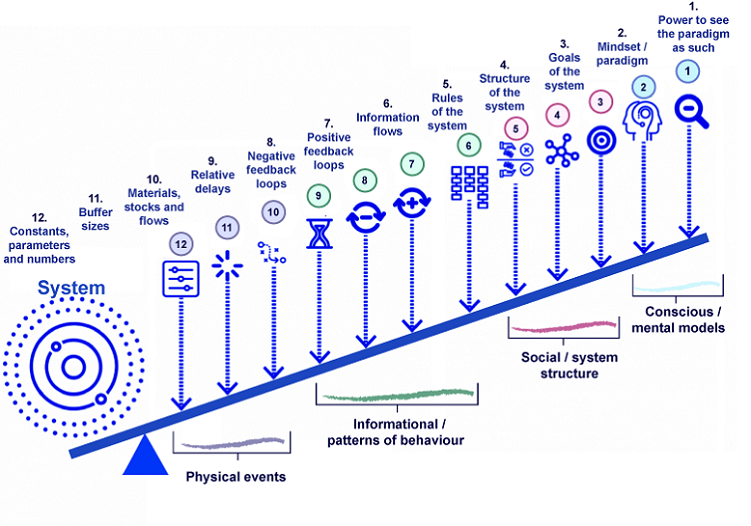
Meadows (1999) posits that there are several opportunities to intervene in a system but, society tends to only focus on ones that are familiar in terms of what is observed and understood and that resonate with known ways of evaluation and decision making. In broad terms this links to quantitative, visible stocks and resource flows and feedback that can be measured (in numerate ways), analysed and redistributed.
Figure 3 shows the points of intervention Meadows describes, with the current system on one side of the fulcrum, and points of system intervention reaching out on the other side. The nearer the intervention to the fulcrum, the less impact it has on changing system parameters (e.g. a force pushing down near the fulcrum has negligible impact on the system on the other side). Conversely, intervention opportunities far away from the fulcrum, once initiated, can make significant differences in system organisation where forces pushing down at the far end of the lever have greater impact (e.g. there is more leverage for pivoting the system to a different position (or paradigm)). Meadows shows that even small interventions can provide shifts in paradigms and many small changes at the right point in a system can have a big impact:
Paradigms are the sources of systems. ... There’s nothing necessarily physical or expensive or even slow in the process of paradigm change. In a single individual it can happen in a millisecond. All it takes is a click in the mind, a falling of scales from eyes, a new way of seeing. Whole societies are another matter. They resist challenges to their paradigm harder than they resist anything else.
A takeaway here is that change is impossible (or at least immeasurably difficult) if we try and make change in contexts where success, or not, is measured by existing ways of knowing and valuing.
Sterling’s call for a wisdom revolution is poignant in terms of creating new ways of seeing, being and doing, and in our case, of reframing education as sustainability (rather than just learning about it). So, the ‘how’ of change is going to require not only new knowledge but also the mechanisms, structures, organisation, policy, processes and communities to generate new curricula and learning practices that reflect the social system structures and conscious mental models of a new ecological paradigm.
Transformations in the way things are done depend on transformations in the way things are understood – in the worldview or perspective assumptions that condition those understandings.
This is a transition in practice.
Activity 6.2 Characteristics of transformative learning experiences
3.  Share three opportunities or barriers to transformative education practice or policy with your peer online learners on the Activity 6.2 forum discussion [Tip: hold Ctrl and click a link to open it in a new tab. (Hide tip)] .
2 Exploring a transformative approach to learning