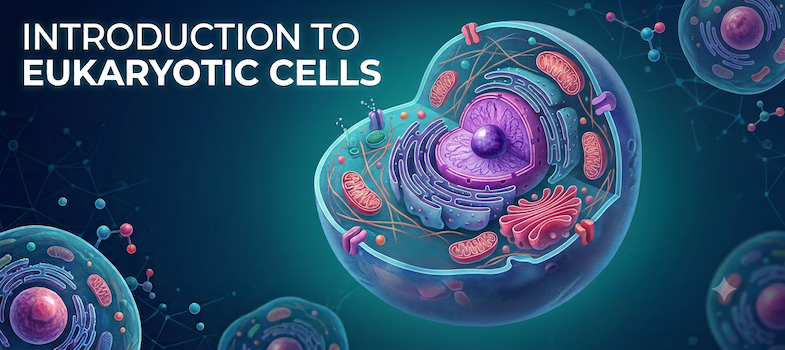
A. Introduction to Eukaryotic Cells
1. Cells and Types of Cells
The cell is fundamentally defined as the basic unit of independent life. A cornerstone of biology is the principle that all independent living organisms are fundamentally composed of cells. Despite the vast diversity of life, cells across all domains are constructed from the same basic kinds of molecules, which are characteristically assembled in highly similar arrangements. The study of cells is a critical and active area of research.
Other biological entities, specifically viruses, viroids, and prions, while very relevant and related, are generally not considered independent living organisms because they lack the capacity for independent life, requiring a host cell to carry out metabolic and reproductive functions.
Living cells are broadly classified into two primary architectural types:
- Prokaryotic Cells: These are typically smaller and simpler in structure, usually lacking internal membrane-bound organelles and lacking a defining feature of higher life: a true nucleus. Despite their simplicity, prokaryotes are biochemically diverse and highly efficient, often characterized by rapid metabolic rates.
- Eukaryotic Cells: These cells are substantially larger and more complex, containing numerous and extensive internal membrane-bound organelles. The essential distinguishing characteristic is the presence of a true nucleus. This complexity enables a much higher capacity for both specialization and differentiation, a feature that is absolutely necessary for the formation of multicellular organisms.