

How places affect well-being
Introduction
Welcome to this short course looking at the relationship between places and well-being. Before you get stuck into the research in this area, start with the first activity.
Activity 1: Emotion mapping
Emotion mapping is a technique used in both therapy and research to understand how people relate to the places they live in. Have a go at producing an emotion map yourself following the instructions below.
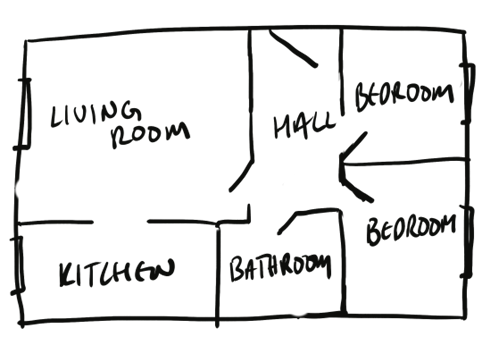
2. Now think through a typical week in your home. Pick up to three emotions represented by the emoticons below, representing laughter, happiness, indifference, sadness, upset, grumpiness/anger, and love/affection. Now draw these emoticons on your map, in the places where you remember feeling the emotions you have chosen.

3. Now look at where you’ve placed your emoticons. Are there any patterns? What might this tell you about how the way that people feel is influenced by their environment?
Comment
In the original study this task is based upon, the sociologist Jacqui Gabb asked families to complete this task over the course of a week. She found that the families reported different emotions happening in different parts of the house.
Arguments, for instance, were particularly likely to happen in the doorway of teenager’s bedrooms. Both arguments and strong positive emotions happened in the kitchen and shared living spaces. You can probably think of some reasons why this might be. A teenager’s bedroom is an important territory for them and the doorway is a border between the shared space of the home and the teenager’s own territory. Living rooms and kitchens are more communal spaces, whereas bedrooms might have more experiences of contentment and calm, but fewer joyful or fun experiences.
What this kind of exercise demonstrates is the way in which people’s emotions and psychological experiences are located. The way that people feel is not only driven by their internal thoughts and feelings, but also is made possible, shaped and limited by the environments that people live in.
In this course you will learn about some of the evidence from psychology and other areas of research that has tried to understand the relationship between places and how people feel.