

1.1 Neighbourhoods
Some of the earliest research indicating that the neighbourhood someone lives in can influence their mental health was done in Chicago, US in the 1930s. Like a lot of the evidence about what kinds of effects places have on people, this research looked at people’s experiences of mental health problems, rather than more positive experiences of well-being. This is a general bias in psychological research, which tends to focus on negative experiences.
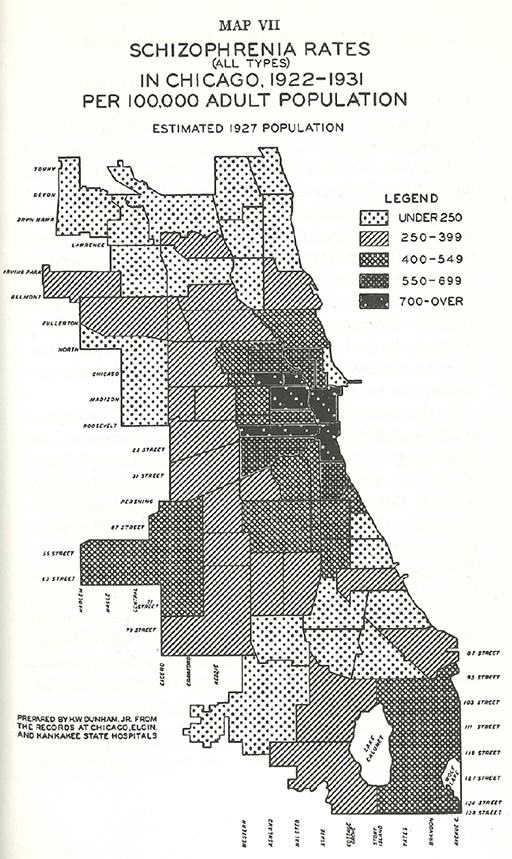
Faris and Dunham (1939) mapped the incidence of schizophrenia, a serious mental health condition, across the city of Chicago. They found that these people diagnosed with schizophrenia were concentrated in some areas of the city. Complete the activity below to explore their work in more detail.
Activity 2: Schizophrenia in the city
Below is the original Faris and Dunham map of Chicago. Where are the most incidents of schizophrenia? What kinds of areas do you think these might be?
Comment
Faris and Dunham identified that people diagnosed with schizophrenia were most likely to live in the central areas of the city, and that incidence decreased in the outer suburbs. This pattern has been found in many other places across the world in subsequent studies. In 2012, researchers looked at all the available data from studies looking at urban areas and schizophrenia incidence together, in a type of study called a ‘meta-analysis’. They found that when all the data was combined together, the risk for developing schizophrenia was 2.37 times higher in the most urban environments compared to the most rural environments.
There are a few possible explanations for this pattern. You may be thinking that poverty is an obvious explanation for mental health issues being more centred in the inner city. It is well known that there is a ‘social gradient’ in mental health diagnoses, meaning that people who are poorer are more likely to experience mental health difficulties. Poorer people are also more concentrated in inner-city areas. A limitation of this explanation, however, is that there is also a lot of poverty in rural areas, but the same level of poverty in a rural area does not seem to translate into the same risk for schizophrenia.
Another explanation could be that people who are diagnosed with schizophrenia might become poor due to their difficulties, and might end up in poorer urban areas, elevating the numbers. This is known as the ‘social drift’ hypothesis. People with serious mental health problems certainly do face difficulties with employment and are poorer on average.
There is, however, also evidence that the conditions of the neighbourhood itself play a role, independently of these personal factors. A Danish study that tracked people from birth found that being born in an urban inner-city area increased a person’s chance of developing schizophrenia in adulthood by 2.4 times, compared to being born in a rural area (Mortenson et al., 1999). This figure of between two and two and a half times more likely to develop schizophrenia is pretty much consistent across all studies that have looked at the relationship between urban areas and serious mental health issues (Pignon et al., 2023).
In the later sections of this course, you will explore some of the ways that researchers think that places impact mental health – both negatively, as seen in this example, and positively. First, you can learn in the next section about some more specific features of buildings and design that have been found to influence how people feel when living in their homes.