

Find out more about The Open University's Health and wellbeing courses and qualifications.
Mental health difficulties during pregnancy and early parenthood (perinatal period) represent a significant public health issue. Many parents remain unheard, misunderstood, or fearful of disclosing their experiences. This article brings together the voice of parents, clinicians and academics to explore how we can better support parents during the critical ‘1001 days’ – the period from conception to a child’s second birthday – for lifelong health and wellbeing (Leach, 2018).
The most recent published prevalence data indicates that 26% (national average) of women/birthing people will experience perinatal mental health conditions (Office for Health Improvement & Disparities, 2025). If left untreated, mental health issues can have significant negative and long-lasting effects on the woman, the child, and the wider family (Office for Health Improvement and Disparities, 2022; Howard & Khalifeh, 2020; Stein et al., 2014). Figure 1 shows the detailed breakdown of age ranges.
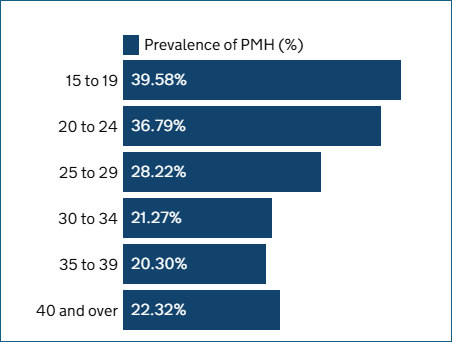
Figure 1 Perinatal mental health condition prevalence (%) by age 15 to 55 inclusive (2016)Age 15-19: 39.58%; 20-24:36.79%; 25-29: 28.22%; 30-34: 21.27%; 35-39: 20.30%; 40 and over: 22.32%
Parents with lived experience often describe thoughts that feel intrusive, frightening, or alien. Some hear voices or experience confusion that disrupts daily life and relationships. One parent explained:
'Internally I would be screaming but no one could hear me. My thoughts were not my own, and I was too scared to tell anyone.'
Fear plays a central role in non disclosure (Biggs et al., 2023). Parents worry about judgement, blame, and child removal. This fear is not irrational; it is shaped by stigma, misinformation, and previous experiences of not being believed. Research suggests that a significant proportion of parents minimise or conceal symptoms, delaying access to care and increasing risk for both parent and child.
Perinatal mental health difficulties include anxiety disorders, depression, OCD, PTSD, and postpartum psychosis (Howard and Khalifeh, 2000). These experiences exist on a spectrum from mild to severe and require different forms of support. What they share, however, is the need for early recognition, relational safety, non judgemental responses and a community approach that is built on trust.
Compassionate support begins with listening
Listening does not mean fixing, reassuring, or explaining away distress. Parents consistently report that well intentioned responses such as 'This is normal' or 'Just try to enjoy it' or 'Everyone gets the baby blues' can feel invalidating. Instead, supportive responses involve curiosity, openness, and respect for the parent’s meaning making.
Helpful questions include:
- 'Can you tell me more about what that’s been like for you?'
- 'What worries you most right now?'
- 'What kind of support would feel safest?'
 Supporters – whether professionals, colleagues, or family members – also need to understand the wider context. Early parenthood is a time of intense neurological development for infants, with over one million neural connections forming each second in the early years (Harvard Center on the Developing Child, 2026). Supporting parental mental health is therefore also an investment in long term family wellbeing.
Despite rising demand, perinatal mental health services across the UK have faced significant funding pressures. This places greater responsibility on all structures around the new parents such as health care, social care, education, workplaces and communities, to respond thoughtfully and collaboratively (Royal College of Psychiatrists, 2025).
Effective support is rarely delivered by a single service. It relies on joined up working, clear signposting, and shared responsibility. Community-based and peer-led services play a vital role, particularly for parents who may mistrust statutory systems or feel excluded from traditional care pathways. Peer support, grounded in lived experience, can reduce isolation and shame while offering hope. Local services such as Connected (available in Derby) and UK-wide partnerships such as Hearts & Minds demonstrate the value of co-produced approaches that recognise the diversity of family experiences.
Boundaries also matter. Supporting parents does not mean carrying everything alone. Knowing when and how to encourage additional support is a key skill. Framing referrals as acts of care, rather than escalation or failure, helps build trust.
Above all, compassionate support recognises that parents are experts in their own lives.
When their voices are kept at the centre of discussion and decisions, and relationships with professionals are authentic and collaborative, outcomes for parents and child improve.
This article includes contributions from parents with lived experience, professionals from a perinatal mental health service, academics from Nursing, Social Work and Early years across two universities, including:
- Megan Harrison: Mother of 3 with lived experience of postnatal depression, 7 years on I am still recovering with the help of family and professional services. Finding the light.
The mental health and wellbeing collection (Wales) provides a hub of free, bilingual resources that aim to promote positive wellbeing and support good mental health.
Level: 1 Introductory
Discover our Wellbeing and mental health collection...
Wellbeing and mental health collection

Over the past century there has been a radical shift in responses to people who experience mental health problems. In this free course, Making sense of mental health problems, you will learn about how key perspectives in the field have made sense of mental health problems. By directly relating key perspectives to a case study, you will reflect ... Each year thousands of pounds are spent on medications to treat conditions such as anxiety and depression. These medications often have negative side effects. Exercise is an alternative treatment that is low cost and has few side effects. In this free course, Exercise and mental health, we will look at the links between exercise and improved ... In this free course, Mental health in society, you will explore and critically reflect on mental health. You will explore the relationship between the lived experiences of individuals, and the society and environment in which they live. Different perspectives, approaches and models of understanding and critiquing mental health will be explored ...Discover our FREE courses on mental health
Making sense of mental health problems

Exercise and mental health

Mental health in society

Rate and Review
Rate this article
Review this article
Log into OpenLearn to leave reviews and join in the conversation.
Article reviews