

Valentine’s Day, with its excess of cards, plastic and fluffy hearts, may be a modern, commercialised institution, but its origins go far back, and sometimes can be found in unexpected circumstances. Although some celebrations and traditions can be traced to Roman times, it was during the nineteenth century that the modern-day customs began to take shape. Cards began to be produced commercially, and the exchange of tokens, gifts and flowers became widespread.
My own work, as a Professor of Music, considers life in nineteenth-century mental health institutions, most recently centring on the Crichton Royal Institution in Dumfries, Scotland. My particular focus is on the use of music, with both social and therapeutic functions. Here, I’ve found programmes for annual Valentine’s concerts starting in the late-1840s which both demonstrate some of the repertoire in popular use at the time and illustrate some of the customs around the day itself. Under the Crichton’s superintendent W.A.F. Browne, the institution aimed to act as a microcosm of normal social experience, and so we might imagine some of these customs mimic common practice in 1840s Scotland.
The first mention of St Valentine’s Day celebrations comes in the Crichton’s in-house patient magazine, The New Moon. In March 1848 it recorded the following:
St. Valentine’s Eve was celebrated by us somewhat in imitation of a practice in vogue during the Roman Lupercalia, when the names of the young women were put into a box, and drawn out by the young men; with this difference, that, although we had the box, the prizes were dissimilar, and the ladies, equally with the gentlemen, anxious for a draw. The mirth occasioned at the long face of a swain, who, supposing that, like Pandora’s box, the best prize lay at the bottom, nevertheless discovered he had drawn a bland; the laughter at another, who beheld himself travestied in a caricature; and the joy of some fair lady at the beauty of the valentine which had fallen to her lot, made up a scene, between the parts of a concert which was given in honour of the Saint, which must have delighted every beholder. The corps musicale had very serious misgivings, as to whether the fun would ever cease, and very nearly came to the conclusion that the further display of their powers must be postponed. But they were wrong; and, at the finish, the following extemporaneous compliment by one of the auditory was handed up to them:-
“Some sing for money, and some for glory,
But you sing here all con amore.”
And so the fun was over. But the amusement was so delightful, and the cogitations consequent thereon so pleasant, that, upon retiring, we were led to exclaim –
“Pause and reflect
That a day like this may never dawn again.”
The magazine records that a Drawing-room concert was given to mark the occasion, but no programme survives.
The earliest preserved programme of a Valentine’s Day concert is from the following year, 1849. The New Moon recorded on 3 March that 14 February saw ‘Concerts and Festivities [as] usual on St. Valentine’s Night’. The concert programme centres on Scottish and popular song, bookended by piano duets and small ensemble pieces. The repertoire is similar to other concerts performed at the Crichton, with little to reflect the special occasion.
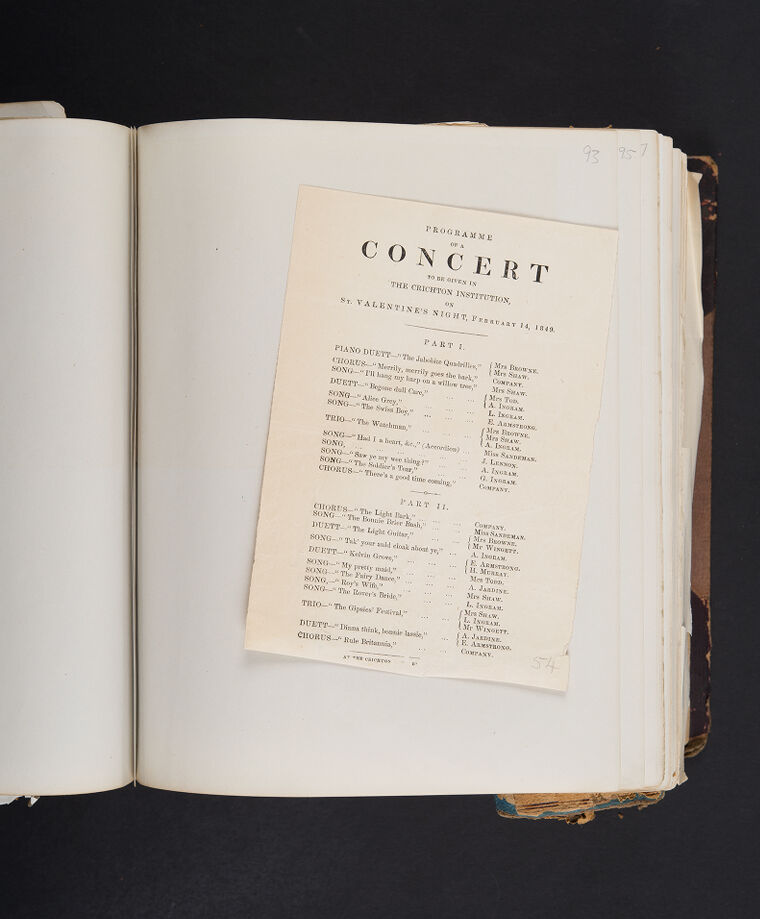 Concert programme, 14 February 1849.
(Recreation and Printing Scrapbook. Source: Wellcome Collection; https://creativecommons.org/licenses/by-nc/4.0/)
Most of the performers here are staff of the institution; Mrs Browne, wife of the Superintendent, regularly contributed piano duets with Mrs Shaw, a local piano teacher and organist. Nevertheless, we might imagine patients joining in well-known songs and choruses.
The concert tradition continued into the 1850s, with the gradual introduction of repertoire more closely reflecting the theme of the day, such as the song ‘O my Love’s Bonny’, the Trio ‘Twas on the Morn of Valentine’, the glees ‘Here’s a health to all good Lasses’ and ‘To all ye Ladies’, the song ‘The Old Maid’s Love Letter’, and the humorous song ‘Scotch Wooing’. The concerts also included the practice of exchanging or delivering valentine’s cards and gifts. In 1855, for example, the programme notes that immediately before the interval, the ‘Post Delivers Valentines’.
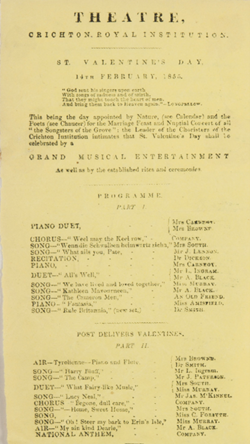
Concert programme, 14 February 1855.
(Recreation and Printing Scrapbook. Source: Wellcome Collection; https://creativecommons.org/licenses/by-nc/4.0/)
At the Crichton the emphasis was clearly on fun, entertainment and community rather than the celebration of couples we see today. Nevertheless, they ensured all patients had an opportunity to take part in traditional revelries, reinventing practices and developing new ones to provide, as far as possible, a positive experience for patients and staff alike.
See more of our Valentine's content in our OpenLearn Valentine's collection.
Read more articles like this
-
How can the arts improve health and wellbeing?
Read now to access more details of How can the arts improve health and wellbeing?What evidence is there supporting the potential of the arts to aid health and wellbeing in both formal and informal settings?

-
Music and mental health: the parallels between Victorian asylum treatments and modern social prescribing
Read now to access more details of Music and mental health: the parallels between Victorian asylum treatments and modern social prescribingDid you know that doctors were exploring the links between mental health and music back in the Victorian era? This article explains more about musical treatments in the asylum.

-
What were Victorian pauper's graves like?
Read now to access more details of What were Victorian pauper's graves like?An account of a tragedy in a London graveyard gives an insight into the way the poor were buried in 19th Century England.
Like this? Try a FREE course
-
What do historians do?
Learn more to access more details of What do historians do?What do historians do? In this free course you will explore some of the ways that historians work to develop our understanding of the past. You will learn about three aspects of the historian’s craft through three topic areas: landscapes, infant health and criminal justice. Through the activities in the course, you will experience a wide range ...

-
History of reading: An introduction to reading in the past
Learn more to access more details of History of reading: An introduction to reading in the pastThis free course, History of reading: An introduction to reading in the past, consists of a series of essays, drawn from material contained in the Reading Experience Database, that illustrate different aspects of reading in Britain during the period from 1450 to 1945. These essays are designed for you as the reader to dip in and dip out, ...

-
Introducing music research
Learn more to access more details of Introducing music researchIntroducing music research provides you with insights into the wide variety of possibilities for studying music at postgraduate level. In this free course you will explore diverse musical topics through four themes: inclusions and exclusions, practice, technology, and community. You will encounter music from different times, places and genres ...

Rate and Review
Rate this article
Review this article
Log into OpenLearn to leave reviews and join in the conversation.
Article reviews