
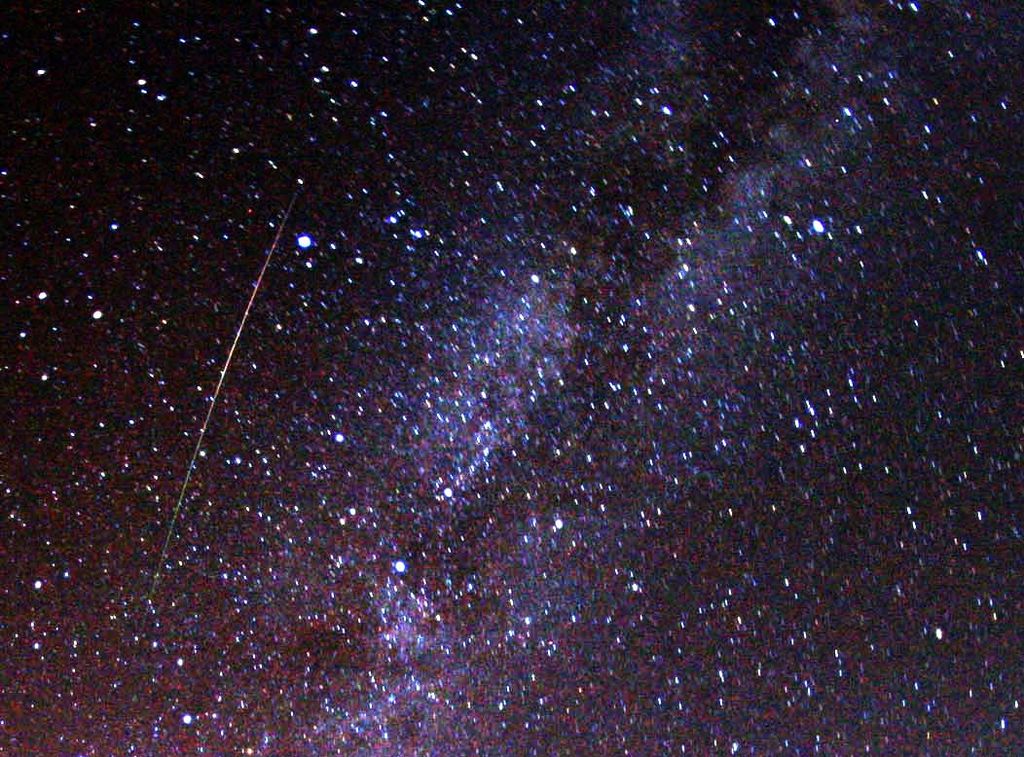
 The Perseid meteor shower is one of the highlights of the astronomical calendar, appearing each year during July and August as Earth passes through a trail of debris left behind by Comet 109P/Swift-Tuttle.
In 2026, the Perseids are active between 17 July and 24 August, reaching their peak overnight on 12–13 August.
And this year, conditions are particularly favourable. The peak coincides with a New Moon, meaning there will be very little moonlight to interfere with the view. From a dark location with clear skies, observers could see dozens of meteors an hour, with some estimates suggesting considerably higher rates under ideal conditions.
Despite their name, ‘shooting stars’ aren't stars at all. Meteors are caused by tiny pieces of dust and rock entering Earth's atmosphere at extremely high speeds. As they travel through the atmosphere, the air around them heats up, creating the bright streak of light we see from the ground.
The Perseids get their name from the constellation Perseus, because the meteors appear to radiate from a point in this part of the sky. This is an effect of perspective: the particles themselves are travelling along roughly parallel paths.
How to see the Perseids
You don't need a telescope or binoculars to watch a meteor shower – in fact, the naked eye is best because it allows you to take in as much of the sky as possible.
For the best chance of spotting a Perseid:
- find somewhere dark, away from streetlights and other artificial light
- choose a spot with a wide, unobstructed view of the sky
- give your eyes around 20–30 minutes to adjust to the darkness
- look up and be patient – meteors can appear anywhere across the sky.
The later it gets, the higher Perseus rises in the sky and generally the more meteors become visible, making the hours after midnight and before dawn particularly good for viewing.
With dark skies provided by the New Moon, 2026 should be an excellent year to look out for the Perseids – as long as the British weather cooperates.
Test your knowledge on meteoroids with this game
-
Meteoric
Take part now to access more details of MeteoricRocks hurtling through space shape the surface of the moons and planets as collide – and now you can use your skill and knowledge to make your own mark. Can you cover a target percentage of a planet or a moon’s surface with impact craters – by choosing meteroids based on size, make-up and speed and aiming them at your chosen target.

Level: 1 Introductory
Meet Perseus - the man who inspired the name 'Perseids'
-
Perseus: what’s in a name?
Read now to access more details of Perseus: what’s in a name?As the Perseid Meteor Shower reaches its annual peak, Dr Joanna Paul, a Lecturer in Classical Studies, lifts the lid on the details behind its namesake, Perseus, a mythological character whose story has been told time and time again.

Level: 1 Introductory
Discover how to find your own meteorite
-
Meteorite - or Meteor-wrong?
Read now to access more details of Meteorite - or Meteor-wrong?There's a simple test which can tell if you've found a rock - or something extra-terrestrial, explains meteorite hunter Rob Elliott
Level: 1 Introductory
What have meteors and iron got to do with Egyptian beads?
-
Iron from the sky: Meteors, meteorites and ancient culture
Read now to access more details of Iron from the sky: Meteors, meteorites and ancient culture3-4 January 2023 will see the peak of the Quadrantid meteor shower. What’s the connection between meteors, iron and Egyptian beads? Dr Diane Johnson, a Post Doctoral Research Associate in the Faculty of Science, explains more about ‘iron from the sky’.

Level: 1 Introductory

Rate and Review
Rate this article
Review this article
Log into OpenLearn to leave reviews and join in the conversation.
Article reviews