

Find out more about The Open University's Computing and IT courses and qualifications.
Artificial intelligence (AI) is everywhere. It powers voice assistants like Siri and Alexa, and chatbots like ChatGPT, Gemini and Claude. Every time you ask a question or make a request to an AI assistant, a computer somewhere in the world springs into action to process it. And that comes at a cost. A single ChatGPT query uses around 2.9 watt-hours of electricity, about ten times more than a standard Google search (0.3 watt-hours). With hundreds of millions of queries sent every day, it all adds up fast.
The UK's AI tools and data centres used around 3.6 TWh of electricity in 2020, roughly 1.3% of the country's total electricity consumption, equivalent to powering around one million homes for a year. By 2030, that figure is expected to exceed 70 TWh, enough to power over 20 million homes. That is nearly a quarter of the UK's entire electricity use, just to keep AI running.
So how do we keep advancing AI without the planet paying the price?
Inspiration from the brain
Our brain is made up of billions of cells called neurons, connected to each other through junctions called synapses. When you learn something, those connections strengthen. When you forget, they weaken. As shown in Figure 1 below, the brain is essentially a vast network of these neurons. Scientists borrowed this idea to build artificial neural networks (ANN), the mathematical backbone of almost every AI model in use today.
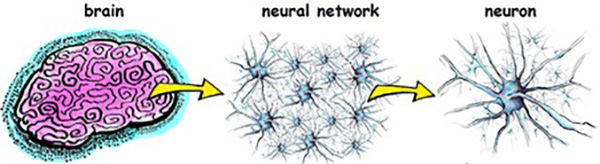 Figure 1 From brain to neural network to neuron. Image source: Frontiers for Young Minds
The irony is that even though AI was inspired by the brain, the hardware running it looks nothing like one. Your brain runs on about 20 watts, which is less than the power to power a light bulb. The brain, optimised by millions of years of evolution, achieves efficiency by storing and processing information in the same place, at the synapse. Conventional computers keep these two tasks separate, resulting in a bottleneck limited by data speed transfer and consuming a huge amount of energy. Scientists call this the ‘Von Neumann bottleneck’, and it is one of the main reasons AI is so power-hungry.
The logical solution? Build hardware that actually works like a brain, not just software that thinks like one.
Neuromorphic computing
Instead of running brain-inspired software (ANN) on conventional hardware, neuromorphic computing is a hardware replication of our brain's neurons and synapses, emulating how the brain passes and processes information. Memory and processing happen in the same place, just as neurons and synapses do. The core building block of any neuromorphic chip is a device called a memristor, a portmanteau for memory resistor.
A memristor is a tiny electronic component that behaves a bit like a synapse. It can change its electrical resistance when a voltage is applied, and it remembers that change even after the power is switched off.
This is useful because:
- it can store information without needing constant power
- it can process and store data in the same place, just like a synapse.
An array of memristors, if scaled properly, could run AI tasks using a fraction of the energy needed today. This is an elegant solution: the software that was once inspired by the brain, now running on hardware that mimics it too.
Neuromorphic computing is not just a theory. Intel's Loihi chip and IBM's TrueNorth have already built working brain-inspired chips, proving the concept is technically feasible. At the heart of these chips are memristors, the tiny components that act as artificial synapses. The next big challenge is finding the right material to build them from.
Memristor materials
A good memristor material needs to be reliable, low-power, and easy to manufacture. Researchers are exploring several promising materials for memristors, including metal oxides, phase-change materials, and ultrathin nanomaterials. One of the most exciting ultrathin nanomaterials is MXene, sheets of material just a few atoms thick that conduct electricity well and whose properties can be tuned by tweaking their surface chemistry. As you can see in Figure 2 below, MXene naturally forms an accordion-like layered structure. These layers can be peeled apart into individual sheets, each just a few atoms thick, which can then be used to build incredibly small devices.
 Figure 2 SEM image of Ti₃C₂Tₓ MXene showing the characteristic accordion-like layered structure
The bigger picture
Neuromorphic computing will not replace your laptop tomorrow. There is still significant work to be done before brain-inspired chips are ready for widespread use. But the direction is clear: if we want AI to scale without the energy cost scaling alongside it, we need hardware that thinks a little more like a brain.
Materials like MXene are helping make that possible, one small device at a time.
Read more articles like this
-
STEM postgraduate research
Learn more to access more details of STEM postgraduate researchThis content hub highlights the diverse range of topics explored by postgraduate research students in STEM (Science, Technology, Engineering and Mathematics) at The Open University.
Visit our AI hub
-
AI Hub
Learn more to access more details of AI HubWelcome to the AI Hub from Microsoft and The Open University. Explore free, accessible courses designed to build your confidence and skills in artificial intelligence. Whether you’re just starting out or looking to deepen your knowledge, the AI Hub supports your learning journey with expert-led, trusted, easy to-use resources.

Try a FREE course
-
An introduction to artificial intelligence
Learn more to access more details of An introduction to artificial intelligenceArtificial Intelligence represents great opportunity, but also significant disruption for modern societies and cultures. This course investigates the historical, ethical and social issues surrounding this technology. It is aimed at people interested in understanding where this technology has come from, the kinds of opportunities it brings to ...

-
AI fluency
Learn more to access more details of AI fluencyAI fluency is a beginner-friendly learning path designed to build confidence and understanding in artificial intelligence. Through a series of practical sessions, learners explore AI fundamentals, generative AI, responsible AI principles, and the real world impact of AI across work, accessibility, and society. The course also introduces ...
-
An introduction to computers and computer systems
Learn more to access more details of An introduction to computers and computer systemsThis free course, An introduction to computers and computer systems, challenges how we view computers through the examples of processors in kitchen scales and digital cameras, as well as examining the work of art that, at heart, is a computer. You will also explore how computers are connected together to achieve even more than when working alone.

Rate and Review
Rate this article
Review this article
Log into OpenLearn to leave reviews and join in the conversation.
Article reviews