
Understanding the 1826 Weavers Uprising and Chatterton Massacre is essential to understanding the broader history of early industrial Britain and the struggles faced by working people in the Northwest of England.
This significant historical event saw the mobilisation of thousands of people across Pennine Lancashire and West Riding of Yorkshire in late April, and early May 1826 focused on the destruction of power looms. Over 1100 power looms were broken in Lancashire alone during these April days.
The property destruction arose in the context of the very real fear of mass starvation and the long-term threat of the power looms to the handloom weavers’ way of life. While the local authorities had some sympathy for the weavers’ plight, there was little tolerance of social disorder, and the loom breakers were met with the full force of the law.
The aim of the Rise Up! project is to give voice to those that have previously been silenced or ignored and help to visibilise state violence that has long been mystified or forgotten.
Witnessing the Rising Interactive Map
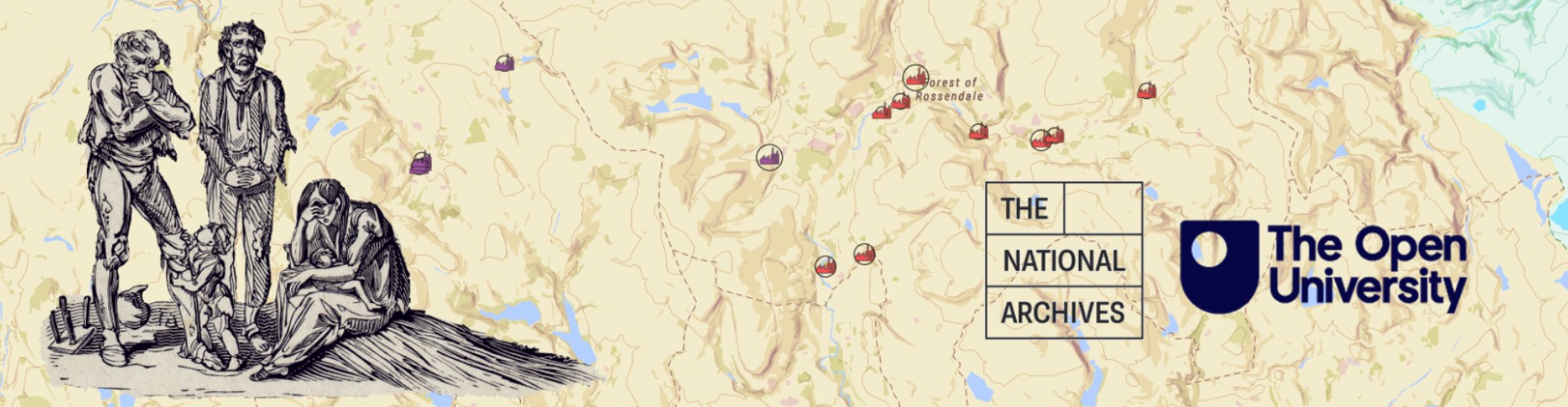
Made in collaboration with The National Archives, a new interactive map has been created that provides not only a detailed context and overview of the 10-day uprising, but also maps out the destruction of over 1100 power looms at 38 different mills.
The map also showcases historical records from The National Archives (UK) to raise public awareness of the weavers’ rising of 1826. This includes previously lost eyewitness testimonies from the Chatterton Massacre inquests and over 100 legal depositions that were taken by local magistrates at the time.
The interactive map was launched in May 2026 to mark the 200-year anniversary of the rising and aims to contextualise this important moment in British history by making it easier to understand and engage with. The interactive map is to be accompanied by learning resources and lesson plans for secondary school children.
Click here to explore the digital mapping project created by The National Archives and The Open University: Witnessing the Weavers’ Rising of 1826 map
The Teaching Toolkit
The story of the 1826 weavers uprising reveals how protest has long been part of British history and how social change has often come at great cost. At present, events like the uprising and its brutal repression – notably the Chatterton Massacre – are not part of the compulsory primary curriculum.
Younger people in Pennine Lancashire and elsewhere for generations have missed the opportunity to explore this important story. Yet, learning about such tragic yet historically significant events helps children make sense of their local history and deepens their understanding of democracy, justice, and equality.
This educational resource has been developed by The Open University to support primary teachers in introducing this complex but vital subject to primary-aged children in an age-appropriate and meaningful way.
This teaching toolkit – Educational Resource for Young People – Rise Up! The Lancashire Weaver's Rising and Chatterton Massacre – covers the objectives of the National Curriculum across a range of subjects, including History, English, PSHE and Art. It is specifically aimed at pupils in Upper Key Stage Two (9–11 year olds), however it can be differentiated to include pupils with additional needs and can also be useful for teaching older children and young adults.
Chatterton: Riot, Fight or Massacre?
On 26 April 1826, the picturesque village of Chatterton was the site of one of the most contested moments in British industrial history. On that day, 20 soldiers from the 60th Duke of York Own Rifles and 15 Queen Bay Cavalrymen fired somewhere between 400–600 bullets into a crowd of 3000 anti-starvation protestors.
At least six people – James Lord, John Ashworth, Richard Lund, James Rothwell, Mary Simpson and James Waddicar – were shot dead by soldiers and several others seriously wounded. No one knows for sure the exact numbers of those who died – newspapers reported that 3 more bodies were found in the woods the following day, and the names of those who may have later died of their wounds have never been recorded.
Only seven years after the infamous Peterloo Massacre, 16 August 1819, the indiscriminate deaths of Chatterton were for a long time a kind of historical secret, lost to public memory.
In the documentary ‘Chatterton: Riot, Fight or Massacre’, Dr David Gordon Scott explains what happened on the 26 April 1826 and how the Chatterton Massacre was hidden in plain sight for two centuries.
Chatterton: Acknowledging the Truth
Click here to find out more about The Open University Rise Up! Open Societal Challenge
Explore related content on OpenLearn
-
The Tulsa Race Massacre
Read now to access more details of The Tulsa Race MassacreThe Tulsa Race Massacre of 1921 saw between 39-300 people killed and 10,000 African Americans made homeless after two days of state violence. So why have we only begun to hear about this recently? Dr David Scott explores.

-
Abolitionism must come from below: A critique of British Anti-Slavery Abolition
Read now to access more details of Abolitionism must come from below: A critique of British Anti-Slavery AbolitionDavid Scott argues that contemporary penal abolitionists can take inspiration not from British liberal anti-slavery ‘abolitionism from above’ but from the lived experiences and testimonies of slaves and former slaves...

-
No place like home: Prisons and homelessness
Read now to access more details of No place like home: Prisons and homelessnessThe homeless and especially those who are rough sleepers, comprise a disproportionate number of people in prison in England and Wales. Dr David Scott looks at why prisons and the streets are not a replacement for a true home.

Rate and Review
Rate this article
Review this article
Log into OpenLearn to leave reviews and join in the conversation.
Article reviews