2. Exploring Competencies in depth (Pg 2/2)
Click the arrow, top left, to go to the previous page
Click the arrow, top right, to go to the next page
Click the link below the image to view it in full screen
Click your browser's back button, top left, to exit full screen
Understanding Competencies for Career Development
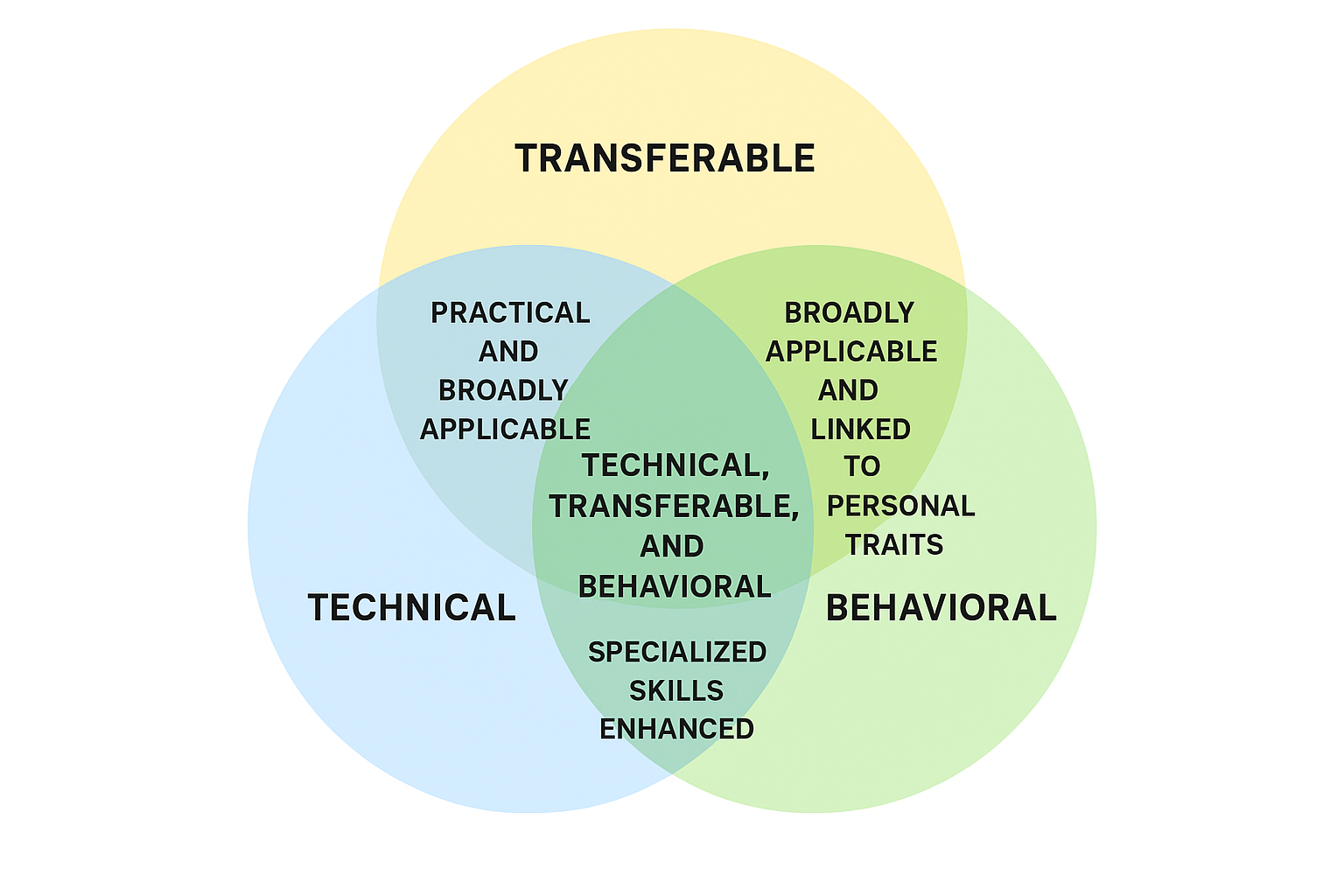
Developing a clear understanding of your competencies is important because it guides your career growth, makes you adaptable to change, and helps you stand out in the workplace. Competencies can be broadly divided into three types: technical, transferable, and behavioral, and as illustrated below its possible for a competency to include both technical and behavioural aspects. Recognizing each type and how they overlap (as illustrated below) can help you focus on building the skills that will support both your studies and your future career.
Click to view the image in full screen
Types of Competencies
Technical, behavioral, and transferable skills explained
These three main types are now briefly described:
🛠️ Technical Competency
Technical competencies are measurable skills or knowledge needed to perform specific tasks, usually learned through education, training, or hands-on experience. They are often job-specific and teachable.
Example: Using Excel for data analysis.
🤝 Behavioral Competency
Behavioral competencies relate to attitudes, interpersonal and intrapersonal skills, and how a person acts or interacts in different situations. They develop through real-life experiences and are transferable across many jobs.
Example: Demonstrating teamwork when collaborating with others.
🚀 Transferable Competency
A transferable competency (or skill) is a versatile ability, like problem-solving or communication, that you gain in one context (work, school, life) and can successfully apply to many different jobs, industries, or career changes.
Unlike job-specific skills, these core competencies are portable and signal your potential to learn and succeed in new environments.
Example: Critical thinking, teamwork, time management, leadership, and digital literacy.
Whether for yourself or helping students develop these competencies, it is important to be familiar with 21st century skills, which are key competencies many employers now look for when recruiting new employees.
Click here to go to the next page