Bringing it all together
Finally, we will look at how we can bring all of this together by using a Mentor Questioning Cycle.
Good mentors don't ask more questions—they ask better questions
Reinforce that the purpose isn't to turn every mentor meeting into an interview. Instead, questioning should be deliberate and linked to the trainee's stage of development.
Introduce a simple model they can remember, for example:
The Mentor Questioning Cycle
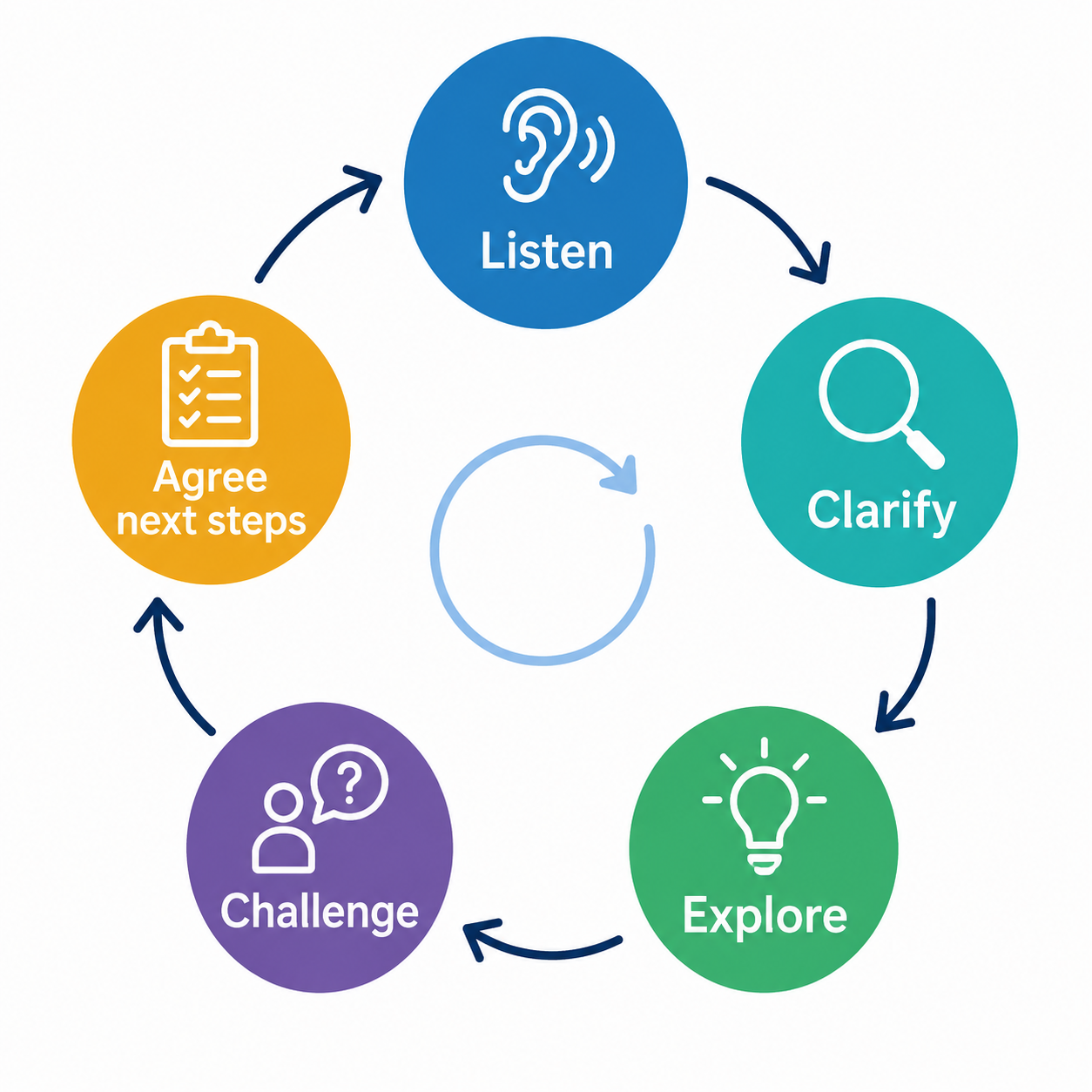
Let's briefly look at each point in turn.
Listen
Every mentoring conversation should begin with listening. Before asking questions or offering advice, the mentor should seek to understand the trainee's perspective. Listening provides the evidence needed to determine what level of support the trainee requires.
When a trainee requires greater support
You may need to encourage the trainee to describe what happened.
Mentor
"Talk me through the lesson from your perspective."
"How do you feel the lesson went?"
"Which part of the lesson are you thinking about?"
These questions encourage the trainee to begin organising their thinking.
When a trainee is becoming more independent
You can expect the trainee to begin the conversation with greater analysis.
Mentor
"Having reflected on the lesson, what stands out to you most?"
The trainee now takes greater responsibility for initiating the discussion, with the mentor listening carefully for evidence, misconceptions and opportunities to deepen reflection.
Clarify
Once the trainee has begun reflecting, you start to clarify their understanding before reaching any conclusions.
The aim is to gather evidence rather than make assumptions.
When greater scaffolding is needed
You may ask several linked questions.
"What were you hoping pupils would learn?"
"What did pupils do that made you think they understood?"
"Can you tell me a little more about that?"
These questions help the trainee organise their thinking and provide the mentor with a clearer picture of what happened.
As independence develops
You might begin reducing the number of prompts.
Instead of several questions, one carefully chosen question may be sufficient.
"What evidence supports your evaluation?"
The responsibility for explaining and justifying thinking now sits increasingly with the trainee.
Explore
Once you understand the trainee's perspective, questioning moves towards analysis.
The aim is to help the trainee understand why events occurred rather than simply describing what happened.
When greater support is needed
You might guide the trainee through the reflective process.
"Why do you think pupils found that activity difficult?"
"How do you think your explanation influenced their understanding?"
Here, you are helping the trainee make connections between teaching decisions and pupil responses.
As independence develops
You're going to expect the trainee to make these connections with less support.
"What patterns are beginning to emerge across your recent teaching?"
"How has your approach changed since we first identified this target?"
These questions encourage the trainee to synthesise evidence across multiple lessons rather than analysing isolated incidents.
Challenge
Effective mentors do more than encourage reflection. They also introduce professional challenge. Challenge should deepen thinking rather than simply point out weaknesses.
When greater support is needed
You might offer an alternative perspective through questioning.
"You mentioned pupils became distracted during independent work. What might have happened if they had seen one more modelled example?"
The question gently prompts the trainee to consider another possibility.
As independence develops
You increase the level of cognitive challenge.
"You've identified questioning as an area for development for several weeks. Why do you think this aspect of your teaching has been more difficult to improve than your classroom management?"
Rather than focusing on a single lesson, the trainee is encouraged to evaluate longer-term professional development.
Agree Next Steps
Finally, you and the trainee identify the most appropriate next step. The aim is to ensure that reflection results in deliberate improvement.
When greater support is needed
You might help prioritise the next target.
"Based on everything we've discussed, which area do you think would have the greatest impact on pupil learning?"
If required, tyou might then refine or narrow the target further.
As independence develops
Responsibility increasingly shifts to the trainee.
"What do you think your next developmental priority should be?"
"How will you know you've been successful?"
The trainee now identifies appropriate targets independently, with the mentor acting as a critical friend—challenging, refining and extending thinking where appropriate.
Key Message
The purpose of questioning is not to ask more questions.
It is to ask the right questions, at the right time, with the right level of support.
As trainees develop, mentors should gradually reduce the amount of structure they provide. This does not mean asking fewer questions; it means asking questions that place increasing responsibility on the trainee to analyse evidence, evaluate practice and identify future actions.
Ultimately, the aim of mentoring is to help trainees internalise this reflective process so that, over time, they begin asking these questions of themselves. At that point, questioning has achieved its greatest purpose—not simply improving a lesson, but developing an autonomous, reflective teacher.