
Using the ITTECF to Transform Feedback into Professional Learning
This section explores how the ITTECF can be used to transform feedback into professional development. We'll look at the importance of shared language before exploring how we can use the ITTECF to support your ability to deconstruct key developmental areas into manageable targets that support trainee development.
Feedback Needs a Shared Language
One of the challenges of mentoring is ensuring that feedback is both consistent and precise.
Without a shared professional language, feedback can quickly become vague.
For example, mentors frequently write comments such as:
- Improve behaviour management.
- Work on your questioning.
- Increase pupil engagement.
- Develop adaptive teaching.
Whilst these statements identify broad areas for development, they provide very little guidance about what the trainee should actually improve.
The ITTECF provides mentors with a common professional language that helps overcome this challenge. Rather than simply identifying an area of weakness, mentors can locate the relevant Learn that and Learn how to statements to identify the precise knowledge and technique that requires development. The ITTECF therefore moves feedback from being general to being specific, evidence-informed and actionable.
From Observation to Improvement
One of the most common misconceptions about feedback is that observations automatically lead to meaningful targets. In reality, there are several important stages between observing a lesson and agreeing a developmental target. Effective mentors should therefore think of feedback as a structured process.
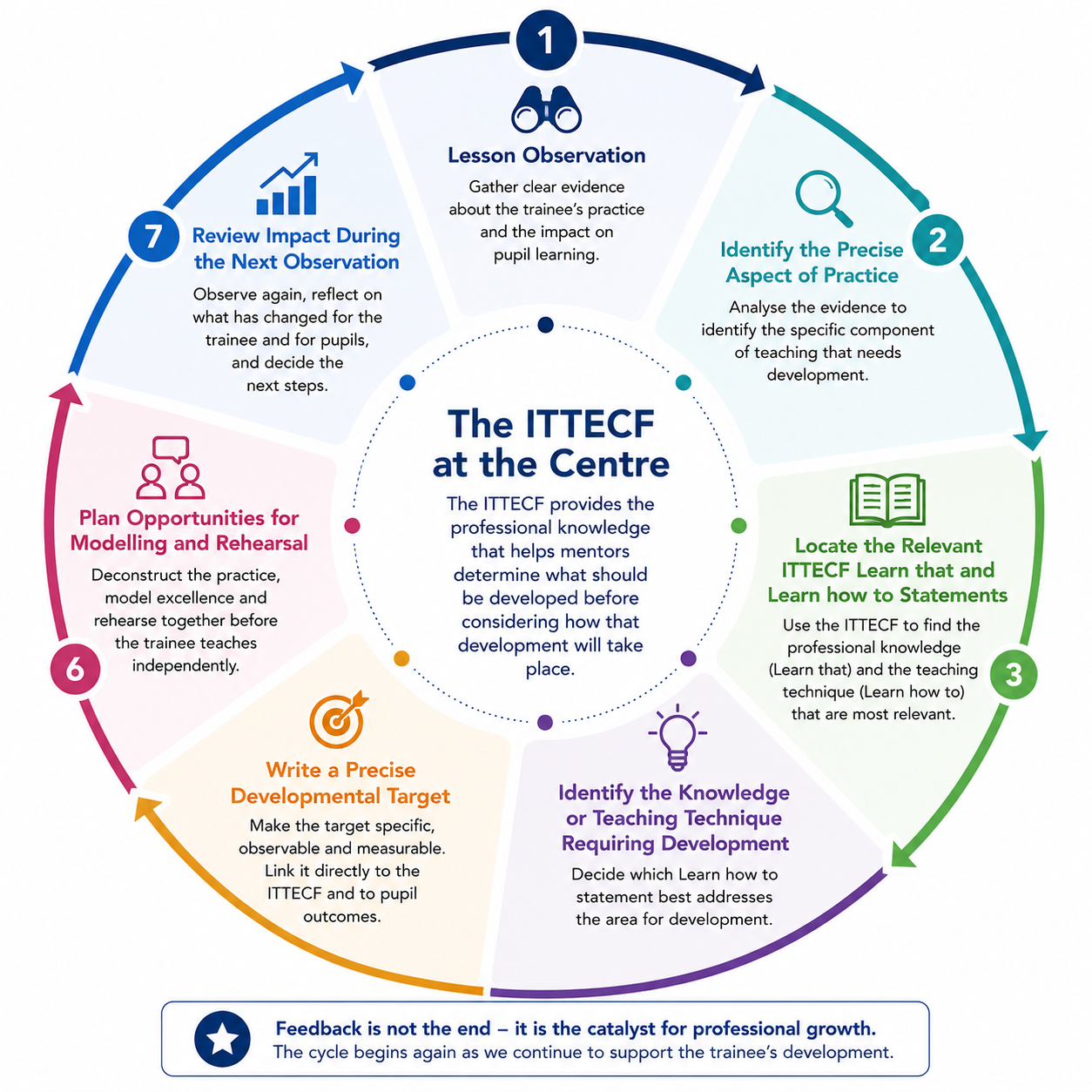
Notice that the ITTECF sits at the centre of this process.
It provides the professional knowledge that helps mentors determine what should be developed before considering how that development will take place.
Understanding the Difference Between "Learn that" and "Learn how to"
The ITTECF deliberately separates professional knowledge from professional practice.
Learn that
The Learn that statements describe the knowledge that trainee teachers should understand. They explain why particular approaches are effective by drawing upon educational research and evidence.
For example, a trainee might encounter a Learn that statement explaining that carefully planned questioning can reveal misconceptions and deepen pupils' thinking. Understanding this principle is essential. However, knowing why something matters does not necessarily mean a trainee knows how to apply it successfully within the classroom.
This is where mentoring becomes particularly important, and also where the 'learn how to' statements come in.
Learn how to
The Learn how to statements describe the observable professional practices that trainees should learn to implement. These statements are particularly valuable during mentor meetings because they translate research into practical teaching techniques.
Rather than writing a target such as:
"Improve questioning"
a mentor might instead identify the relevant Learn how to statement and agree a target based directly upon that practice.
For example, in an observation, you noticed that several pupils gave one-word answers throughout the lesson.
Relevant Learn how to statement
Plan sequences of questions which identify misconceptions and deepen pupil thinking.
Developmental target
Plan three questions within your next lesson that require pupils to explain or justify their thinking. We will review the quality of pupil responses during next week's observation.
Notice how the target has become:
- specific;
- observable;
- measurable;
- directly linked to the ITTECF; and
- focused upon improving pupil learning rather than simply changing teacher behaviour.
Using the Learn How Statements to Deconstruct Practice
One of the greatest strengths of the ITTECF is that it naturally supports deconstruction.
Teaching is complex. Novice teachers often attempt to improve several aspects of practice simultaneously. This can quickly become overwhelming.Instead, mentors should identify the smallest component of practice that is most likely to improve teaching.
For example, imagine the observation below.
Observation
In the observation, you notice that the trainee's explanation was clear, but pupils struggled to begin independent work confidently.
A broad piece of feedback might be:
Improve your explanations.
However, this feedback gives the trainee little indication of what specifically needs to change. Instead, the mentor could use the ITTECF to help identify the component of practice that requires development.
This may involve:
- improving modelling;
- checking pupils' understanding before independent work;
- providing worked examples;
- improving explanations of success criteria.
The mentor has now deconstructed the wider skill of explaining into a smaller, teachable component. This reflects the principles of deliberate practice. Improvement becomes more manageable because the trainee is concentrating on one carefully selected aspect of teaching before integrating it into their wider classroom practice.
Did you know that the CPD guides available on the eRPD provide you with a clear process in terms of how you can break complex targets down into manageable and deconstructed components?
Many mentor conversations spend considerable time discussing what happened during a lesson.
Whilst this is important, effective mentoring increasingly shifts towards discussing how the trainee can improve.
The Learn how to statements provide an excellent structure for these conversations because they naturally encourage discussion about implementation.
Rather than saying what needs to be improved, consider asking:
- Which Learn how statement is most relevant here?
- What would successful implementation actually look like?
- Which part of this teaching technique should we practise together?
These questions transform the mentor meeting from a review of performance into a conversation about professional learning.