
From supporter learner to independent practitioner
This section unpicks how a mentor can support a trainee moving from novice to an independent practitioner.
From Supported Learner to Independent Professional
Throughout Initial Teacher Training, mentors provide different forms of support.
- They model practice.
- They ask purposeful questions.
- They provide instructional feedback.
- They challenge misconceptions.
- They encourage reflection.
Over time, however, the mentor's role should gradually change.
Rather than solving problems for trainees, mentors increasingly support trainees to solve problems for themselves.
Wood, Bruner and Ross (1976) describe this gradual reduction of support as scaffolding. Initially, trainees, much like pupils in a school, require considerable guidance in order to complete complex tasks. As knowledge, confidence and competence develop, this support is gradually withdrawn until the learner can perform independently.
This principle is equally applicable to mentoring. The goal is not to produce trainees who remain dependent upon their mentor for answers. Instead, mentors should aim to develop teachers who can critically evaluate their own practice, identify future priorities and continue improving beyond the formal mentoring relationship.
A successful mentoring relationship therefore makes itself increasingly unnecessary.
The Journey Towards Professional Independence
One way of visualising this progression is to consider mentoring as a journey towards professional membership.
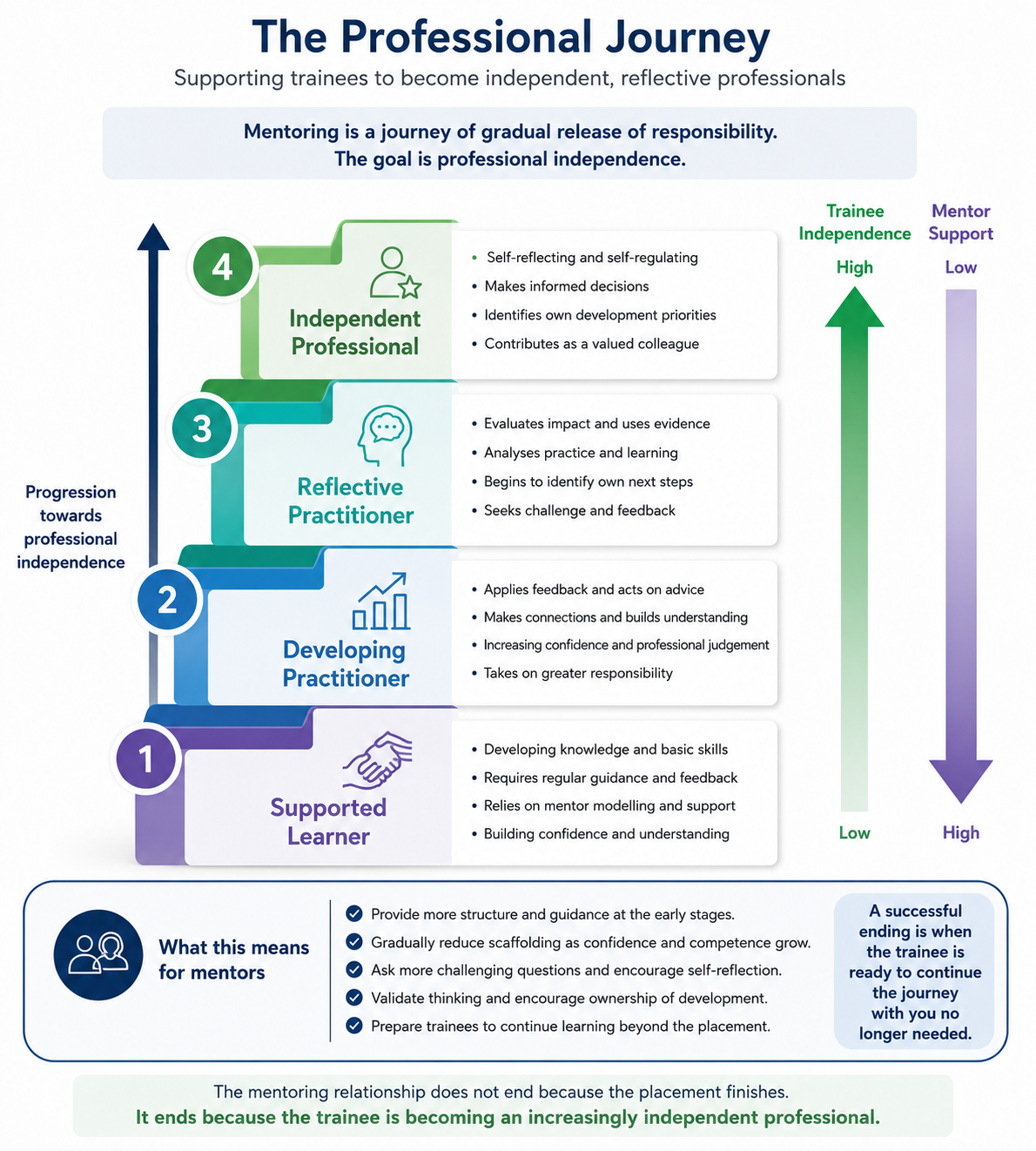
Notice that the trainee moves upwards through the diagram, whilst the mentor gradually reduces the amount of support provided.
The mentoring relationship does not end because the placement has finished. It concludes because the trainee is becoming increasingly capable of regulating their own professional learning.