- Current section: Introduction
- Learning outcomes
- 1 Meeting the insect eaters
- 2 How insect eaters obtain their food
- 3 Adaptations linked to feeding in insect eaters
- 4 Thinking about adaptation
- 5 Temperature regulation and the consequence of size
- 6 Strategies for coping with cold and food shortage
- Acknowledgements
from The Open University
Alternatively you can skip the navigation by pressing 'Enter'.
Studying mammals: The insect hunters
From pygmy shrews to armadillos, a wide range of mammals survive on...
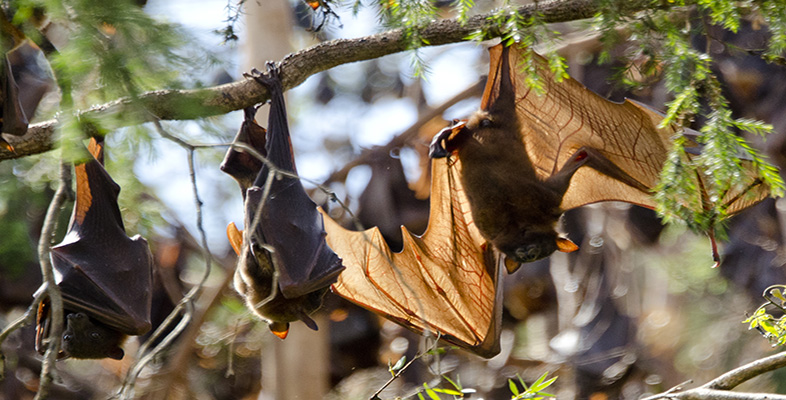
From pygmy shrews to armadillos, a wide range of mammals survive on a diet made up largely of insects. Many of these have fascinating adaptations suited to catching or rooting out their prey. In this unit you will learn about these adaptations, along with survival strategies for when food is scarce. This is the second unit in the ‘Studying mammals’ series.
By the end of this unit you should be able to:
- describe the lifestyle of a variety of insect eaters, from four orders;
- give examples of adaptations linked to feeding in insect eaters;
- explain the limited extent to which insectivores can be regarded as ‘primitive’;
- characterise typical adult mammalian dentition and understand dental formulae;
- recognise teleology and write down accounts of evolution that do not assume purpose or direction;
- describe the relationship between surface area, volume, body mass and BMR;
- identify strategies that insect eaters use to cope with cold and food shortage;
- explain the events of bat and hedgehog hibernation and the evidence for the control of this process.
- Duration: 10 hours
- Published on: Wednesday 8th June 2011
- Level: Introductory
- Posted under: Natural History
Contents
Studying mammals: The insect hunters
Introduction

Sixty-five million years ago, animal and plant life were very different from nowadays, but there were rat-sized placental mammals living successfully on the ground. They were insect eaters, i.e. insectivores, feeding on the vast numbers of insects and other invertebrates living in soil, leaf litter and low-lying vegetation. Insectivore means ‘insect eater’, and in this unit we will explore the world of insect-eating mammals, classified together on the basis of a reasonably close evolutionary relationship.
This is the second in a series of units about studying mammals. To get the most from these units, you will need access to a copy of The Life of Mammals (2002) by David Attenborough, BBC Books (ISBN 0563534230), and The Life of Mammals (2002) on DVD, which contains the associated series of ten BBC TV programmes. OpenLearn unit S182_8 Studying mammals: life in the trees contains samples from the DVD set. You should begin each unit by watching the relevant TV programme on the DVD and reading the corresponding chapter in The Life of Mammals. You will be asked to rewatch specific sequences from the programme as you work through the unit.
This unit is from our archive and is an adapted extract from Studying mammals (S182) which is no longer taught by The Open University. If you want to study formally with us, you may wish to explore other courses we offer in this subject area [Tip: hold Ctrl and click a link to open it in a new tab. (Hide tip)] .
Archive content
This is an extract from an Open University course which is no longer available to new students. If you found this interesting you could explore more free Natural History course units or view the range of currently available OU Natural History courses.
Other pages You might like

Try: Studying mammals: Meat eaters
The powerful and majestic carnivores are the focus of many television documentaries. In...

Try: School activities: Evolutionary tree of...
This introduction to the evolution of mammals considers Darwin’s observations on...

Try: Life in the Palaeozoic
Fossils are a glimpse into the distant past and fascinate young and old alike. This unit...

Try: Neighbourhood nature
There is a fascinating world of nature all around us which we can see if we know how to...

Try: Introducing environmental decision...
Many of the decisions we make have implications for our environment, particularly those...

Try: Studying mammals: Food for thought
Who were our ancestors? How are apes and humans related? And where does the extinct Homo...

Try: Studying mammals: Chisellers
Ever wondered why rats, mice and squirrels seem to reproduce at such an alarming rate?...

Try: An introduction to biological...
This unit is concerned with macroevolution – the patterns and processes of evolution...

Try: Studying Darwin
This unit brings together a collection of units from the OpenLearn site that would be of...

Try: Studying mammals: Life in the trees
David Attenborough looks at ‘life in the trees’: examining how species have evolved...

Try: Animals at the extremes: Hibernation...
Hibernation is an ingenious adaptation that some animals employ to survive difficult...

Try: Animals at the extremes: The desert...
Animal life has adapted to survive in the most unlikely and inhospitable habitats. This...
Comments
Be the first to post a comment
Copyright & revisions
Copyright information
- Creative-Commons: The Open University is proud to release this free course under a Creative Commons licence. However, any third-party materials featured within it are used with permission and are not ours to give away. These materials are not subject to the Creative Commons licence. See terms and conditions. Full details can be found in the Acknowledgements section.
Feeds
If you enjoyed this, why not follow a feed to find out when we have new things like it? Choose an RSS feed from the list below. (Don't know what to do with RSS feeds?)
Remember, you can also make your own, personal feed by combining tags from around OpenLearn.
Alternative Formats
Tags, Ratings and Social Bookmarking
Page Tags
Sign in or create a free account to add tags to your personal tag cloud using:
Have you tried our free courses?
Back on the streets
More Or Less returns
OU TV & Radio
-
More Or LessBBC Radio 4
Sunday 20:00 -
Thinking Allowed: Plenty & stammeringBBC Radio 4
Monday 0:15 -
Bang Goes The Theory s6e5Eden
Monday 9:00 -
Bang Goes The Theory s6e6Eden
Monday 9:30 -
Bang Goes The Theory s6e6Eden
Monday 9:30
Views
Votes
Comments
Tags
- climate change (373)
- business (277)
- diaries (194)
- bottom line (169)
- food (168)
- Rough Science (162)
- internet (147)
- BBC Two (145)
- BBC Radio 4 (140)
- BBC (133)
- Scotland (121)
- points for debate (120)
- listings (120)
- children (116)
- Bang goes the Theory (116)
- Creative Climate (116)
- English Civil War (115)
- astronomy (108)
- Thinking Allowed (104)
- religion (98)
- 20th century (94)
- marketing (94)
- Charles I (93)
- evolution (92)
- communication (92)
- research (89)
- sustainability (89)
- architecture (86)
- energy (83)
- National Health Service (NHS) (78)
OpenLearn Links
Copyrighted imageCredit: Background image Lucian Milasan | Dreamstime.com