

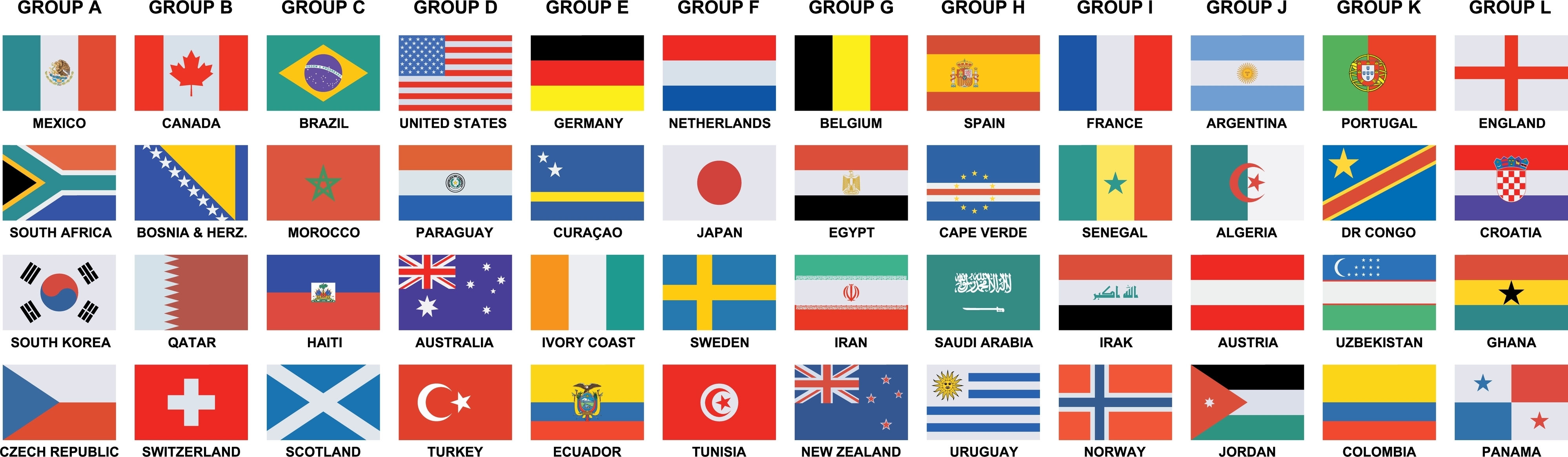
On Thursday 11 June, the 23rd FIFA World Cup will kick off in the fabled Mexico City Stadium when co-hosts Mexico play South Africa. It will conclude on Sunday 19 July when the final is held at MetLife Stadium in New York/New Jersey. In between there will be another 102 matches to see who competes in the final. The matches will be held across 16 stadia, with 11 in USA, 3 in Mexico and 2 in Canada.
It will be the largest tournament yet with 48 teams competing in 12 groups to reach the newly introduced Round of 32. There has been an extra round added meaning there are 5 matches between the qualifying rounds and the final for the eventual winners to navigate. The extended nature of this tournament gives it a ‘lucky dip’ element and makes it even more challenging to decide who the contenders may be.
There are four first time nations completing in Curacao, Cape Verde, Jordan and Uzbekistan. Curacao will become the smallest nation ever to play at the World Cup. This is a country smaller than the Isle of Man, with a population of 150,000. Although in Tahith Chong they have a player who has played for Manchester United. Curacao will play the 2014 champions, Germany, in the group stages, while Cape Verde will play 2010 champions, Spain. Cape Verde, which is a collection of 10 islands off the coast of Africa, will be the third smallest country to play in the World Cup and only gained independence from Portugal in 1975.
No shortage of controversies and potential problems!
As it always seems to do, this World Cup has thrown up several talking points already. Not withstanding the fact that the host nation are currently at war with one of the other nations and there are other countries which are involved as well.
Another big controversy has been around the price of tickets and the cost of travelling to the venues, which has made the tournament prohibitive to most fans. Even the President of the United States declared that he would not be willing the pay the prices FIFA had set!
The BBC calculated that it could cost as much as £6500 for an England supporter to follow the team to the final, or £22,300 for a family of 4. For Scottish fans the cost is even higher at around £7,500 per person (Johnson, 2026). This accounts for tickets, travel, air fares and hotel accommodation.
Due to the tournament being held across an entire continent it is also considered that this World Cup will be the most polluting World Cup ever. Calculations suggest an England fan following their team to the final would produce a carbon footprint of 3.5 tonnes which is equivalent to the amount of energy required to heat a UK home for 19 months (Gornall, 2026).
Who will win the 2026 World Cup?
Firstly, there are two home nations competing in England and Scotland.
Scotland will compete in their first finals since 1998 and as they did then they will play Brazil. It will be their third match after playing Haiti and Morocco and promises to be a great occasion as it will be held at the Hard Rock Stadium in Miami. The presence of Brazil (ranked fifth in the world) and Morocco (ranked eleventh) make this a tough group, but Scotland have a squad with some players with extensive international experience and should get through to the knockout stages.
England appointed Thomas Tuchel, a German coach, with the specific aim of winning the tournament for the first time in 60 years so there is pressure on the squad to deliver. Tuchel chose a slightly controversial squad with some big name omissions and surprise inclusions, and they will look to win a group with Croatia, Ghana and Panama as challengers.
It is impossible to predict a winner but a prediction of the final 8 might be easier. There are 5 teams who should be safe bets: Argentina and Brazil from South America; and Spain, France and England from Europe. Germany, Belgium and Norway will also be competitive but as for the other 3 teams we are plumping for Netherlands, Türkiye and, as surprise outsiders, Senegal.
Netherlands are chock full of experienced Premier League players and have a formidable manager in Ronald Koeman. Turkey have some outstanding young players and Senegal were impressive in the African Cup of Nations, despite being disqualified in the final for walking off the pitch in protest against a refereeing decision. While Senegal also have a squad full of current and former Premier League players such as Sadio Mané, Nicolas Jackson, Ismaila Sarr, Iliman Ndiaye and Pape Matar Sarr they face another of the toughest groups with France and Norway as opponents. If they can progress from this group they could be difficult to beat in the knockout phase.
Who will be the breakout stars?
Desire Doue of Paris St Germain and France, and Lamine Yamal of Barcelona and Spain are already stars of the global game despite being aged 20 and 18 respectively. Doue may not start every game as the French are blessed with attacking talent and our first player to watch in particular. That is Michael Olise, once of Crystal Palace, who recently became the second player in the German Bundesliga to score 15 goals and make 15 assists in a season. Olise was born in London and could have represented England at this World Cup. The second player is Yan Diomande of the Ivory Coast who is a speedy left winger with fast feet and an excellent goal scoring record. Thirdly, Tottenham Hotspur fans will be eager to see how well 19-year-old Luka Vušković plays for Croatia. Vušković, a central defender, has been on loan to Hamburg in the Bundesliga for the past two seasons, and his performances have attracted interest from clubs like Bayern Munich and Real Madrid. A successful World Cup could see Vušković back at Spurs as part of a comprehensive squad re-build.
It's not going to be dull!
Despite making these predictions there are always unforeseen events that make and shape a tournament. There is the hot weather, temporary grass pitches, some new refereeing guidelines to navigate and changing regulations around VAR – what could possibly go wrong?!
We hope you enjoy the tournament as it unfolds. There are bound to be some big shocks, thrills, and interesting discussion points.
Explore more World Cup related resources
-
The Men’s World Cup 2026
Read now to access more details of The Men’s World Cup 2026The men’s World Cup tournament starts on 11 June 2026 and is being held in Canada, Mexico and the United States. Take a look at our dedicated content for the tournament.

-
Life in a bubble: the training camp experience at a World Cup
Read now to access more details of Life in a bubble: the training camp experience at a World CupIn the context of the men’s World Cup 2026, explore the effects of being in a training camp and at a tournament for a sustained period of time.
-
The football World Cup: where sport and politics collide
Learn more to access more details of The football World Cup: where sport and politics collideOccasionally, controversies arise that remind us of the link between sport and politics. It was once common for leading figures in the sporting world to declare that sport was, effectively, a politics-free zone. Sport was cast as the perpetual innocent party, liable to be corrupted by any connection with politics. However, it has become ...

-
Club v Country: The psychology of switching support
Read now to access more details of Club v Country: The psychology of switching supportGraham Pike explores the psychology behind the 'club versus country' conundrum as a football fan.

-
African and Caribbean coaches in international football: is there enough progress?
Read now to access more details of African and Caribbean coaches in international football: is there enough progress?Whether or not you agree with the format of a 48-team World Cup, the number of African and Caribbean nations that have qualified is significant. At the 2022 Qatar World Cup, five African nations participated. In 2026, ten have qualified for the final tournament. No Caribbean nations qualified for Qatar; but in 2026 there are two Caribbean ...
Fanatic about sport? Try one of our free courses
-
Supporting female performance in sport and fitness
Learn more to access more details of Supporting female performance in sport and fitnessDo you support women’s performance in sport or fitness as a coach or parent? Are you a female athlete who wants to optimise your performance using recent research insights? If so, then this free course is for you. It addresses the problem of sports science research traditionally being male dominated and the assumption that if it works for men ...

-
The business of football
Learn more to access more details of The business of footballIf you are fascinated by men's and women's football and interested in discovering more about business and management, then this engaging and stimulating course is for you.

-
Sporting women in the media
Learn more to access more details of Sporting women in the mediaThe mass media (e.g. radio, TV, internet) has become one of the most powerful institutional influences in society. This free course, Sporting women in the media, explores whether gendered inequalities exist in sport by evaluating the media coverage. The media can be highly influential in shaping perceptions about gender in sport and headlines ...

-
The athlete’s journey: transitions through sport
Learn more to access more details of The athlete’s journey: transitions through sportThe athlete’s journey through sport can be characterised by several transitions and periods of change. This course is designed to help you understand that journey, whether in reference to a professional or recreational athlete, and the nature of support they may need at different times. The course also provides practical guidance, whether ...

-
Coaching others to coach
Learn more to access more details of Coaching others to coachAre you responsible for supporting sport and physical activity coaches to become inspirational and excellent in their practice? This course is designed for coach developers, educators, mentors and tutors who support coaches to improve. You will explore how people learn, what are the skills and qualities of an effective coach of coaches, as well ...

-
Communication and working relationships in sport and fitness
Learn more to access more details of Communication and working relationships in sport and fitnessExplore the personal skills that underpin so much work in sport and gyms. We often hear employers refer to the importance of these interpersonal relationships or ‘soft skills’ in sport and fitness, and in this unique course you’ll build valuable insights into understanding workplace communication, motivation and self-awareness and how this can ...

-
Exploring sport coaching and psychology
Learn more to access more details of Exploring sport coaching and psychologyThis course investigates how scientific and management ideas contribute to success, referencing unique sporting case studies and insights that will change how you view and study sport. You will consider how the mind, the body, the environment and training techniques all contribute to optimum fitness.

-
Exploring the psychological aspects of sport injury
Learn more to access more details of Exploring the psychological aspects of sport injuryHave you ever experienced a sport injury? Have you ever thought there could be a psychological dimension to sport injuries, as well as a physical one? Sport injury is relatively common among sport and exercise participants, and while the physical impact of injury is often easy to recognise, the psychological impact is less obvious. In this ...

-
The football World Cup: where sport and politics collide
Learn more to access more details of The football World Cup: where sport and politics collideOccasionally, controversies arise that remind us of the link between sport and politics. It was once common for leading figures in the sporting world to declare that sport was, effectively, a politics-free zone. Sport was cast as the perpetual innocent party, liable to be corrupted by any connection with politics. However, it has become ...
-
Learning from sport burnout and overtraining
Learn more to access more details of Learning from sport burnout and overtrainingSport can place high levels of stress on athletes, coaches and others involved. If unable to cope with these stresses they may be vulnerable to developing burnout. This free course, Learning from sport burnout and overtraining, examines burnout in sport from various perspectives including both the coach’s and athlete’s perspective. Drawing on ...

-
Training for endurance in sport and fitness
Learn more to access more details of Training for endurance in sport and fitnessIn this free course you will explore an important aspect of strength and conditioning which refers to the physical preparation of athletes: endurance. You will look at the physiological factors that underpin endurance and assess how endurance can be developed relative to performance in a range of sports.

-
Training for speed and power in sport and fitness
Learn more to access more details of Training for speed and power in sport and fitnessThis course explains the physiological principles that underpin speed and power, and how to apply a range of training techniques in practice.

-
Developing employability through sport and physical activity
Learn more to access more details of Developing employability through sport and physical activityWhile many people recognise the positive impact of engaging in sport and/or physical activity on their physical and mental well-being, research indicates that participation can also equip us with valuable skills that enhance our employability. Engaging in sport and physical activity provides opportunities to develop a diverse skill set that can ...

-
Doping: a contemporary sports issue case study
Learn more to access more details of Doping: a contemporary sports issue case studyIn this free course, doping (performance enhancing drugs, or PEDs) is used as an example of how contemporary issues in sport might be studied. Doping is used to illustrate how you can think about the debates involved in an issue and this will help you develop appropriate skills to discuss other contemporary issues in sport.

-
Developing resilience in sport
Learn more to access more details of Developing resilience in sportExplore how the concept of resilience can support athletes on their athletic development journey. You will examine how resilience can act as a buffer to protect against the challenges that might be faced by athletes and coaches. The protective qualities of resilience make it an important consideration for wellbeing and performance in sport, with...

Rate and Review
Rate this article
Review this article
Log into OpenLearn to leave reviews and join in the conversation.
Article reviews