
My article QATAR 2022 must impart a positive coaching legacy for Africa and the Caribbean member associations questioned whether the trend of all five African World Cup representatives in 2022 being led by indigenous head coaches was an ‘ongoing trend or a flash in the pan’. As the 2026 World Cup started, the landscape revealed a mixture of continued progress and a return to ‘foreign’ leadership in several nations.
Tunisia is a case in point. Throughout the qualification process for the 2026 World Cup they were led by head coach Sabri Lamouchi who was born in France to Tunisian parents and holds both Tunisian and French citizenship. However, Lamouchi was sacked after Tunisia lost to Sweden in their first game and was replaced by the experienced French coach Herve Renard for the final two group games. Algeria, like Tunisia, appointed the experienced Bosnian coach Vladimir Petokic for the World Cup finals after a disappointing AFCON 2025 where they were coached by Algerian Djamel Belmadi.
After the group stage of the 2026 World Cup, these were the head coaches who are native to the African countries that qualified for the knockout phase:
- Cape Verde: Pedro ‘Bubista’ Brito
- Egypt: Hossam Hassan
- Côte d’Ivoire/Ivory Coast: Emerse Faé (born in France, but is a former Ivorian international player and citizen)
- Morocco: Mohamed Ouahbi (dual Belgian-Moroccan national)
- Senegal: Pape Thiaw
Taking a closer look at each of these countries reveals some interesting insights into the ongoing development of African and Caribbean coaches. For example, following their historic semi-final run in 2022 World Cup Finals, Morocco’s technical leadership has transitioned from Walid Regragui to Mohamed Ouahbi. Both coaches are Moroccan, and Morocco has been extremely successful over the last few years. In October 2025, Morocco broke the world record for the longest winning streak in international football, surpassing Spain’s previous mark of 15 consecutive victories set between June 2008 and June 2009. Egypt are also attempting to be consistent with native leadership. The country is currently led by its all-time leading goal scorer, Hossam Hassan, who has been in post since 2024 and led the team to fourth place at AFCON 2025.
Côte d’Ivoire achieved historic success by winning AFCON 2023 after Emerse Faé took charge of the team under extraordinary circumstances. After the dismissal of head coach Jean-Louis Gasset (a French national) following a humiliating 4-0 group-stage defeat to Equatorial Guinea, Faé was promoted from assistant coach to caretaker manager just before the knockout rounds began. He then orchestrated a remarkable and miraculous run as the host nation’s leader, which culminated in a 2-1 victory over Nigeria in the final, making Faé the first manager in history to win a major tournament after taking over mid-competition. For this achievement, he was named the Best Coach of the 2023 AFCON.
Following the tournament, Faé was rewarded with a permanent contract in February 2024. Under his permanent guidance, he led the Elephants through an undefeated qualifying campaign for the 2026 FIFA World Cup, ending a 12-year drought for the nation on the global stage. His success is frequently cited as a landmark for the credibility of indigenous African coaching, proving that homegrown talent can deliver elite results under immense pressure.
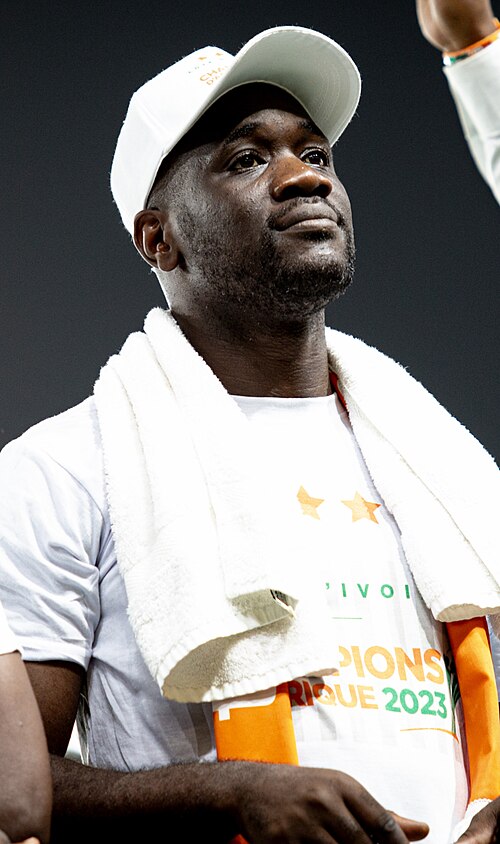 Emerse Faé
The contribution of FIFA
Since 2022, FIFA, CONCACAF (Confederation of North, Central American and Caribbean Association Football), and CAF (Confederation of African Football) have significantly expanded their investments in coaching development through new regulatory frameworks, specialised training workshops, and digital learning platforms. Through the revenue generated by past World Cups, FIFA has also created a global training centre and the FIFA World Cup Qatar 2022 Legacy Fund has a Footballing Pillar focused on technical development and knowledge exchange. In November 2024, Aruba hosted the FIFA Coach Education Leaders' Knowledge Exchange Programme, which was aimed at implementing best practices across English-speaking Concacaf member associations. The Concacaf Coaching Convention, initially launched in March 2022, serves as the primary regulatory framework for standardising and raising the quality of coach education across its 41 Member Associations. This has led to Concacaf announcing in January 2026 its Pro Licensing programme, that was developed in collaboration with UEFA through the UEFA Together initiative, and sought to establish a unified, high-performance standard for elite coaches.
CAF’s technical renaissance
CAF has also intensified its coaching development by prioritising indigenous expertise and enforcing strict technical standards through the CAF Coaching Convention. Associations like Morocco have leveraged their youth setups, such as the coaching team of the Under-20 World Cup-winning squad, to create a pipeline for senior technical leadership, which led to the current coach succeeding the previous coach. A major milestone for CAF was Nigeria’s re-admission to the CAF A-License convention in 2026 after a nine-year absence. The Nigeria Football Federation (NFF) subsequently finalised plans for refresher courses and an elite six-module CAF A-License coaching course. Despite these programmes, sources highlight that participation and progression are often hampered by financial disparities. The cost of elite licensing remains a significant barrier; for example, the NFF/CAF A-License costs between $2,000 and $3,000, which is a prohibitive sum for many local candidates without National or club backing, in Nigeria. To address this, policy recommendations suggest establishing localised licensing subsidy mechanisms and shared regional high-performance hubs to ensure equitable access to these development programmes.
Summary
The development of African and Caribbean coaches is an ongoing process, but a process that is important for the future of world football. There is no reason why the national teams from CAF and CONCACAF should not be coached by an indigenous coach rather than a foreign coach. Progress may be uneven, but it is certainly not a flash in the pan. Furthermore, when will we see an African or Caribbean educated coach becoming the head coach of an English Premier League club? There is no reason why this should not be the case given the number of players from Africa or of African heritage playing in the Premier League.
|
Country |
Current coach (at 2026 World Cup) |
Indigenous/nationality |
Coach(es) during qualifying period |
|
Algeria |
Vladimir Petković |
Bosnian / Swiss |
Djamel Belmadi (started) / Vladimir Petković (finished) |
|
Cape Verde |
Pedro ‘Bubista’ Brito |
Cape Verdean |
Pedro ‘Bubista’ Brito |
|
Egypt |
Hossam Hassan |
Egyptian |
Rui Vitória (started) / Hossam Hassan (finished) |
|
Ghana |
Carlos Queiroz |
Portuguese |
Chris Hughton (started) / Otto Addo (finished) |
|
Côte d’Ivoire/Ivory Coast |
Emerse Faé |
Ivorian |
Jean-Louis Gasset (started) / Emerse Faé (finished) |
|
Morocco |
Mohamed Ouahbi |
Dual Belgian-Moroccan national |
Walid Regragui |
|
Senegal |
Pape Thiaw |
Senegalese |
Aliou Cissé (started) / Pape Thiaw (finished) |
|
South Africa |
Hugo Broos |
Belgian |
Hugo Broos |
|
DR Congo |
Sébastien Desabre |
French |
Sébastien Desabre |
|
Tunisia |
Hervé Renard replaced Sabri Lamouchi |
French |
Jalel Kadri (started), Sami Trabelsi and Sabri Lamouchi (finished) |
|
Curaçao |
Dick Advocaat |
Dutch |
Dick Advocaat stepped away briefly for personal family reasons allowing Fred Rutten to take charge of the team temporarily. Advocaat returned to take over the final phase to the World Cup |
|
Haiti |
Sébastien Migné |
French |
Sébastien Migné took over in March 2024 and coached the entire CONCACAF cycle |
The men’s World Cup tournament starts on 11 June 2026 and is being held in Canada, Mexico and the United States. Take a look at our dedicated content for the tournament. With the men’s World Cup starting in June 2026, Simon Rea and Alex Twitchen explore some key facts about the tournament and discuss some of the key players to look out for. In the context of the men’s World Cup 2026, explore the effects of being in a training camp and at a tournament for a sustained period of time. Occasionally, controversies arise that remind us of the link between sport and politics. It was once common for leading figures in the sporting world to declare that sport was, effectively, a politics-free zone. Sport was cast as the perpetual innocent party, liable to be corrupted by any connection with politics. However, it has become ... Graham Pike explores the psychology behind the 'club versus country' conundrum as a football fan. Explore more World Cup related resources
The Men’s World Cup 2026
World Cup 2026: it looks like a lucky dip tournament!
Life in a bubble: the training camp experience at a World Cup
The football World Cup: where sport and politics collide

Club v Country: The psychology of switching support
Fanatic about sport? Try one of our free courses
-
Supporting female performance in sport and fitness
Learn more to access more details of Supporting female performance in sport and fitnessDo you support women’s performance in sport or fitness as a coach or parent? Are you a female athlete who wants to optimise your performance using recent research insights? If so, then this free course is for you. It addresses the problem of sports science research traditionally being male dominated and the assumption that if it works for men ...

-
The business of football
Learn more to access more details of The business of footballIf you are fascinated by men's and women's football and interested in discovering more about business and management, then this engaging and stimulating course is for you.

-
Sporting women in the media
Learn more to access more details of Sporting women in the mediaThe mass media (e.g. radio, TV, internet) has become one of the most powerful institutional influences in society. This free course, Sporting women in the media, explores whether gendered inequalities exist in sport by evaluating the media coverage. The media can be highly influential in shaping perceptions about gender in sport and headlines ...

-
The athlete’s journey: transitions through sport
Learn more to access more details of The athlete’s journey: transitions through sportThe athlete’s journey through sport can be characterised by several transitions and periods of change. This course is designed to help you understand that journey, whether in reference to a professional or recreational athlete, and the nature of support they may need at different times. The course also provides practical guidance, whether ...

-
Coaching others to coach
Learn more to access more details of Coaching others to coachAre you responsible for supporting sport and physical activity coaches to become inspirational and excellent in their practice? This course is designed for coach developers, educators, mentors and tutors who support coaches to improve. You will explore how people learn, what are the skills and qualities of an effective coach of coaches, as well ...

-
Communication and working relationships in sport and fitness
Learn more to access more details of Communication and working relationships in sport and fitnessExplore the personal skills that underpin so much work in sport and gyms. We often hear employers refer to the importance of these interpersonal relationships or ‘soft skills’ in sport and fitness, and in this unique course you’ll build valuable insights into understanding workplace communication, motivation and self-awareness and how this can ...

-
Exploring sport coaching and psychology
Learn more to access more details of Exploring sport coaching and psychologyThis course investigates how scientific and management ideas contribute to success, referencing unique sporting case studies and insights that will change how you view and study sport. You will consider how the mind, the body, the environment and training techniques all contribute to optimum fitness.

-
Exploring the psychological aspects of sport injury
Learn more to access more details of Exploring the psychological aspects of sport injuryHave you ever experienced a sport injury? Have you ever thought there could be a psychological dimension to sport injuries, as well as a physical one? Sport injury is relatively common among sport and exercise participants, and while the physical impact of injury is often easy to recognise, the psychological impact is less obvious. In this ...

-
The football World Cup: where sport and politics collide
Learn more to access more details of The football World Cup: where sport and politics collideOccasionally, controversies arise that remind us of the link between sport and politics. It was once common for leading figures in the sporting world to declare that sport was, effectively, a politics-free zone. Sport was cast as the perpetual innocent party, liable to be corrupted by any connection with politics. However, it has become ...
-
Learning from sport burnout and overtraining
Learn more to access more details of Learning from sport burnout and overtrainingSport can place high levels of stress on athletes, coaches and others involved. If unable to cope with these stresses they may be vulnerable to developing burnout. This free course, Learning from sport burnout and overtraining, examines burnout in sport from various perspectives including both the coach’s and athlete’s perspective. Drawing on ...

-
Training for endurance in sport and fitness
Learn more to access more details of Training for endurance in sport and fitnessIn this free course you will explore an important aspect of strength and conditioning which refers to the physical preparation of athletes: endurance. You will look at the physiological factors that underpin endurance and assess how endurance can be developed relative to performance in a range of sports.

-
Training for speed and power in sport and fitness
Learn more to access more details of Training for speed and power in sport and fitnessThis course explains the physiological principles that underpin speed and power, and how to apply a range of training techniques in practice.

-
Developing employability through sport and physical activity
Learn more to access more details of Developing employability through sport and physical activityWhile many people recognise the positive impact of engaging in sport and/or physical activity on their physical and mental well-being, research indicates that participation can also equip us with valuable skills that enhance our employability. Engaging in sport and physical activity provides opportunities to develop a diverse skill set that can ...

-
Doping: a contemporary sports issue case study
Learn more to access more details of Doping: a contemporary sports issue case studyIn this free course, doping (performance enhancing drugs, or PEDs) is used as an example of how contemporary issues in sport might be studied. Doping is used to illustrate how you can think about the debates involved in an issue and this will help you develop appropriate skills to discuss other contemporary issues in sport.

-
Developing resilience in sport
Learn more to access more details of Developing resilience in sportExplore how the concept of resilience can support athletes on their athletic development journey. You will examine how resilience can act as a buffer to protect against the challenges that might be faced by athletes and coaches. The protective qualities of resilience make it an important consideration for wellbeing and performance in sport, with...


Rate and Review
Rate this article
Review this article
Log into OpenLearn to leave reviews and join in the conversation.
Article reviews