
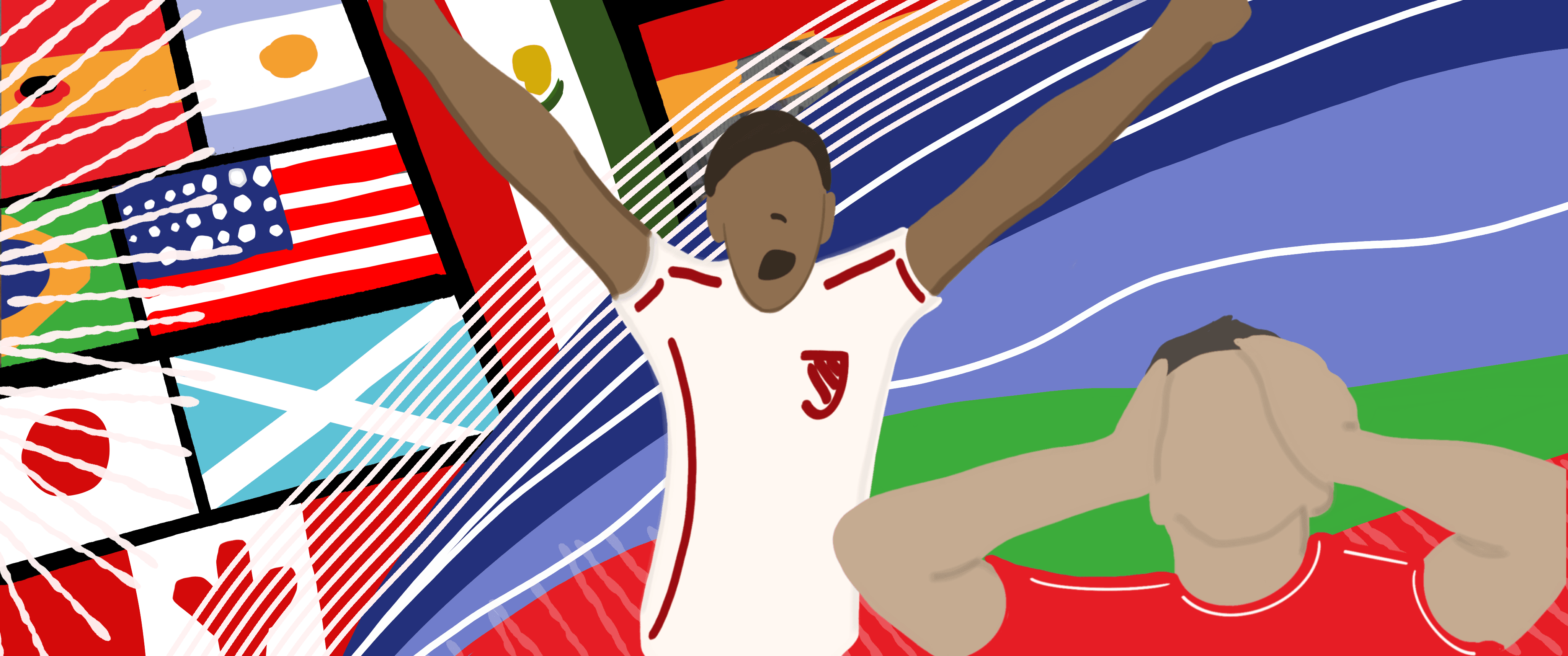
Since the start of the Premier League in 1992, players have come from 128 different countries, with Mozambique, Iraq and Bangladesh being added to the list in 2026. In the 2025/26 season, 65 different nationalities were represented, including 36 players from the Netherlands, 15 of whom are in that country’s national squad for the 2026 World Cup. In other words, topflight football is a deeply globalised sport.
This can lead to a scenario that anyone who is a keen supporter of a football club will recognise. You are watching the World Cup and suddenly players that have been your opponents all season long are now playing for your country, even those from ‘that’ club (you know the one), that you have such a close rivalry with. These players are no longer rivals but are now ‘your’ players and playing for ‘your’ country. It can be quite a paradoxical feeling when you consider it, a feeling of newfound camaraderie with a longstanding enemy.
The psychology of this is, to start with at least, fairly simple. Groups and group membership tend to play an important part in establishing our identity, in making us who we are. Forming groups has been an important part of our evolution, and we have developed mechanisms that make these groups coherent. Supporting a football club makes us part of a group that includes the players and fans of the club. They become our ‘in-group’. Players and fans of other clubs become an ‘out-group’, and psychologists have found that whilst in-groups will cohere by adopting shared beliefs and behaviours, they will also feel hostility towards out-groups, particularly when groups are put in a position where they must compete against each other.
In-group to out-group
Of course, the reality is far more complex than this, and our identities and the ways that groups work are not nearly so straightforward. However, ‘in-group/out-group’ is a powerful psychological phenomenon. Research has found that group membership can drive hostility and conflict even when there is no history of interaction between the groups and even when the groups are randomly assigned according to meaningless categories. For example, a famous series of studies conducted by Henri Tajfel and colleagues in the 1970s found that teenage boys would favour their in-group over their out-group even when the group was ‘virtual’ (the boys never met and there was no tangible link between them to create the group). At least this seems to be true of the cultures in North America and Britain. The results of this research were not found in New Zealand when the participants were Maori and Pacific Island children, though European New Zealand children did produce the same results.
As well as previously out-group players now becoming part of your own in-group, the opposite also occurs. If, for example, you support teams from the Premier League, Championship or Scottish Premiership, many of the players from your club are likely to play for a different country to your own. Might that mean you see them in a different light? A player that has been part of your in-group all season becomes part of your out-group when they play against your country’s team!
'Real' and parasocial relationships
As well as the formations of groups and how they impact our identity, it is also possible to form relationships with the players of your team. Unless you know the player personally, these are referred to as ‘parasocial relationships’ as they are entirely one-way. Even so, parasocial relationships can effectively replace ‘real’ relationships in staving off loneliness and even providing the positive health benefits associated with relationships.
Just like ‘real’ relationships, it seems people who form parasocial relationships can also experience ‘break ups’; and that’s not just your favourite soap opera character leaving or the end of your favourite series of novels, it also seems to apply to football fans. A study was published in 2023 (Mikkilineni et al., 2023) that explored the impact on FC Barcelona fans of the departure of Lionel Messi in 2021, which found that fans had formed a parasocial relationship with the footballing star and also experienced a parasocial breakup when he left!
Of course, when a player for your club takes the field for a country that is competing against yours it is not quite a break-up, because they will be back in your in-group for the start of the next season, but it could well feel like you are ‘on a break’!
Find out more
We are currently conducting some research looking at fans’ relationships with players during the 2026 FIFA World Cup. If you would like to find out more about this research, and even to participate (it doesn’t take long), go to World Cup Study.
You can find out more about in-groups and out-groups in this Starting with psychology course.
You can find out more about parasocial relationships in this What happens to when you read? course.
This article is based on research conducted by Graham Pike, Sarah Laurence, Maika Telga and Martin Thirkettle, and was co-edited by Alex Twitchen.
The men’s World Cup tournament starts on 11 June 2026 and is being held in Canada, Mexico and the United States. Take a look at our dedicated content for the tournament. With the men’s World Cup starting in June 2026, Simon Rea and Alex Twitchen explore some key facts about the tournament and discuss some of the key players to look out for. In the context of the men’s World Cup 2026, explore the effects of being in a training camp and at a tournament for a sustained period of time. Occasionally, controversies arise that remind us of the link between sport and politics. It was once common for leading figures in the sporting world to declare that sport was, effectively, a politics-free zone. Sport was cast as the perpetual innocent party, liable to be corrupted by any connection with politics. However, it has become ... Whether or not you agree with the format of a 48-team World Cup, the number of African and Caribbean nations that have qualified is significant. At the 2022 Qatar World Cup, five African nations participated. In 2026, ten have qualified for the final tournament. No Caribbean nations qualified for Qatar; but in 2026 there are two Caribbean ...Explore more World Cup related resources
The Men’s World Cup 2026
World Cup 2026: it looks like a lucky dip tournament!
Life in a bubble: the training camp experience at a World Cup
The football World Cup: where sport and politics collide

African and Caribbean coaches in international football: is there enough progress?
Fanatic about sport? Try one of our free courses
-
Supporting female performance in sport and fitness
Learn more to access more details of Supporting female performance in sport and fitnessDo you support women’s performance in sport or fitness as a coach or parent? Are you a female athlete who wants to optimise your performance using recent research insights? If so, then this free course is for you. It addresses the problem of sports science research traditionally being male dominated and the assumption that if it works for men ...

-
The business of football
Learn more to access more details of The business of footballIf you are fascinated by men's and women's football and interested in discovering more about business and management, then this engaging and stimulating course is for you.

-
Sporting women in the media
Learn more to access more details of Sporting women in the mediaThe mass media (e.g. radio, TV, internet) has become one of the most powerful institutional influences in society. This free course, Sporting women in the media, explores whether gendered inequalities exist in sport by evaluating the media coverage. The media can be highly influential in shaping perceptions about gender in sport and headlines ...

-
The athlete’s journey: transitions through sport
Learn more to access more details of The athlete’s journey: transitions through sportThe athlete’s journey through sport can be characterised by several transitions and periods of change. This course is designed to help you understand that journey, whether in reference to a professional or recreational athlete, and the nature of support they may need at different times. The course also provides practical guidance, whether ...

-
Coaching others to coach
Learn more to access more details of Coaching others to coachAre you responsible for supporting sport and physical activity coaches to become inspirational and excellent in their practice? This course is designed for coach developers, educators, mentors and tutors who support coaches to improve. You will explore how people learn, what are the skills and qualities of an effective coach of coaches, as well ...

-
Communication and working relationships in sport and fitness
Learn more to access more details of Communication and working relationships in sport and fitnessExplore the personal skills that underpin so much work in sport and gyms. We often hear employers refer to the importance of these interpersonal relationships or ‘soft skills’ in sport and fitness, and in this unique course you’ll build valuable insights into understanding workplace communication, motivation and self-awareness and how this can ...

-
Exploring sport coaching and psychology
Learn more to access more details of Exploring sport coaching and psychologyThis course investigates how scientific and management ideas contribute to success, referencing unique sporting case studies and insights that will change how you view and study sport. You will consider how the mind, the body, the environment and training techniques all contribute to optimum fitness.

-
Exploring the psychological aspects of sport injury
Learn more to access more details of Exploring the psychological aspects of sport injuryHave you ever experienced a sport injury? Have you ever thought there could be a psychological dimension to sport injuries, as well as a physical one? Sport injury is relatively common among sport and exercise participants, and while the physical impact of injury is often easy to recognise, the psychological impact is less obvious. In this ...

-
The football World Cup: where sport and politics collide
Learn more to access more details of The football World Cup: where sport and politics collideOccasionally, controversies arise that remind us of the link between sport and politics. It was once common for leading figures in the sporting world to declare that sport was, effectively, a politics-free zone. Sport was cast as the perpetual innocent party, liable to be corrupted by any connection with politics. However, it has become ...
-
Learning from sport burnout and overtraining
Learn more to access more details of Learning from sport burnout and overtrainingSport can place high levels of stress on athletes, coaches and others involved. If unable to cope with these stresses they may be vulnerable to developing burnout. This free course, Learning from sport burnout and overtraining, examines burnout in sport from various perspectives including both the coach’s and athlete’s perspective. Drawing on ...

-
Training for endurance in sport and fitness
Learn more to access more details of Training for endurance in sport and fitnessIn this free course you will explore an important aspect of strength and conditioning which refers to the physical preparation of athletes: endurance. You will look at the physiological factors that underpin endurance and assess how endurance can be developed relative to performance in a range of sports.

-
Training for speed and power in sport and fitness
Learn more to access more details of Training for speed and power in sport and fitnessThis course explains the physiological principles that underpin speed and power, and how to apply a range of training techniques in practice.

-
Developing employability through sport and physical activity
Learn more to access more details of Developing employability through sport and physical activityWhile many people recognise the positive impact of engaging in sport and/or physical activity on their physical and mental well-being, research indicates that participation can also equip us with valuable skills that enhance our employability. Engaging in sport and physical activity provides opportunities to develop a diverse skill set that can ...

-
Doping: a contemporary sports issue case study
Learn more to access more details of Doping: a contemporary sports issue case studyIn this free course, doping (performance enhancing drugs, or PEDs) is used as an example of how contemporary issues in sport might be studied. Doping is used to illustrate how you can think about the debates involved in an issue and this will help you develop appropriate skills to discuss other contemporary issues in sport.

-
Developing resilience in sport
Learn more to access more details of Developing resilience in sportExplore how the concept of resilience can support athletes on their athletic development journey. You will examine how resilience can act as a buffer to protect against the challenges that might be faced by athletes and coaches. The protective qualities of resilience make it an important consideration for wellbeing and performance in sport, with...

Rate and Review
Rate this article
Review this article
Log into OpenLearn to leave reviews and join in the conversation.
Article reviews