

2 Helping parents/carers to feel empowered
A number of studies focussing on the prevalence of children’s pain in hospital suggest that a key factor likely to be contributing to this high prevalence is a lack of parental involvement in the management of their child’s pain. Yang et al. (2022) conducted a randomised controlled trial (RCT) with 413 children aged 1–7 years and their parents and found that when parents participated in a Parent Participation Programme intervention, pain scores were significantly lower in the intervention group than in the control group. Jenkins et al. (2019) evaluated the impact of nurse and parent training using a pre-post design and found that when nurses and parents work together, they help reduce children’s pain postoperatively. Despite this, parents have been found to be reluctant to report post-surgical pain, which can result in children experiencing unnecessary pain (Bakir et al., 2023).
To help alleviate this reluctance and feel more at ease, parents reported that they appreciate nurses who spend time with their child and get to know them, listen to their child and them as a parent, and believe them rather than seeing them as unnecessarily anxious (Simons et al., 2024). A recent study by Bakir et al. (2022) revealed that parents reported needing open communication with nurses where they are listened to and have the right to voice their concerns. This helps the child feel seen and the parent be involved in their child’s pain care.

For parents/carers, knowing a nurse’s name is helpful, as is having a nurse checking in with them regularly and asking about their child’s pain, as often parents/carers are hesitant to bother nurses or doctors for fear of interrupting or disturbing them (Simons and Plowright Pepper, 2024). Some parents/carers like to be given options like a pain scale rating from 0–10, when being asked about their child’s pain.
Being told what to expect regarding pain and understanding when their child is due medication for pain, also helps parents/carers feel more in control. Having nurses explain that they are there to help parents/carers and encourage them to approach them if they need help is reassuring for parents/carers.
Good communication between parents/carers and nurses is one of the primary factors in empowering parents/carers to be effectively involved in the management of their child’s pain. This is because children are more likely to tell their parents/carers than a nurse that they are in pain, meaning parents/carers play a crucial role in communicating this to nurses who are then able to act and relieve the pain. However, in a study by Vasey et al. (2019), parents, children and nurses explained that it is often poor communication that occurs, which creates obstacles to the effective management of a child’s pain.
You will look at this in more detail in the next section after you have completed Activity 1.
Activity 1 Parents/carers and pain
Watch the short animation and make a note of two things you think would help a parent/carer become more involved in managing their child’s pain in hospital where you work.
Is there anything you could do to build the confidence of parents/carers who hesitate to approach a nurse when their child is in pain?
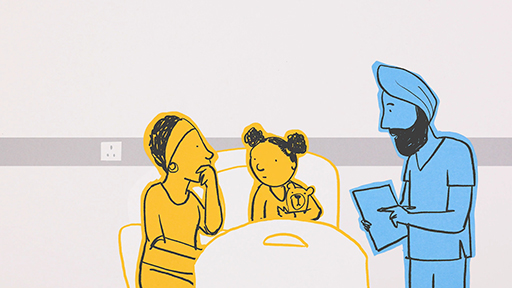
Transcript: Animation 2
[TEXT ON SCREEN: So remember... You know your child better than anyone and can be their voice. No question is a silly question and it’s important to ask if you don’t understand. The nurses ad doctors are there to help and want to make your child as comfortable as possible.]
Comment
Nurses should:
- Encourage rapport building with parents/carers as this helps them feel that they can approach their nurse when needed.
- Explain to parents/carers it is helpful for them to let their nurse know if their child is in pain and that this will allow them to keep their child comfortable.