
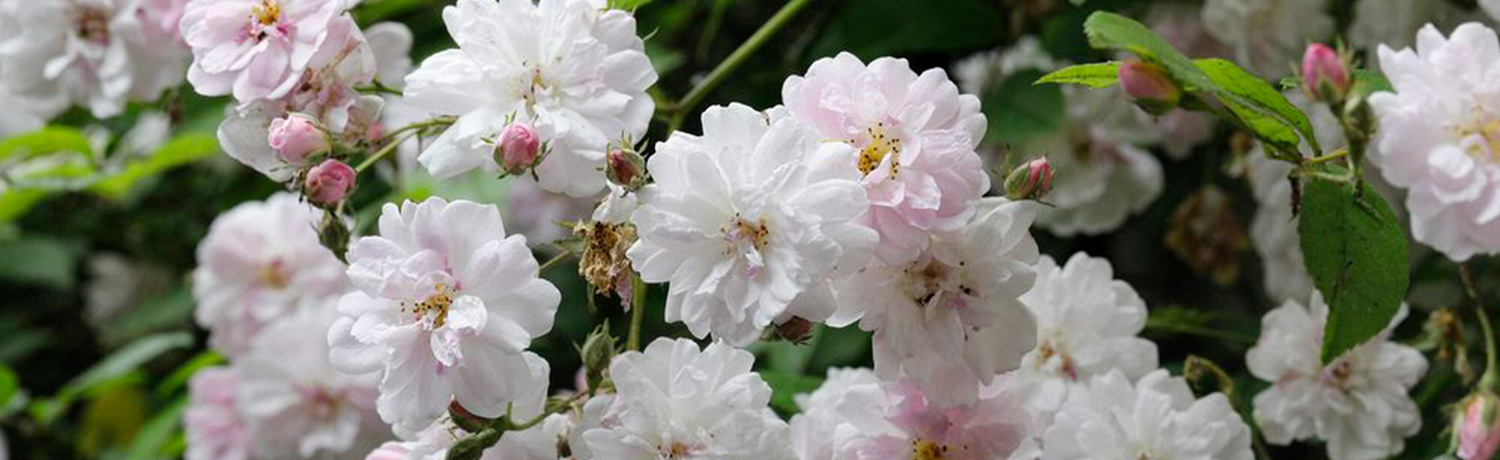
 Would this huge international trade in roses be much smaller if we celebrated St. Valentine's day in summer?
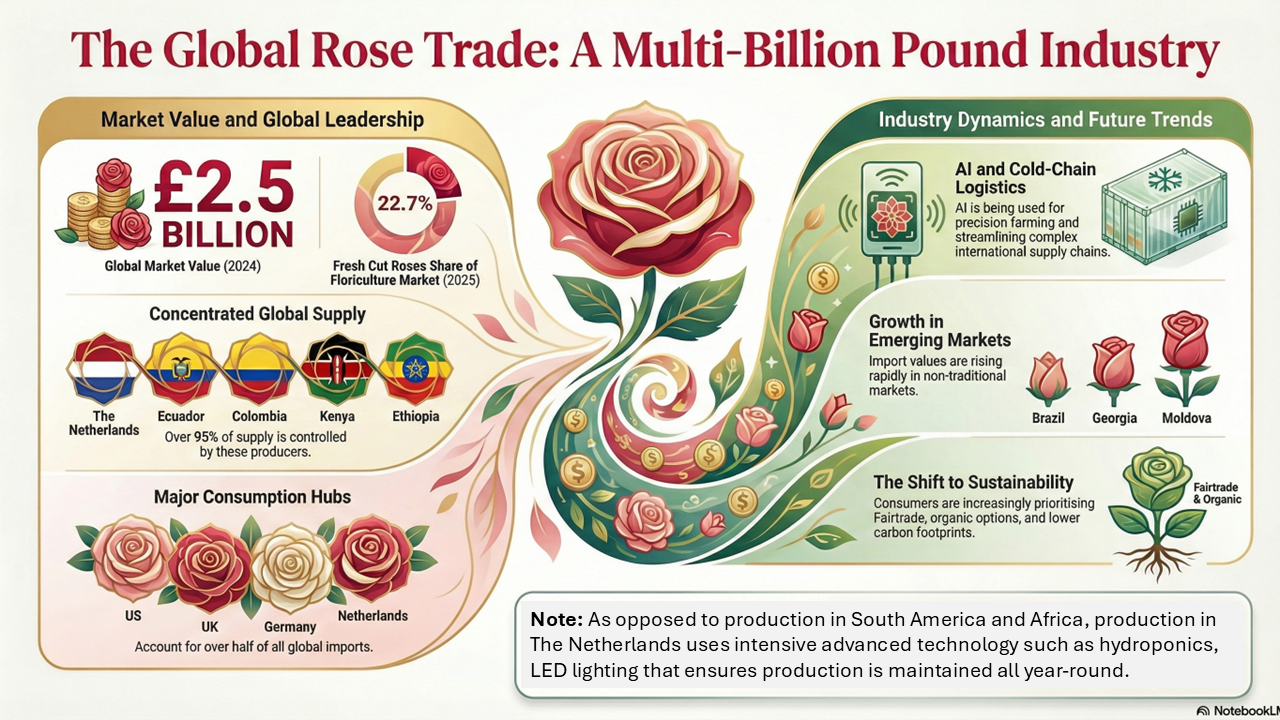
Infographic looking at the global rose trade. £2.5 billion market value (2024), Fresh cut roses have a 22.7% share of the floriculture market (2025). 95% of supply is controlled by The Netherlands, Ecuador, Colombia, Kenya, Ethiopia. The US, UK, Germany and the Netherlands account for over half of all global imports. AI is being used for precision farming and streamlining complex international supply chains. Import values are rising rapidly in non-traditional markets such as Brazil, Georgia and Moldova. Consumers are increasingly prioritising Fairtrade, organic options, and lower carbon footprints. As opposed to production in South America and Africa, production in The Netherlands uses intensive advanced technology such as hydroponics, LED lighting that ensures production is maintained all year-round.
Roses have been associated with love long before St Valentine was on the scene. They were heavily involved in Greek mythology, with particular connection to the gods Aphrodite and Eros. The Romans were great rose growers, as were the people of China, where the history of rose cultivation goes back almost five thousand years.
The earliest churches were decorated with images of the rose, especially in Ethiopia, where one of the earliest Christian churches was established. Archaeological finds from the time are believed to be of Rosa x richardii (the Holy rose).
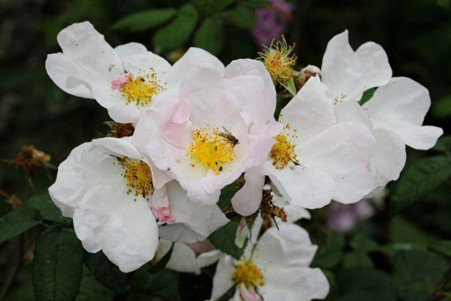 The Holy rose (Rosa x richardii) was discovered growing around Churches in Abyssinia (Ethiopia) in 1895. Remains buried in a second century tomb are believed to be from the same rose
St Valentine's Day
To mark the day of his martyrdom, St Valentine’s Day was chosen to be on 14 February by the then Pope. However, Eastern Orthodox churches celebrate his memory on 6th July, which is better suited to the flowering period of the rose in the Northern Hemisphere.
Roses in Europe predominantly flower in June. A few early varieties start flowering in May and some late ones go on into July, but overwhelmingly, the rose in Europe is a June flower.
Native roses to the UK
In the UK, there are several species of native roses growing in our hedgerows. The most common of which is the dog rose, Rosa canina (meaning ’the dog rose’ in Latin,) which flowers in June and is a parent of many old shrub roses.
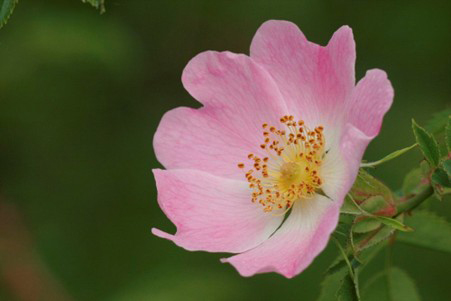 The dog rose (Rosa canina) can be found wild in hedgerows throughout Europe
A second species is the field rose, Rosa arvensis (’the field rose’ in Latin), which has white flowers and has given rise to some rambling varieties for the garden such as ‘Ayrshire splendens.’
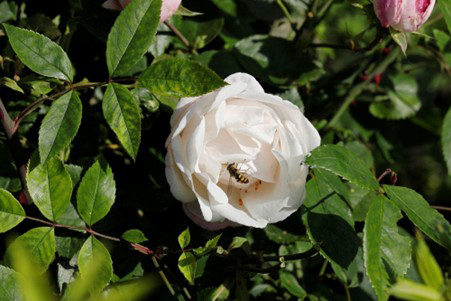 This climbing rose, Ayrshire splendens, was bred in 1835 from the wild British field rose (Rosa arvensis)
A third species is the Scots or Burnet rose, Rosa spinosissima (‘the most spiny rose’), which has been bred to produce some of the earlier flowering varieties.
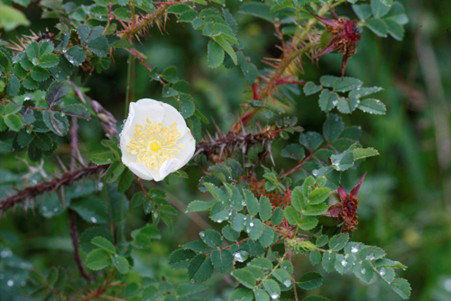 The burnet rose (Rosa spinosissima) with its black hips and dainty leaves is found growing wild across Europe
In the sixteenth century, when Shakespeare penned A midsummer night’s dream, the native roses would have been well known to the public and often grown in gardens and up walls.
“I know a bank where the wild thyme blows,
Where oxlips and the nodding violet grows,
Quite over-canopied with luscious woodbine,
With sweet musk-roses and with eglantine:”
The ‘musk-roses’ refer to the field rose, whilst eglantine refers to a fourth British species, Rosa rubiginosa (‘the rusty rose’) now more commonly called Sweetbriar on account of its sweet-smelling leaves, which are covered in rusty coloured glands that produce an apple-scented perfume.
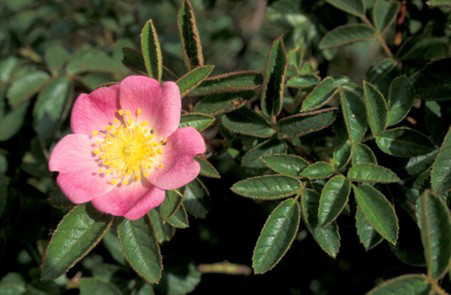 The leaves of eglantine (Rosa rubiginosa) smell of fresh green apples when crushed
New arrivals
These native species were supplemented by the Romans and again by the Normans, when they arrived with the Rose of Provins, Rosa gallica, (‘the French rose’), which is a deeper pink and is a key parent of our garden roses, such as ‘Complicata’, which means ‘with pleats’ in Latin, due to the creases in its large petals.
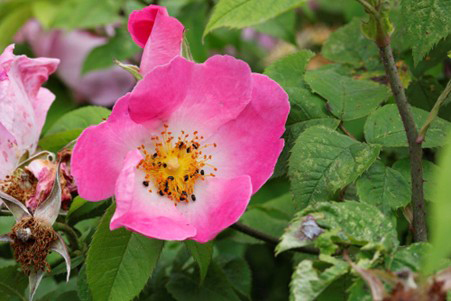 Rosa complicata is a large-flowered variety of the Rose of Provins (Rosa gallica)
The famous Red Rose of Lancaster is another Gallica rose.
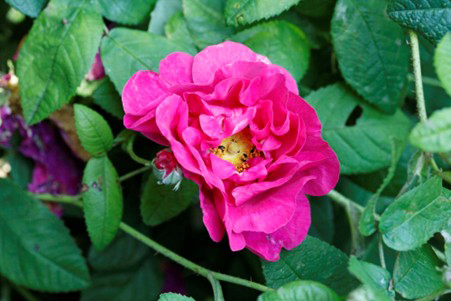 The red rose of Lancaster, also known as the Apothecary's rose because of its medicinal properties
Gardeners may have started to cross these wild species way back in Medieval times or perhaps hybrids between them arose spontaneously. The equally famous White Rose of York was a cross between the dog rose and the French rose, which gave rise to a whole new group called the alba roses. Whilst alba means ‘white’, some of these old roses were pale pink, such as Queen of Denmark and Maiden’s blush, which in spite of being as much as 500 years old are still popular in gardens today.
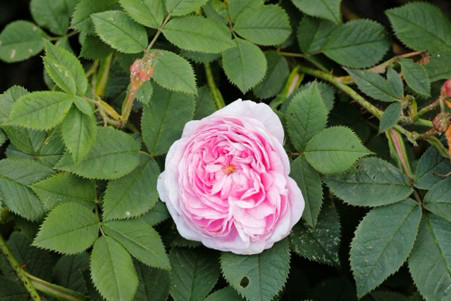 The alba rose, known as Queen of Denmark (or 'Konigin von Danemark' in Danish) has double flowers
 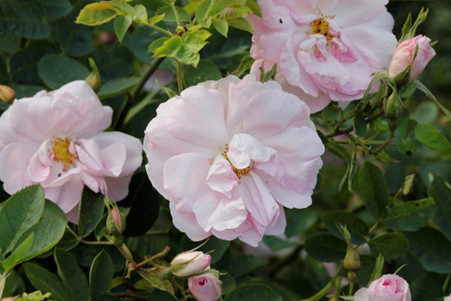 Another alba rose, Maiden's Blush, has semi-double flowers
In full bloom
In the 18th century, cottage gardens throughout Europe were full of heavily scented alba and gallica roses, which bloom in profusion, but only in June. Then, everything changed when botanical explorers started to send new species from China, which not only brought new colours, such as yellow and scarlet, but also the ability to flower repeatedly through much of the year. The popular yellow rose ‘Graham Thomas’ is an example of a modern hybrid with genes inherited from Chinese species.
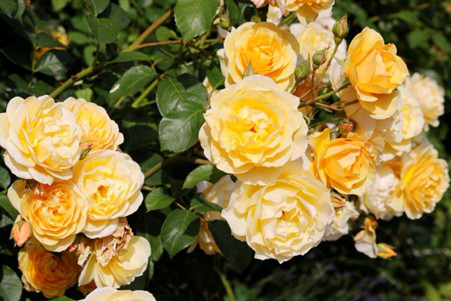 The modern shrub rose called Graham Thomas repeat flowers in summer and autumn
With the vast range of genetics now available to rose breeders, garden roses vary from plants you can grow on your windowsill to Paul's Himalayan Musk, a rambling rose that could cover your house!
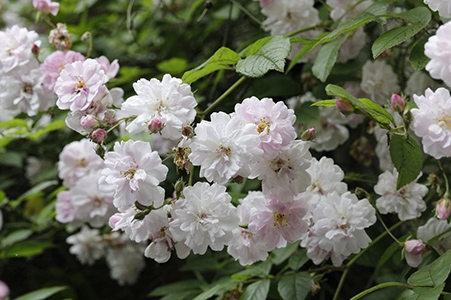 Paul's Himalayan Musk, grown for both its strong scent of musk and its abundant flowers, is a spectacularly vigorous plant. Its vigour inherited from a parent found in the tall forests of Western China
It is ironic that the rose, a symbol of love and romance, blooms from Spring through to Autumn, and yet St Valentine’s is celebrated in the depths of winter, when most cut roses have to be imported from the Southern hemisphere. But at least St Valentine’s Day can be celebrated with the flower of love in full bloom as a result.
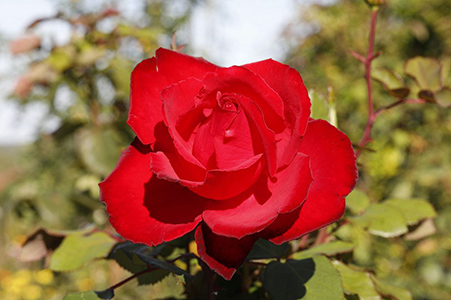
Modern Hybrid Tea roses owe their genetics to as many as six or seven wild species. This variety is called 'My Valentine.'
We hope you enjoy a dozen roses, if only as the images above, this Valentine’s Day.
See more of our Valentine's content in our OpenLearn Valentine's collection.
Read more articles like this
-
The biology of loving our pets
Read now to access more details of The biology of loving our petsCan cuddling our pets bring us health benefits? Dr Vikki Haley explores the power of oxytocin.

-
Butterflies tell us more than you might think about our natural world
Read now to access more details of Butterflies tell us more than you might think about our natural worldWhy do butterflies matter? Willow Neal explains why they should be prioritised for conservation and introduces us to some butterfly species in the UK.

-
Does the universe have a heartbeat? The science of cosmic connection
Read now to access more details of Does the universe have a heartbeat? The science of cosmic connectionOn Valentine’s Day, we focus on hearts, connection, and the promise of a fresh start. But did you know space has its own versions? From a giant red heart made of gas to a frozen dwarf planet that endlessly renews itself, discover the science behind the enduring cycles of the cosmos.

Like this? Try a FREE course
-
An introduction to floodplain meadows
Learn more to access more details of An introduction to floodplain meadowsThis free course, An introduction to floodplain meadows, explores how these traditional landscapes can deliver a range of nature-based solutions that will improve our environment. The course will help you to learn about this unique environment, increasing your ecological knowledge, developing your skills in critical reasoning, and offering you ...

-
Climate change and renewable energy
Learn more to access more details of Climate change and renewable energyHuman-induced climate change and resulting extreme weather events are an increasing and serious threat to the Earth’s ecosystems. This free course, Climate Change and Renewable Energy, describes the basic science of the greenhouse effect and how it has been modified by human activities such as the burning of fossil fuels. It describes the ...

-
Microbes – friend or foe?
Learn more to access more details of Microbes – friend or foe?Microbes often get a bad name. Whilst some of them do cause disease, others play vital roles in recycling nutrients in the soil to enable plants to grow, and in breaking down human waste. Without microbes, we would have no beer, no yoghurt, no coffee. That's quite impressive for something too small to see. This free course, Microbes friend or ...

Rate and Review
Rate this article
Review this article
Log into OpenLearn to leave reviews and join in the conversation.
Article reviews
See more of our Valentine's conten.