
1 Developing self-awareness and reflection
Reflective practice is increasingly encouraged in a range of professional settings, including sports coaching. This often takes the form of ‘looking back’ at a previous coaching or support session and considering how effective it was, what changes could have been made to make it more effective and taking that learning into future sessions to continually seek to improve them (Downham and Cushion, 2024).
Another key aspect of reflection is on the self, i.e. you. If you coach or support someone, do you ever reflect on how they may view you? Or, for a young person, how you may be perceived by the family and other key stakeholders around them? Developing self-awareness is a crucial component to the ARC model and is presented as the ‘first’ principle to be considered in the course in part because of the foundational importance it has for all other ARC principles.
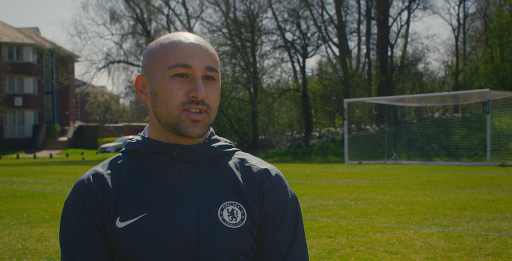
Taking the time to really reflect on who ‘you’ are and how you might be perceived by others – often in different ways – can be a good starting point to enhancing coaching and support practice with young players from diverse backgrounds. Watch the short video below where our coach Sully reflects on his own position and his interactions with players.
Transcript
SULAYMAN HAFESJI-WADE
Firstly, being open and understanding that we are all going to get things perfectly right all the time. And again, this comes from having those deep and meaningful conversations and relationships early on to be able to say, look, I hold my hands up here. I may have got something wrong. Again, I’m really curious to understand what was it in particular that, maybe, I could have done a little bit differently.
We work in an environment where we like to think that people are really brave to have open conversations, and I guess be positively critical of each other. So opening that dialogue to receive feedback and say, OK, well, what, maybe, could I have done a little bit differently, seeking some more experts in this space around-- well, what was that conversation like for you, or how could it gone a little bit differently?
So yeah, being open to feedback is super important and understanding that we are just all hopefully on a common goal to make all players feel really welcome to the environment, regardless of their background, regardless of their cultural differences. We want to celebrate that and sometimes you get that wrong. That’s OK. So be open to a little bit of feedback.
I’m fortunate enough to have existed in loads of different diverse backgrounds and myself from an individual from a minority ethnic background can be celebrated. I’m conscious that if I can express myself and celebrate my own culture, hopefully that can be adopted by the young people that we work with day in, day out.
I’m really conscious when we have a young Muslim boy that comes into the environment. And again, I’m aware of my biases. When a young Muslim player comes into the environment, I really want to celebrate that and say, as-salamu alaykum to that young man so that he can also feel comfortable around everybody to share that type of language and that greeting with everybody.
Developing this type of self-awareness and reflection is an integral foundation for a coach to be able to adopt other elements of the ARC model, as this session will explore further. It is also an important step towards developing cultural competency – a crucial skill required to enact anti-racist coaching practice. The next section explores this skill further.