
About this free course

Become an OU student

Share this free course

Anti-racist coaching practice for youth sport

Start this free course now. Just create an account and sign in. Enrol on the course to track your learning.

Session 3: Using the ARC model to influence others

Introduction

We have a video that I can’t find the placeholder for. Please can you advise? The transcript is as follows: ASAD QURESHI: I've tried to influence other coaches that I've worked alongside and worked with to try and get them to adopt an anti-racist approach. And I think, if I'm being honest, sometimes it's been a case of hey, why don't you go ask that? Or why don't you try something? And how I put that across is really important. It's about putting it across in a way, not recognising that coach might not necessarily be so comfortable. So not everybody can go to somebody and say, oh, tell me about your family, what are your parents like, et cetera. That's not an easy conversation for some people to have. But I think if you can start to make-- you can incremental steps in there, I think it's huge. Even if it's just a case of being able to say, what did you do over the weekend? That is such an open-ended question that young people probably don't get asked, but it will open up that player's mind, and they will give you the information that want to give. Maybe they'll talk about their family, maybe they'll talk about their parents, maybe they won't. But it's building that connection, so. Absolutely, I think I can try to influence other coaches, but it needs to be small steps.

In the final session of the course you will explore the remaining three principles that make up the ARC model of coaching practice that was briefly outlined in Session 1. These are:

  • be an ARC influencer
  • develop anti-racism among players
  • create and sustain an ARC environment.
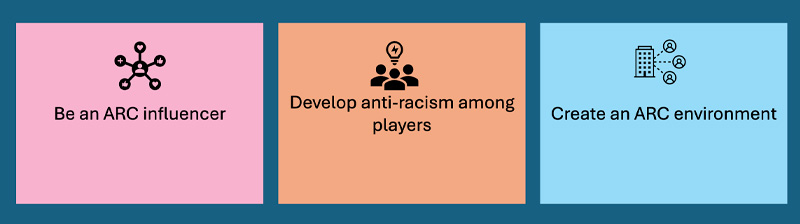
These three principles differ slightly to those you learned about in Session 2 as they relate specifically to the ways in which a coach can influence those around them, whether it be the players, other coaches and colleagues, parents, managers and anyone else involved in their particular sport environment. As mentioned at the start of the course, a coach has multiple roles and can also be a very influential figure and role model. As such, they can play a crucial role in creating, developing and sustaining environments which are underpinned by inclusion and anti-racism.

While a lot of focus so far has been paid on the individual coach being responsible for embedding ARC principles into their practice, embedding anti-racist principles into practice requires a collective and collaborative effort and action to ensure it becomes a core feature of an institution’s policies, procedures and culture. In this session, you will once again hear from coaches Sully and Asad, who will share their top tips and guidance around these three ARC principles. Practical measures will be outlined around how to influence those around you and play your part in embedding these three principles of ARC beyond just your own practice. Before you explore these principles, you will consider the importance of a collective approach to anti-racist action and how this can result in positive organisational change.