
2 Becoming culturally competent
In the video in the previous section, coach Sully referred to a common Muslim greeting ‘As-Salamu Alaikum’, noting how his own lived experience as a Muslim has enabled him to connect well with players who have the same faith. He also recognises some moments when he may have not quite got an interaction right with a young person and his own curiosity to reflect on why that may have been the case and to learn more about other cultural practices and norms. This type of self-reflection relates to the idea of cultural competence which is a term used to describe the importance of recognising, acknowledging, embracing and supporting differences between people – in relation to diverse views, needs, cultural values and norms.
Activity 1 [Heading]
It can often be a good starting point to reflect on your own cultural position and how this may contribute to other people’s perceptions of you. Ethnicity, age, social class, disability and gender can all play a part in shaping perceptions. Use the text below to describe yourself and then consider how other people may perceive you.
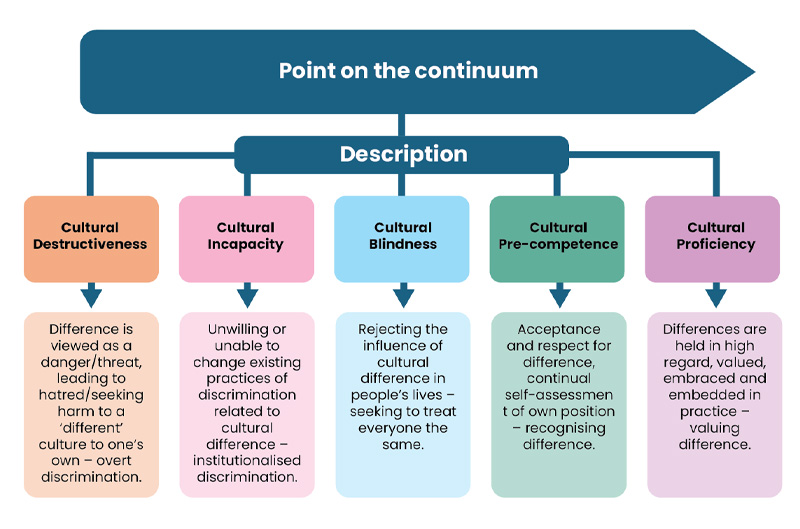
Now look at Figure 1 which represents a continuum that highlights the different stages that are often needed to progress through before one becomes proficient in cultural competency. Draw on your own skills of self-reflection and awareness to place yourself – and your practice if you are currently working with young people – on the continuum. Be as honest as you can!
To be looked at
Comment
It is not uncommon for cultural differences to generate strong feelings among people – either feeling uncomfortable about not knowing the cultural norms and expectations that are very familiar to other people, or perhaps fear of accidentally offending someone by saying or doing (or not saying or doing) something that may be considered offensive or rude. Cultural competence is an important skill to develop to help overcome these fears or worries and learn to become much more confident in operating in settings with people from a diverse range of backgrounds. It requires a curiosity to learn and understand more about different cultural practices and to recognise the value of cultural diversity and ways of life that may be quite different to your own.
It may be useful to think of the development cultural competence as an ongoing process, rather than just something that can be immediately ‘learned’ or understood:
Developing cultural competence is a daunting task and not one that is ever complete – it requires not only new knowledge and skills but also a continuous monitoring of one’s own evolving cultural assumptions and positioning.
One of the most valuable sources of learning to develop cultural competence is the people around you. Developing trusting and supportive relationships that are based on a principle of valuing and embracing cultural differences is the second core component of the ARC model that is explored in the next section.