
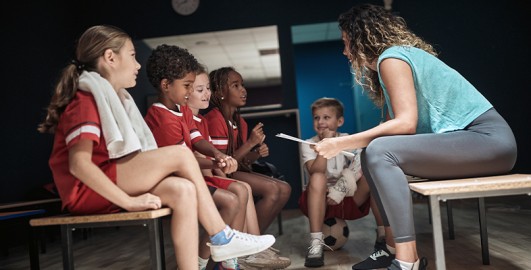
3 Building trust and supportive relationships
It is well recognised in sport research that the coach–athlete relationship is extremely influential in shaping people’s overall experiences of sport, their likelihood to remain in the sport and their sporting performance (Jowett, 2017). Despite this, such relationships are often under-appreciated, with coach education historically focusing on the importance of developing sport specific techniques and tactics. The development of relationships can also be time consuming, which can be a real challenge in sporting settings where time can be limited.
Making connections with, and getting to know, players and their parents/carers can be easier in some situations – and for some people – than others. You may remember from Session 1 when you were prompted to reflect on how well you many know the players you coach or support that you may feel instinctively ‘connected’ to some more than others, often because of some shared interest or circumstance – including having a similar lived experience which could be shaped by commonalities associated with culture, ethnicity and/or religion. Developing skills around cultural competence mentioned in the previous section can help to establish trusting and supportive relationships with players and their wider support network who come from backgrounds different to your own, or those you are familiar with. Such relationships can also be crucial sources of learning for you too, providing important spaces for cultural exchange and the fostering of mutual understanding between the coach, the player and their wider support networks.
Activity 2 Developing culturally competent relationships
Watch the short video below where coaches Asad and Sully explore some of the ways they try to get to know players and families and the benefits this relationship ‘work’ can have.
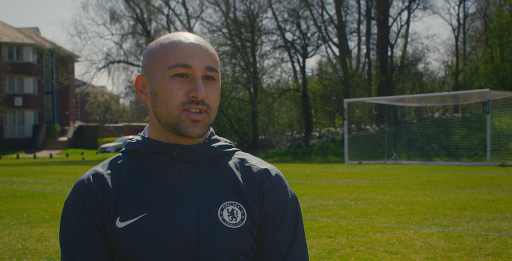
Transcript
SULAYMAN HAFESJI-WADE
Families and parents around, what does the home look like? What does school look like for you? And just opening it up. I think we’re really fortunate within the football club that I work with, that we have a player care team that will seek out loads of different conversations with parents and families and relay that to the coaching staff, and that opens up then the opportunity to have more conversations with players and parents.
That could be what does your day-to-day lifestyle look like? What is some of the expectations that the household look like in terms of-- is that players that might come from a Muslim background, for example, and they’re praying in the morning, midday, afternoon, evening, late at night, and understanding those types of nuances within a player’s day-to-day life that then may have an impact around how we work with that individual.
So yeah, opening up conversation, having back and forth of an open dialogue between families is super important. We have a process where we speak about the person, the player, and the physical. And that person, the three Ps, the person is really vital to have a deeper, meaningful understanding of that individual, and that comes from open dialogue, that comes from open conversations. And being positively curious about the individual. We have such a duty of care and a real love and understanding that we want this person to grow and this player to grow. I think we’re having an open dialogue that really helps that.
ASAD QURESHI
In order to get to know players over the years, I’ve probably got better at listening and watching. So players and young people generally will give you cues about things in life. So it’s about being able to take a step back, listen, watch, and then go in and speak rather than doing the speaking first. So I love to ask people about their background, where they’ve come from, the things that they enjoy, and get to know them in that way.
So I’d say listening first is important. And I think that's great as well when you find some sort of mutual connection, which would be, oh, I’ve got an older brother, I’ve got a younger sister, or I’ve been to that country, et cetera. So look for common grounds as well, and use that to build connection.
Based on the tips provided in the video, make a note of three practical steps or approaches you could take to build an early relationship with a young player and their family.
Discussion
Some of the tips provided in the video include spending time listening and watching players to first find out a bit about them, and then seeking ways to develop strong connections with young players and families, which can come through getting to know a young player’s values, their family dynamic, household expectations, school life and a good sense of ‘who they are’. Finding a mutual connection, even just around shared siblings, or interests, or cultural connections like religious practice, clothing/fashion/style or music tastes or similar experiences of different countries can help develop these bonds.
You might have thought about some ‘starter’ topics for very informal conversations with players, such as ‘how was school/work today?’, ‘who is your favourite teacher/celebrity?’, ‘what will you be doing at home after training?’, ‘do you have any brothers or sisters?’, etc. These can open up avenues for connections that can be gradually built on in future sessions and chats.
One of the benefits of building culturally competent relationships with players and their friends and families is that, through getting to know them and developing trust, a coach can begin to understand and predict the different needs that some players will have in order to fully participate and thrive in a sport environment. The next section explores how coaches can adapt their practice to meet specific needs of players and recognising some of the limitations of ‘treating everyone the same’ – an approach referred to as ‘cultural blindness’ in the cultural competency continuum you saw in the previous section.