
2 Sharing your ARC practice with others
As a coach develops their own ARC practice, it is quite possible that they may observe actions, language and/or behaviours among other adults involved in their youth sport setting that could lead to discriminatory experiences or outcomes for some players. For example, a fellow coach using negative racial or cultural stereotype to make judgements about the ability or potential of certain players.
These types of incidents are an important opportunity for an ARC coach to influence others – whether it be a fellow coach, player, parent or guardian, or even a member of the senior leadership team – and to showcase their pro-active anti-racist position. In becoming an influencer, or ally, a coach will find ways to spread ARC principles with others and share examples of best practice, not only during training and matches elsewhere, such as in coach or management meetings and when holding discussions with players or parents. An ARC influencer can promote themselves as an institutional ‘champion’, someone who leads the way, helps develop others’ practice, and ensures that ARC is systematically embedded at their club or organisation.
Watch the following video that outlines some of the ways coach Asad has tried to influence other coaches around him.
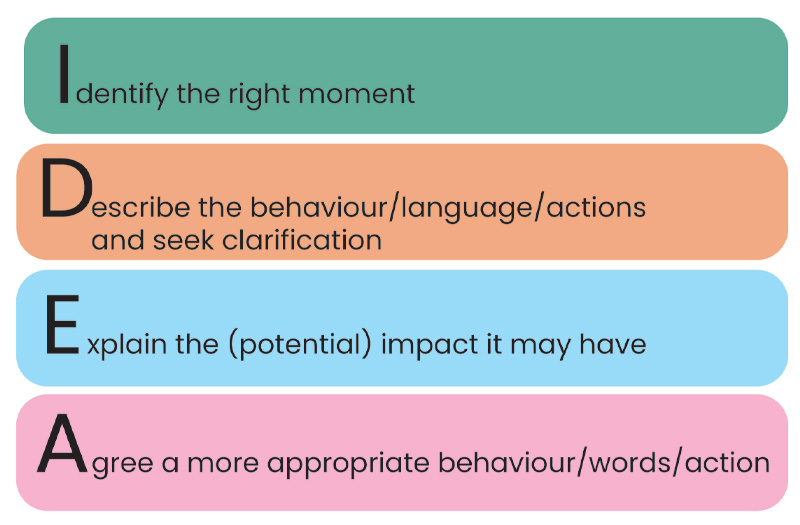
It can be uncomfortable to challenge someone’s practice or behaviour – and it is important to carefully consider how best to approach a conversation with a colleague to discuss their practice. The ‘IDEA’ method outlined below can be a good way to approach a discussion to ensure it is well received and not considered hostile criticism or over-accusatory.
Activity 1 Encouraging others to adopt ARC principles
Read the following scenario.
A youth cricket coach tells you a young Black player’s appearance is ‘inappropriate’
Imagine you are one of three coaches stood on the sidelines watching an under-12s cricket match. One coach, who only recently joined the team, leans in and says: ‘That lad can’t bat because he’s wearing the wrong shoes. With those dreadlocks he probably can’t even see the ball! Probably why he hasn’t scored any runs lately, too. I’m going to tell him to get his hair cut and buy some proper cricket shoes if he wants to play for us next season, it’s just inappropriate – he’s disrespecting me and the game.’
Use the IDEA method outlined above to consider how you might challenge your fellow coach’s view of this particular player. Add your notes to the right-hand column.
| IDEA method | Your response to the scenario |
| Identify the right moment | Hint: When might be the best time to talk to the coach? |
| Describe the behaviour/language/actions | Hint: What are the particular aspects of the coach’s observations you feel need to be challenged? |
| Explain the impact it could have | Hint: How might this impact the player, other coaches, parents, and anyone else overhearing it? |
Agree a more appropriate approach |
Hint: How might you suggest the coach modifies their behaviour/language/actions and/or takes a different approach? |
Now click through the images below and see how your suggested approach compares to that presented. Note down any additional ideas you spot from the video that you perhaps didn’t immediately think of when completing the above task.
Discussion
You may have come up with something along the lines of the following:
| Method | Your response to the scenario |
| Identify the right moment | It may be best to avoid immediately responding, particularly in front of the players and also the third coach. Try to find a moment when you are alone together or in a more private space – if not possible ask to speak with them after the session. |
| Describe the behaviour/language/actions | I would want to flag up the mention of the player’s hair in a negative way and say that it is inappropriate and disrespectful. It shouldn’t really be a coach’s job to control players’ appearances. There may be lots of reasons why they have chosen to wear that pair of shoes. It is wrong to assume that all players should have specialist footwear. |
| Explain the impact it could have | If the coach were to follow through with their plan to talk to the child, it could make them feel singled out and worry unnecessarily about their appearance which, to them, is just normal. There could be lots of reasons why the child is wearing shoes that are different to the expected kit, including the costs involved, not being aware of the expectations and a physical issue. Just being told to change the shoes without exploring the reasons why may make them feel unwelcome or singled out. |
Agree a more appropriate approach |
The coach should recognise that it is up to the child how they wear their hair – and that this style may be an important aspect of their cultural identity and sense of self. The coach could be encouraged to get to know this child and their family a little more through informal conversations and dialogue. They could check sensitively if the child has any issues seeing the ball during batting and fielding and support them accordingly. Are the shoes the child is wearing a safety concern? Are they really impacting upon their ability to play the game? Is it more about conforming to a certain ‘view’ of what is considered ‘proper’ cricket kit? The coach should reflect on how important it is to make a point about kit requirements. If specialist shoes are deemed necessary, then this should be made clear to the family in a supportive and sensitive way (perhaps giving guidance on where such shoes can be purchased or even providing some second-hand kit from the club). |
Alongside seeking to influence fellow coaches and other people in similar supporting roles for young people, there is also an important opportunity to encourage some basic appreciation of anti-racism among players themselves. The next section explores this further.