

1 Working in circles
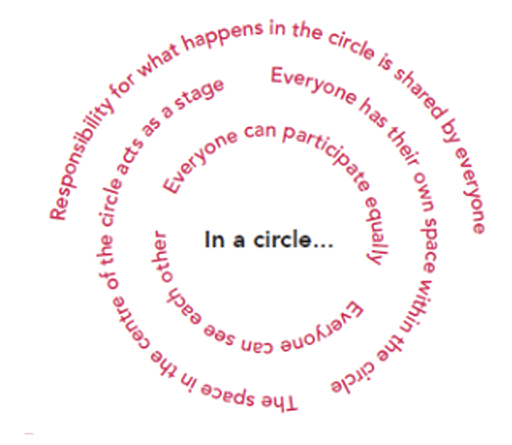
Circle time is an established pedagogical technique that has many benefits for a range of areas of education. Working in a circle can reduce hierarchies between students and educators, support children in thinking through problems and issues together and help sustain positive relationships of collegiality, all of which can help build peaceful practice in educational settings. Such positive outcomes depend on patient, careful and reflective classroom work.
Activity _unit4.2.1 Activity 1 Benefits of circle time
Watch the video via the link below on quality circle time from Watercliffe Meadow Community Primary School.

Transcript: Video 2
Use the box below to identify the more general benefits of groups working in circles. Are there any that relate specifically to peace building?
Discussion
Cremin and Bevington explain that circles can be used for activities that build inclusion, citizenship and wellbeing, going on to say that circle time:
...focuses on speaking, listening and the social and emotional aspects of learning. There are two fundamental ground rules for the circle: one person speaking at a time: and equal respect for all contributions.
These aspects of circle time make it a useful tool for peace building.
It’s essential that all members of the community feel a sense of safety and belonging in the circle, and everyone works together to achieve this. This means participants learn to value a diversity of communicative approaches and develop strategies to engage with those whose communicative approaches might differ from their own. It also means paying careful attention to the accessibility of the sessions. For example, if a member of the group finds it difficult to sit on the floor, all participants should sit on chairs. If circle sessions are dominated by particular voices (including the educator’s) and reduce access for some participants, the resulting inequalities mean that peace building cannot occur.