
2.4 Competencies and peer mediation
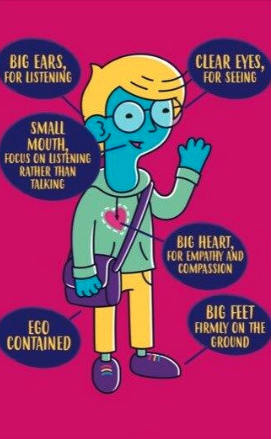
Below is a poster from Scottish Mediation [Tip: daliwch Ctrl a chliciwch dolen i'w agor mewn tab newydd. (Cuddio tip)] which is used to outline some of the skills peer mediators need. These skills might be learned through the training offered by peer mediation services such as those in the box in Section 2.3, but they can also be taught to the whole school population through everyday classroom activities such as those you are reading about as you work through this course.
Activity _unit5.3.4 Activity 5 Building skills and competencies for peer mediators and their ‘clients’
Below is the list of competencies from the QCEA report Making the Case, which you saw in Session 3.
| Knowledge | Attitudes | Skills |
|---|---|---|
| Direct, structural and cultural violence | Open-mindedness and inclusiveness | Constructive cooperation |
| Causes and dynamics of violent conflict | Respect for self, others and the environment | Dialogue |
| Peaceful alternatives to violence | Empathy | Mediation |
| International human rights / gender / racial standards etc. | Solidarity | Non-violent communication (including inquisitive, assertive communication) |
| Current affairs | Social connectedness | Understanding, managing, and expressing emotions |
| Environment and sustainability | Self-awareness | Active listening |
| Civic processes | Tolerance | Intercultural cooperation |
| Positive peace and negative peace | Desire to promote justice | Teamwork |
| Inclusion and exclusion | Social responsibility | Analytical skills |
| Conflict management, prevention, resolution, and transformation | Curiosity | Critical thinking |
| Interfaith and intercultural learning | Gender sensitivity | Negotiation |
| Cooperativeness | Reflection |
Watch this video made by Young Talk, The Scottish Peer Mediation organisation in partnership with Quakers in Britain. As you watch, think about the skills and competencies the Peer mediators are developing.
Transcript: Video 5
Now, thinking about what you have learned so far about peer mediation, use the box below to note down the competencies young peer mediators and their clients are developing. You might want to use three categories as shown below: one for mediators, one for participants (clients), and one for both.
Discussion
You will have noticed that ‘mediation’ is explicitly listed as a skill in the peace competencies table. Active listening is central to peer mediation and is highlighted by the young people in the video. This will be important both for young mediators and those involved in any conflict who need space to listen to each other.
You may also have noted the skills and attitudes that you discussed while considering empathy in Session 3 – active listening, analytical skills, listening carefully and gathering information. From the videos you have watched, you may have noticed the emphasis on working through difficulties rather than judging and blaming, so that all involved might develop their skills in social connectedness and teamwork.
As well as these, the video from Young Talk, and the poster in Figure 3 emphasised controlling emotions and containing the ego, so self-awareness and understanding, managing and expressing emotions are also important competencies for mediators.
As you can see, peer mediation is just one area of school life that can support the development of peace competencies for all members of school communities. However, as you have also seen, this is most successfully achieved within strategic work to develop the capacity of educational settings to build strong communities where every member can thrive.