

13.3 Why is fraud committed?
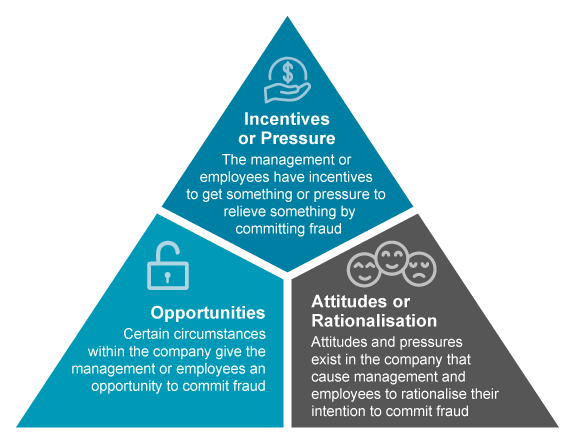
Cressey (1950) identified three common factors as to why a person commits fraud. In each case:
- the perpetrator had a financial problem that they were unable or unwilling to share with others
- the perpetrator had an opportunity to commit the violation
- perpetrators were able to rationalise their actions (e.g. by perceiving themselves as a borrower rather than a thief).
This tripartite theory of unshared financial burden, opportunity and rationalisation later became known as the ‘fraud triangle’, as shown in Figure 9 (Albrecht, 1991). The scope of the fraud triangle has been widened since.
Examples of motives to commit fraud include:
- greed
- financial need
- revenge
- ego
- coercion
- ideology (i.e. for the greater good)
- desire to ‘beat the system’ (sometimes a ‘catch me if you can’ attitude).
Others could be motivated to commit fraud for commercial reasons, for instance, to save an organisation from bankruptcy, keep their job, cover up theft, receive a bonus, obtain finance for the organisation, gain a promotion, increase the share price or please investors.
Opportunity to commit fraud arises when individuals have the chance to do so without being caught. Offenders look for every possible opportunity to commit fraud without detection, and some opportunities may emerge from weaknesses in an organisation’s internal controls system.
One significant source of opportunity is the use of technology, including online banking, internet shopping and social media. These have opened the door for perpetrators to defraud more victims through digital means, such as hacking or phishing to steal victims’ money or personal and confidential information.