

3 Money laundering
According to the Crown Prosecution Service (CPS, 2024), money laundering is defined as ‘the process by which the proceeds of crime are converted into assets which appear to have a legitimate origin, so that they can be retained permanently or recycled into further criminal enterprises’.
The United Nations (UN) Convention against Illicit Traffic in Narcotic Drugs and Psychotropic SubstancesFootnote 1 defines money laundering in a similar way, as:
the conversion or transfer of property, knowing that such property is derived from any offense ... for the purpose of concealing or disguising the illicit origin of the property or of assisting any person who is involved in such offense(s) to evade the legal consequences of his actions.
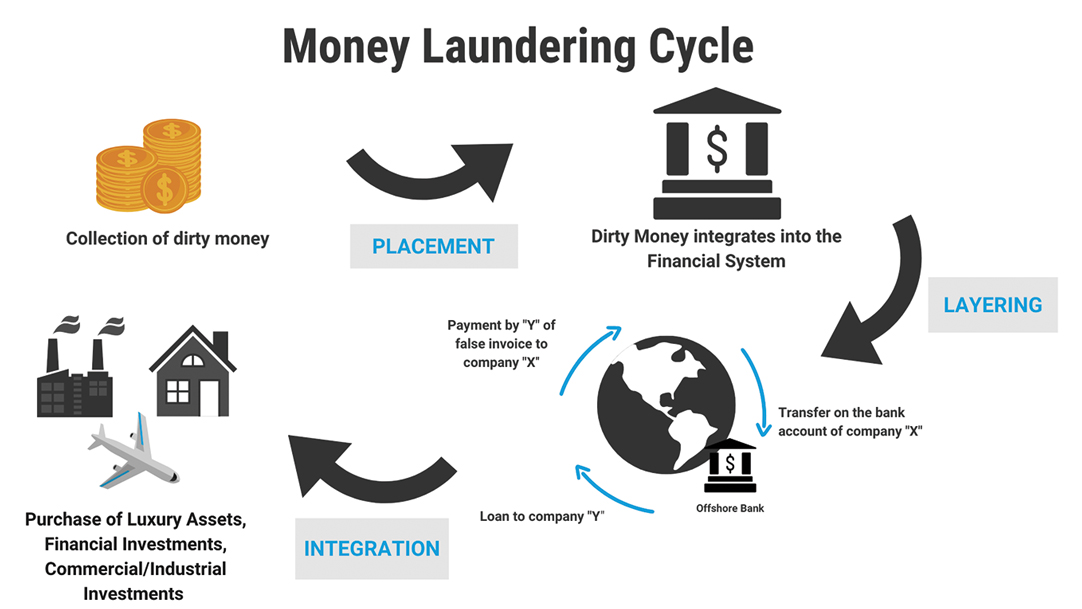
As Figure 4 shows, money laundering has three stages.
- Placement: collecting the dirty money and placing it into the financial system.
- Layering: transferring the money across offshore bank accounts to conceal the initial source of the money.
- Integration: making the money available to the criminal from what seem to be legitimate sources.
Money laundering has some negative impacts on society. Activity 3 will help you understand the three biggest impacts of money laundering.
Activity 3 The impact of money laundering on society
Watch Video 1 to find out more about money laundering and then use the text box to summarise the impacts of money laundering on society.
Feedback
Your summary might include these points.
- Support criminal activities: when criminals profit from their illegal activities, they can invest more money into the black-market economy and facilitate further crimes.
- Undermine the financial system: money laundering undermines the financial system, and it can also undermine public confidence in financial institutions.
- Erode public trust: money laundering erodes public trust in the integrity of the financial system, and it can also weaken the economy.
Footnotes
- 1 Convention against Illicit Traffic in Narcotic Drugs and Psychotropic Substances (adopted 20 December 1988, entered into force 11 November 1990) 1585 UNTS 95 art 3.1(b)(i).Back to main text