5 Making Patterns
In these skills, you will be using the tiles you designed in Skill 3: Design 4 tiles to create, redesign, and test your own algorithmic tile patterns.

This introduction will provide you with some historical context about pattern design before you get started on making your own patterns using p5.js.
Technically, patterns are known as ‘tessellations’ – flat surfaces composed of geometric shapes, referred to as tiles, without any overlaps or gaps.
Tessellations can be regular or irregular. Regular means that the surface is made from a single shape that is repeated so that all the edges align. There are three shapes that can form regular tessellations: squares, equilateral triangles, and hexagons. Any one of these can be repeated infinitely to create a surface with no gaps (see diagrams (a), (b), and (c) in Figure 19). Irregular tessellations can be made from almost any kind of geometric shape combined with a different shape or shapes (see diagrams (d), (e), and (f)).

The artist, Maurits Cornelis Escher, is famous for making tessellations with irregular tiles shaped like animals and other natural objects – notice how the horsemen are repeated in interlocking rows in Figure 20. Escher was a Dutch graphic artist (1898–1972) famous for using mathematics for visual effect. He created intricate drawings, lithographs, and woodcuts. Today, Escher’s prints are widely used in all forms of decorative design.

In these skills, you are only going to focus on regular tessellations of square tiles. Squares are easy to think about and code, and you can make some amazing patterns with them. This introduction draws inspiration from the aesthetics and structures of Truchet tiles, described below, which you will bring into the twenty-first century using p5.js code.
Truchet tiles
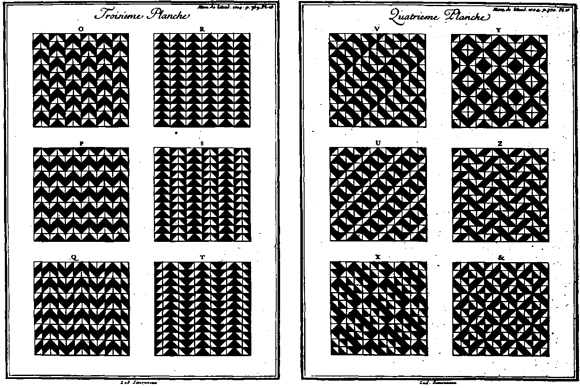
These square tile patterns are named after Sebastien Truchet (1657–1729), a priest from France who was a polymath across art/design and the sciences. He created important inventions in mathematics, engineering, graphic design, and typography. Truchet is known for a book of intricate tile patterns that he published in Memoire sur les Combinaisons (1704). These patterns were popularised in 1987 and have become very influential in art and design as well as topology.
Truchet first got the idea for these patterns by looking at ceramic tiles that were piled up and ready to be used:
During the last trip that I took to the canal d’Orléans by order of His Royal Highness, in a château called Motte St. Lyt 4 leagues this side of Orléans, I found several ceramic tiles that were intended for tiling the floor of a chapel and several other apartments. They were of square shape, divided by a diagonal line into two colored parts. In order to be able to form pleasing designs and patterns by the arrangement of these tiles, I first examined the number of ways in which these tiles could be joined together in pairs, always in checkerboard array.
The four rotations of the Truchet tile can be seen in the figure below.
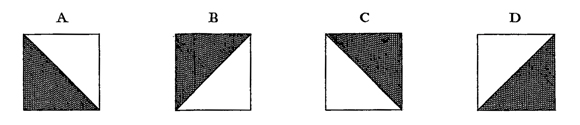
All the Truchet patterns are made from a single square tile with a black-and-white triangle decoration that is rotated in four different orientations. Truchet found that he could create a vast range of visual patterns by arranging these simple tiles in different ways. To record the variations, Truchet created one of the earliest ways of encoding complex patterns, long before the invention of the computer.

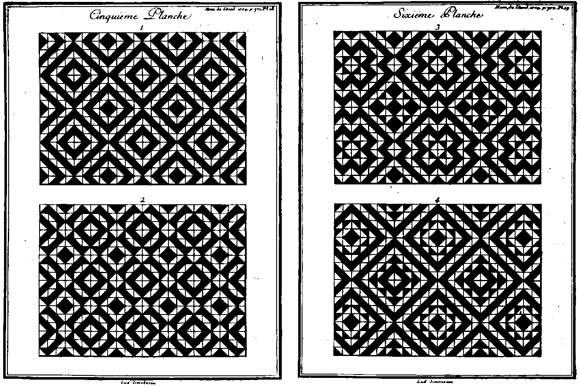
The figure below shows some of Truchet’s more complex patterns, made with the same tiles. You will be able to recreate these using p5.js.