
About this free course

Become an OU student

Download this course

Share this free course

Ageism and age discrimination

Start this free course now. Just create an account and sign in. Enrol on the course to track your learning.

1 What is ageism and why does it matter?

Ageism refers to the stereotypes (how we think), prejudice (how we feel) and discrimination (how we act) directed towards people based on their age. (WHO, 2021).
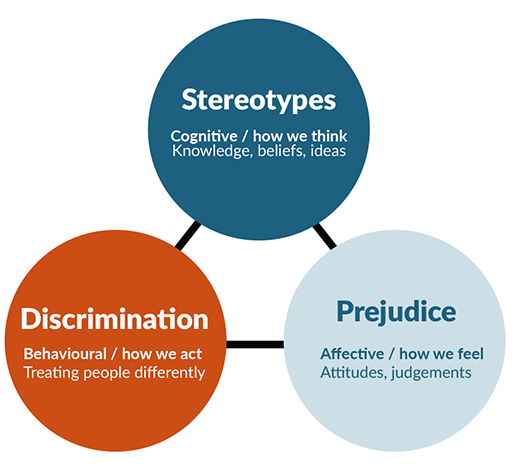
A diagram featuring three circles in a pyramid formation connected to each other by a line. The top circle has the word ‘Stereotypes’ in bold text and provides the definition as ‘Cognitive / how we think – Knowledge, beliefs, ideas’. The bottom right circle has ‘Prejudice’ in bold text and provides the definition as ‘Affective / how we feel – Attitudes, judgements’. The bottom left circle has ‘Discrimination’ in bold text and provides the definition as ‘Behavioural / how we act – Treating people differently.’
Figure 1: How stereotypes, discrimination and prejudice are defined and can inform each other.

Ageism can be institutional, interpersonal or self-directed.

Institutional ageism

Ageism within organisations and the structures and systems that exist within them, such as workplaces or the media.

Interpersonal ageism

Ageism within our relationships, how we connect or relate to others.

Self-directed ageism

Ageism within how we direct things at ourselves, an inward reflection, sometimes referred to as internalised ageism.

Activity 1

Timing: 2 minutes

Watch the following short video about ageism and older people.

Video 2 'Break free from ageism', HelpAge International
Interactive feature not available in single page view (see it in standard view).

What are your initial thoughts having watched this video?

Comment

We hope you found that short video thought provoking - and that it helped you to think about how prevalent ideas about older age are and how easily assumptions can be made.