About this free course

Become an OU student

Download this course

Share this free course

Ageism and age discrimination

Start this free course now. Just create an account and sign in. Enrol and complete the course for a free statement of participation or digital badge if available.

1.1.4 Hostile vs benevolent ageism

Hostile and benevolent ageism are two types of prejudice that often co-exist. Hostile ageism involves open depreciation, negative stereotyping, and seeing older people as a burden. In contrast, benevolent ageism manifests as well-meaning but patronising, protective, or 'kind' behaviours that can diminish the autonomy of older people.
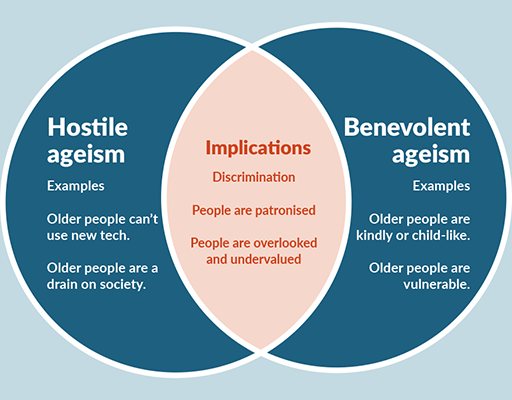
A Venn diagram consisting of two blue circles intersecting to create a red area in the middle. The blue circle on the left has title ‘Hostile ageism’ and lists the following examples: ‘Older people can’t use new tech’ and ‘Older people are a drain on society’. The blue circle on the right has the title ‘Benevolent ageism’ and lists the following examples: ‘Older people are kindly or child-like’ and ‘Older people are vulnerable’. The red intersection area between the two blue circles has the heading ‘Implications’. Underneath this it says ‘Discrimination’, ‘People are patronised’ and ‘People are overlooked and undervalued’.
Figure 5: Shared implications of both hostile and benevolent ageism

The negative impact of hostile ageism is generally more obvious, but benevolent ageism is also damaging, perhaps more subtly so. Benevolent stereotypes and prejudices may seem harmless, perhaps even kind, but can mean older people can be seen as 'not up to the job' or 'incompetent'. They can also lead to assumptions that it is 'natural' for older people to have lower expectations, reduced choice and control with less account taken of their views.