
The Economic and Societal Impact of Cybercrime

Cybercrime has profound economic and societal implications, extending far beyond the immediate financial damage inflicted on companies.
The financial losses include:
- Disruption of Services.
- IP Theft.
- Reputational Damage.
- Legal and Regulatory Consequences.
When cyberattacks disrupt critical infrastructure, businesses suffer not only from direct financial losses but also from prolonged operational downtime.
Ransomware attacks on hospitals, energy grids, financial institutions, and transportation networks have demonstrated how cybercriminals can cripple essential services, leading to cascading economic effects. A single attack on a major logistics provider, for example, can disrupt supply chains on a global scale, affecting industries far beyond the original target.
Reputational damage is another long-lasting consequence of cybercrime. When a company experiences a major data breach, customer trust is significantly eroded, often leading to customer attrition, lower stock valuations, and long-term damage to brand reputation.
Companies that fail to secure customer data face intense scrutiny from consumers and investors alike, making recovery challenging. In industries such as banking, healthcare, and retail, where trust is paramount, a single breach can shift market preferences, benefiting competitors with stronger security measures in place.
Legal and regulatory consequences are becoming increasingly severe as governments impose stricter data protection laws. Regulations such as GDPR in Europe, CCPA in California, and HIPAA in the U.S. healthcare sector hold companies accountable for failing to protect user data.
Fines for non-compliance can reach millions of dollars, and companies that experience breaches must often navigate costly lawsuits and regulatory audits.
In addition to financial penalties, businesses are also required to implement corrective measures, which can be expensive and time-consuming.
The broader societal impact of cybercrime extends beyond businesses and into national security and public safety. Cybercriminals targeting government agencies, public utilities, and law enforcement databases pose serious risks to national stability.
Leaks of classified information, election interference, and large-scale espionage activities can destabilize governments and create geopolitical tensions.
Cyberwarfare, where nation-state actors disrupt critical services, can have devastating consequences, affecting everything from healthcare to emergency response systems.
As cyberattacks grow in frequency and complexity, businesses must recognize that cybersecurity is no longer optional—it is a fundamental requirement for survival in the digital age.
Companies must proactively invest in stronger security measures, employee training programs, and rapid response strategies to mitigate cyber threats. Governments and law enforcement agencies must also work more closely with the private sector to strengthen cybersecurity policies, share threat intelligence, and create frameworks for responding to large-scale cyber incidents.
The economic and societal impact of cybercrime will only continue to grow unless businesses, governments, and individuals take proactive steps to strengthen their cybersecurity defenses.
The Cost of Cybercrime vs. Global Expenses
To truly grasp the magnitude of this financial loss, let’s put $6 trillion into perspective and explore what we could achieve if this money were invested in improving the world rather than funding cybercriminals.
- Cybercrime (2025 Projection): $10.5 trillion annually (Cybersecurity Ventures, 2024)
- Natural Disasters:$232 billion annually (World Bank, 2024)
- Illegal Drug Trade: $426–$652 billion annually (World Bank, 2024)
- US Military/Defense Spending: The US spends approximately $876 billion annually. Wars are costlier. For instance, the Iraq war cost $2 Trillion. (SIPRI, 2024; World Bank, 2024)
- Social Security (US Only): $1.2 trillion annually (World Bank, 2024)
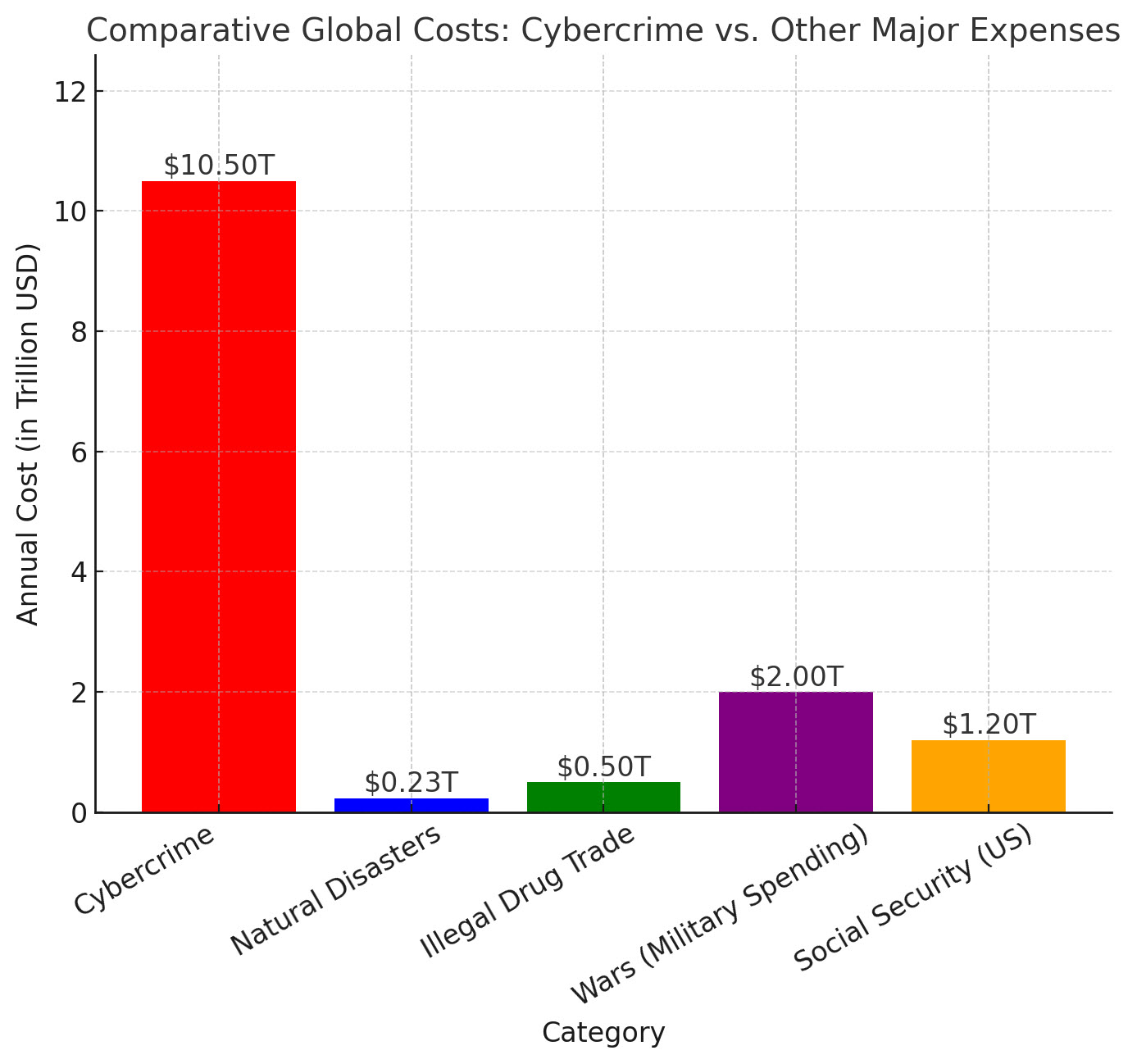
Image Description for Accessibility Purposes
A graph compares the global cost of cybercrime with other major expenses. It cites the global yearly costs as follows: Cybercrime: $10.5 Trillion. Natural Disasters: $0.23 Trillion. Illegal Drug Trade: $0.50 Trillion. Wars and US military spending: $2 Trillion. US Social Security: $1.2 Trillion.
💡 Takeaway: Cybercrime alone costs more than all of these combined. Now, let’s see what we could accomplish with $6 trillion (to increase to $10.5 trillion by the end of 2025) instead of handing it over to hackers and criminals.
What Could $6 Trillion Buy?
Imagine the staggering impact of $6 trillion, the current annual cost of cybercrime.
To put this colossal figure into perspective, here's what $6 trillion could buy:
1. Countries' GDPs:
Comparable Economies: The combined GDPs of countries like Canada and Brazil.
2. Global Initiatives:
Eradicating Global Hunger: Estimated annual cost of $30 billion
Years Funded: 200 years
We could eradicate hunger worldwide for two centuries.

3. Universal Basic Income (UBI):
Annual UBI: $20,000 per person
Coverage: Every single American, 300 million people, would get $20K per year.

4. Animal Shelters:
Average Construction Cost: Building an animal shelter costs about $475 per square foot. Example Facility: A 10,000 square-foot shelter would cost approximately $4.75 million.
Number of Shelters: Over 1.26 million pet rescue shelters.
Enough to rescue and care for every abandoned pet worldwide.

5. Building Hospitals:
Average Construction Cost: A 16-bed inpatient facility can range from $4.7 million to $8.75 million, depending on location and amenities.
Number of Hospitals: Allocating $6 trillion could result in the construction of approximately 685,714 hospitals at the higher-end cost, vastly improving global healthcare access.

6. Building Schools:
Average Construction Cost: The cost to build a school varies widely based on location, size, and facilities.
Estimated Cost: Assuming an average of $20 million per school.
Number of Schools: With $6 trillion, it would be possible to build around 300,000 schools, enhancing educational opportunities worldwide. Enough to provide modern education to millions of children worldwide.

7. Nature Reserves:
Land Acquisition Cost: The cost of land varies significantly based on location and purpose.
Estimated Cost: Assuming an average of $1,000 per acre.
Land Area: With $6 trillion, it would be possible to acquire 6 billion acres of land, creating vast nature reserves to protect biodiversity and endangered species

8. Mega Mansions:
Cost per Mansion: Approximately $100 million
Number of Mansions: 60,000
Enough to house entire cities.

9. Super yachts:
Cost per Super yacht: Around $200 million
Number of Super yachts: 30,000

10. Private Islands:
Cost per Island: Approximately $150 million
Number of Islands: 40,000
Enough to create a whole new country of private islands.

These comparisons highlight the immense scale of cybercrime's financial impact, emphasizing the critical need for robust cybersecurity measures.
Instead of letting cybercriminals drain $6 trillion from businesses and individuals, we could reinvest that money to change the world. Stronger cybersecurity means more money for real progress—healthcare, education, animal welfare, and environmental conservation.
What can businesses do?
- Invest in cybersecurity protections to reduce financial losses.
- Redirect savings into charitable causes and global initiatives.
- Support innovations in security that protect the economy and help humanity thrive.
Cybersecurity isn’t just about protection—it’s about choosing a better future for the entire world.
- Cybercrime damage projected to reach $10.5T annually by 2025
- Ransomware attacks cost American businesses over $59.6M in losses (2023)
- Fines for data breaches under GDPR, CCPA & HIPAA can reach millions
- Cybercrime costs exceed global military & disaster relief spending combined
- With $6T, we could build 300K schools or end world hunger
- Stronger cybersecurity investments can protect economies & drive progress
Cybersecurity Ventures. (2020). Cybercrime to cost the world $10.5 trillion annually by 2025. Retrieved from https://cybersecurityventures.com/cybercrime-damages-6-trillion-by-2021/
Stockholm International Peace Research Institute. (2024). Global military spending surges amid war, rising tensions, and insecurity. https://www.sipri.org/media/press-release/2024/global-military-spending-surges-amid-war-rising-tensions-and-insecurity
World Bank. (2024). Military expenditure: United States. https://data.worldbank.org/indicator/MS.MIL.XPND.CD?locations=US