Types of Companies Most at Risk from Cybercrime
Certain industries are more vulnerable to cyberattacks due to the nature of their operations, the data they handle, and their reliance on digital infrastructure. Below are the businesses most at risk.
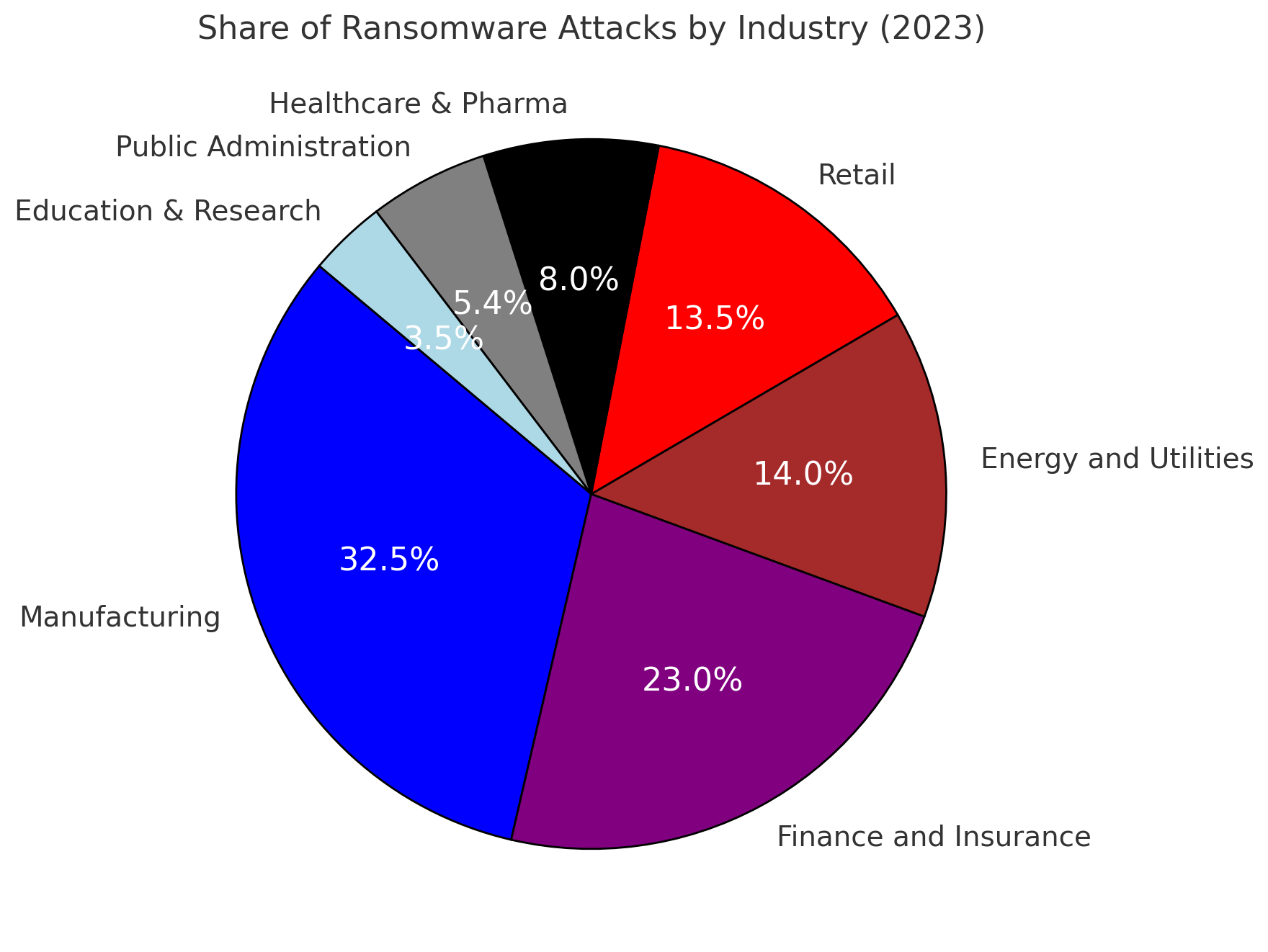
Image Description for Accessibility Purposes
Pie chart graph illustrates the share of ransomware attacks by industry from 2023 statistics. The chart states the following numbers: Manufacturing: 32.5%. Finance and Insurance: 23%. Energy and Utilities: 14%. Retail: 13.5%. Healthcare and Pharma: 8%. Public Administration: 5.4%. Education and Research: 3.5%.
Manufacturing and Supply Chain Businesses – Factories, logistics companies, and supply chain providers rely on connected systems, IoT devices, and automation, increasing their exposure to cyber risks. Attackers often use ransomware to halt production lines or disrupt logistics networks, causing financial and operational losses.
Financial Institutions – Banks, credit unions, and fintech companies are prime targets due to the vast amounts of money and sensitive financial data they store. Cybercriminals frequently use phishing, ransomware, and fraudulent wire transfers to exploit security gaps and steal customer funds. Business Email Compromise (BEC) scams and identity theft are particularly rampant in this sector.
Healthcare Organizations – Hospitals, clinics, pharmaceutical companies, and insurance providers handle highly sensitive patient data, making them lucrative targets for cybercriminals. Ransomware attacks on hospitals can lead to disruptions in medical services, putting lives at risk. Compliance regulations such as HIPAA impose heavy fines for data breaches, adding to the financial burden of cyberattacks.
Small and Medium-Sized Businesses (SMBs): SMBs are frequent targets of cybercriminals due to limited cybersecurity resources and weaker defenses. Many lack dedicated IT teams or advanced security infrastructure, making them vulnerable to ransomware, phishing scams, and data breaches. Since SMBs often work with larger corporations through supply chains, they can also serve as an entry point for cybercriminals looking to infiltrate bigger networks.
E-Commerce and Retail – Online businesses process millions of financial transactions daily, making them susceptible to payment fraud, data breaches, and account takeovers. Attackers often exploit vulnerabilities in payment processing systems, inject malicious scripts to steal credit card details, or launch distributed denial-of-service (DDoS) attacks to shut down online stores.
Government Agencies – National, state, and local government entities are frequent targets of cyber espionage, ransomware, and nation-state attacks. Hackers often aim to steal classified information, manipulate public databases, or disrupt critical services such as voting systems, law enforcement networks, and emergency response services. Cybersecurity for government agencies is a growing niche, with increased demand for professionals who can secure classified data and counter nation-state threats.
Energy and Utilities – Power grids, water supply systems, and oil and gas companies are vulnerable to cyberattacks that can cause large-scale service disruptions. State-sponsored actors often target these infrastructures to destabilize economies or exert geopolitical pressure. The Colonial Pipeline ransomware attack in 2021 highlighted the catastrophic consequences of cyber threats in this sector.
Legal and Professional Services – Law firms and consulting companies store confidential client information, intellectual property, and financial records. Cybercriminals target these firms for espionage, extortion, and fraud. Legal firms are particularly vulnerable due to their reliance on email communications, making them prime candidates for phishing and BEC attacks.
Technology and Software Companies – The tech industry, including SaaS providers, cloud platforms, and IT management firms, faces heightened risks due to their role in managing data for other businesses. Supply chain attacks, where hackers infiltrate software providers to compromise multiple downstream clients, have become a growing concern, as seen in the SolarWinds breach.
Media and Entertainment – News organizations, film studios, and gaming companies face cyber threats ranging from intellectual property theft to website defacement and misinformation campaigns. In the gaming industry, hackers target online accounts, steal in-game currency, and leak unreleased content.
Education Institutions – Schools, universities, and research institutions collect large amounts of personal data on students, faculty, and staff. Many educational institutions have outdated security infrastructure, making them easy targets for ransomware and phishing attacks. Research institutions are also targeted for intellectual property theft, particularly in scientific and medical fields.
These industries must prioritize cybersecurity measures, invest in proactive defense strategies, and stay ahead of emerging threats to protect their operations and customer trust.
References:
Palo Alto Networks. (2021). 2021 Unit 42 ransomware threat report. Unit 42. https://unit42.paloaltonetworks.com/ransomware-threat-report-highlights/
Verizon. (2024). 2024 Data Breach Investigations Report. Retrieved from https://www.verizon.com/business/resources/reports/dbir/
Cybersecurity Ventures. (2020). Cybercrime Damages Report. Retrieved from https://cybersecurityventures.com/cybercrime-damages-6-trillion-by-2021/